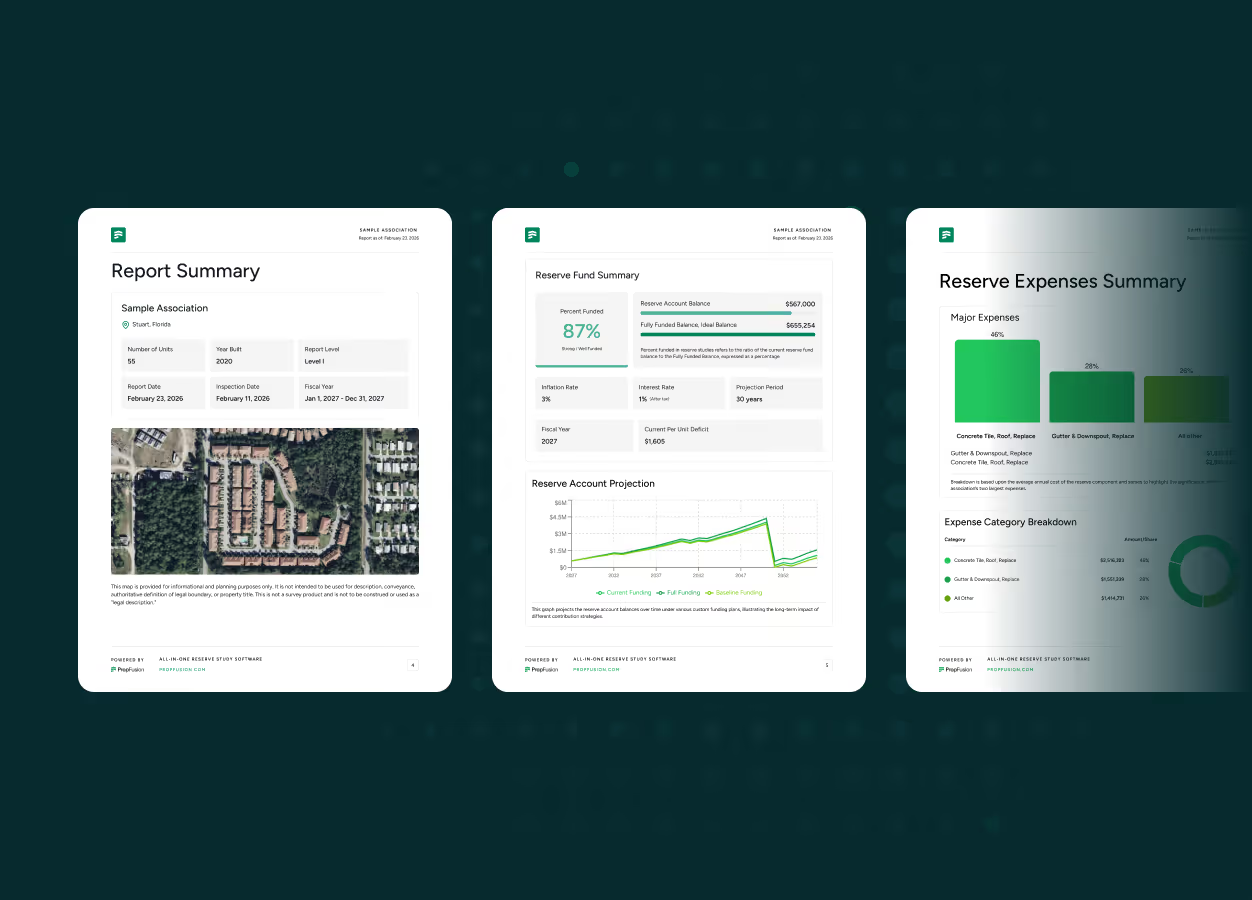
The 3 Types of Reserve Studies (Levels I–III) for HOAs
Get proposals from vetted reserve study professionals - with 30-year funding plans, powered by modern technology, and compared side by side for free.
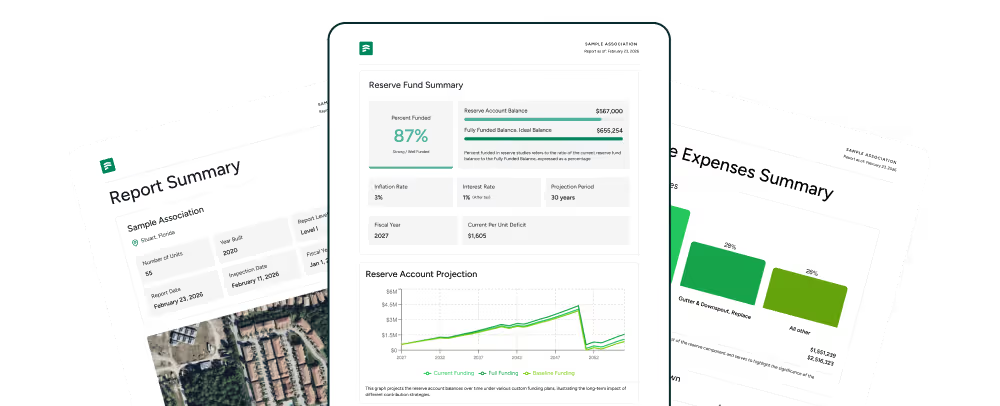
When board members search for the "three types of reserve studies" or "levels of reserve study," they are usually trying to answer a practical question:
What kind of reserve study does our HOA actually need right now?
In the US, most reserve study providers and industry standards (including CAI's National Reserve Study Standards) talk about three primary service levels:
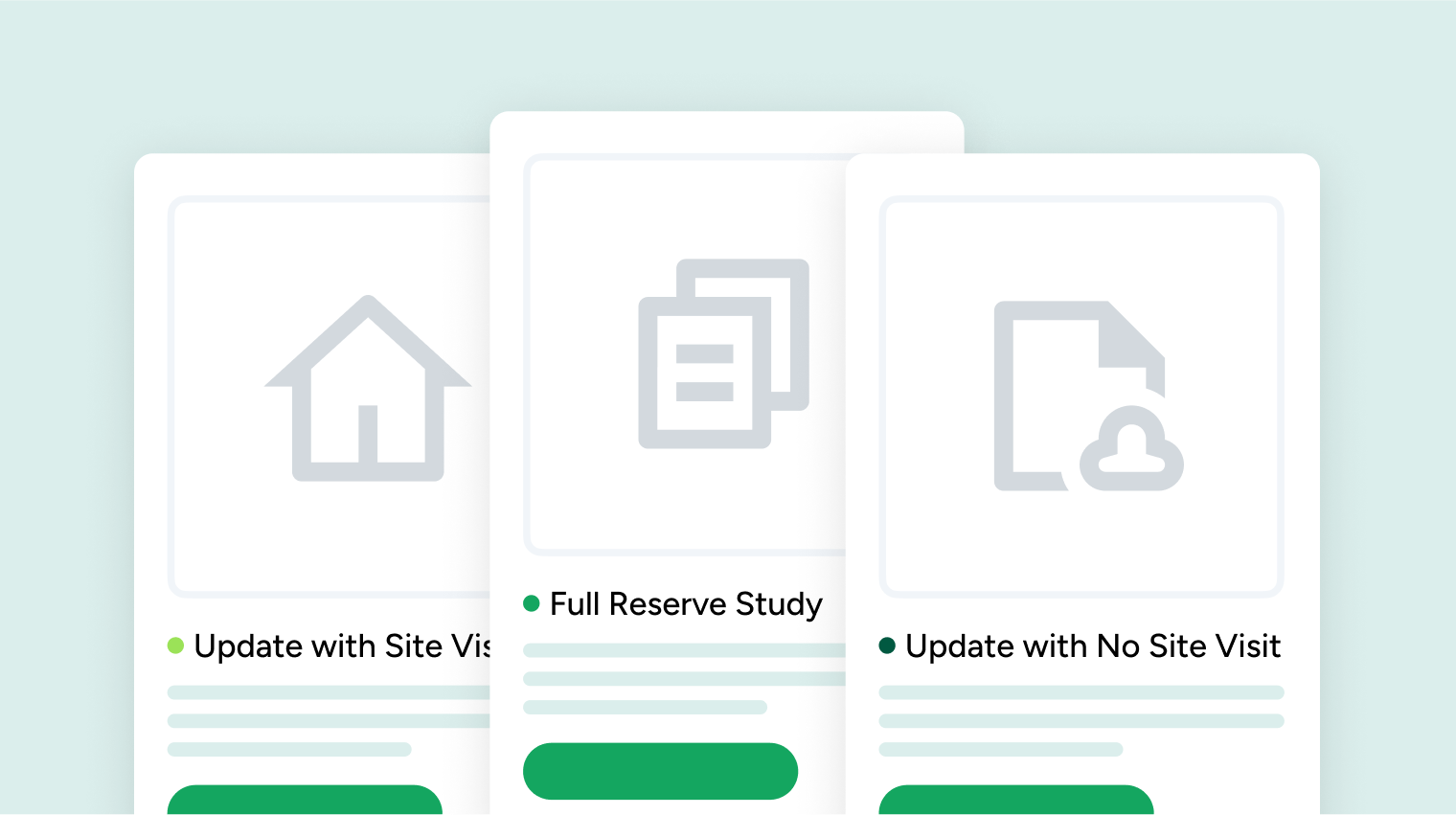
- A Full Reserve Study (often called Level I)
- An Update with Site Visit (Level II)
- An Update without Site Visit (Level III)
Each type has a different scope, cost, and best-use case. If you pick the wrong one, you either overspend on scope you don't need or undercut the quality of your long-term plan.
This guide explains the three types of reserve studies in clear terms, shows how they differ, and walks through when each one is appropriate for an HOA. We will stay focused on the study types themselves. Funding methods (Full vs Threshold vs Baseline, fully funded reserves, and "rule of thumb" ranges) are separate decisions that you can handle with a different set of guides.
What Is a Reserve Study?
A reserve study is the long-term capital planning tool for your HOA.
At a basic level, it combines:
- A physical analysis of your common elements (roofs, paving, siding, decks, elevators, pools, clubhouses, etc.), and
- A financial analysis of your reserve fund balance, contributions, and projected expenses.
The outcome is a report that:
- Lists your major components and their remaining useful life.
- Estimates how much they will cost to repair or replace.
- Forecasts 20–30 years of major expenditures.
- Recommends an annual contribution plan to keep reserves on track.
If you need a deep dive on reserve study basics, you can cover that separately. For this article, the key idea is simple: reserve studies come in different service levels, and knowing those levels helps you order the right work at the right time.
Quick Comparison: The 3 Types of Reserve Studies
Most US HOAs will encounter three main types (or levels) of reserve studies:
Think of it this way:
- Level I builds the foundation.
- Level II keeps both the physical and financial assumptions honest over time.
- Level III keeps the numbers current in years when a site visit is not needed.
The rest of this article breaks each type down in more detail.
Type 1 – Full Reserve Study (Level I)
A Full Reserve Study (Level I) is the most comprehensive version of a reserve study. It is typically the starting point for an association's long-term capital plan.
What a Full Reserve Study Includes
A Level I study generally includes:
- A thorough on-site inspection of all relevant common elements.
- Creation or complete update of the component inventory (what you own and are responsible for).
- Estimates of remaining useful life for each component.
- Current replacement cost estimates based on market pricing.
- A long-range cash-flow projection, usually 20–30 years.
- One or more funding plan options showing different contribution scenarios.
In other words, it's the "from the ground up" analysis that everything else builds on.
When Your HOA Needs a Full Reserve Study
Your board should consider a Full Reserve Study when:
- The association has never had a professional reserve study.
- The last formal study is so old that its component list, costs, or assumptions are no longer credible.
- There have been major changes to the property—new buildings, amenities, or large capital projects that fundamentally changed your component list.
- You've inherited poor or incomplete documentation and need a hard reset.
Because Level I studies require a full physical inspection and more upfront work, they are typically the most expensive option. The good news is that you do not need a Level I study every year. Once you have a solid baseline, you maintain it with Level II and Level III studies.
What Boards Should Expect from a Level I Study
When you commission a full reserve study, you should expect:
- A site visit and walkthrough by the provider.
- Photos and notes documenting key components and conditions.
- A comprehensive written report breaking down components, costs, timing, and funding plans.
- A clear explanation (often in an executive summary) that board members without technical backgrounds can understand.
A good Level I study makes it much easier to communicate with owners, set assessments responsibly, and avoid "we never saw this coming" moments.
Type 2 – Update with Site Visit (Level II)
An Update with Site Visit (Level II) is the study type most HOAs will use on a recurring basis after they have a solid baseline.
What a Level II Study Includes
A Level II reserve study typically includes:
- A site inspection that validates the current condition of your components.
- Updates to remaining useful life estimates based on what the provider sees.
- Adjusted replacement cost estimates to reflect current pricing.
- A refreshed cash-flow projection and funding plan.
The key difference from a Level I study is that the provider is updating an existing component list and analysis rather than building everything from scratch.
When Your HOA Needs an Update with Site Visit
Your board should look at a Level II study when:
- You already have a reasonably recent Full Reserve Study, and the component inventory is still valid.
- It has been 3–5 years since the last site visit.
- You have completed major capital projects (e.g., roof replacements, asphalt work) that change your funding picture.
- You suspect that components are wearing faster (or slower) than the last study assumed.
A Level II study costs less than another full baseline, but it is still hands-on. It gives you fresh, physically validated assumptions, so the financial model is grounded in what is actually happening on the property.
Why Level II Studies Matter
Skipping site-visit updates for too long leads to a disconnect:
- The numbers in the report may look fine,
- But the actual condition of roofs, decks, or structures may be worse than the paper model assumes.
Regular Level II studies protect you from drifting too far away from reality.
Type 3 – Update without Site Visit (Level III)
An Update without Site Visit (Level III) is the leanest type of reserve study. It is focused on updating the financial model without sending someone out to walk the property.
What a Level III Study Includes
A Level III study usually includes:
- No on-site inspection.
- Updates based on financial records (assessment income, reserve contributions, project expenses).
- Incorporation of recent invoices or bids for major projects.
- Revised cash-flow projections under the same or updated funding plan.
The provider relies on the existing component list and remaining life estimates from your most recent Level I or Level II study.
When Your HOA Should Use an Update without Site Visit
A Level III study is appropriate when:
- Your last Level II (with site visit) is still reasonably recent.
- No major, unexpected physical changes have occurred since that visit.
- You want to keep projections and funding recommendations current each year, but a fresh physical inspection is not necessary.
- Budget is tight, but you still want a professional to update the numbers with current financial data.
Because the provider is not spending time on-site, Level III studies are typically the most economical option. They are best thought of as a way to stay on-course financially between more comprehensive site-visit studies.
Limitations of Level III Studies
Boards should not treat Level III studies as a permanent substitute for site visits. Limitations include:
- Emerging physical issues (rot, water intrusion, structural problems) will not be spotted unless someone reports them.
- Remaining useful life estimates can drift if nobody validates them on the ground.
- If you've had major failures or large new projects, a Level II may be more appropriate.
Used correctly, Level III studies are a good tool for annual or periodic updates in a stable situation—not a way to avoid ever having someone look at the property again.
How Often Should Each Type of Reserve Study Be Done?
There is no single rule that fits every HOA, but industry practice and many state requirements point in a similar direction.
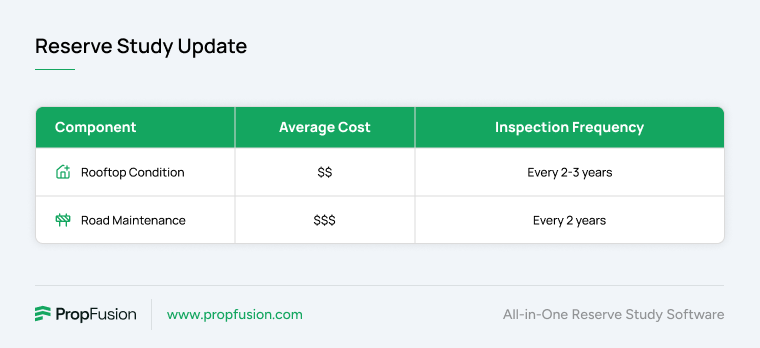
A practical pattern for many associations looks like this:
- Full Reserve Study (Level I):
- Once when the community is new or when you first commit to professional reserve planning.
- Again only if your component list is badly outdated or you have gone many years without a credible study.
- Update with Site Visit (Level II):
- Roughly every 3–5 years, depending on your state's statutes and the complexity of your property.
- More often if you have high-risk components or have experienced unusual failures.
- Update without Site Visit (Level III):
- In the intervening years between site visits.
- Often yearly or every other year, especially if assessments, project costs, or inflation are moving quickly.
Some states specify minimum frequencies for reserve studies or inspections; those legal requirements always come first. Above that floor, your reserve professional can recommend a schedule that matches your community's age, complexity, and risk tolerance.
How to Choose the Right Type of Reserve Study for Your HOA
If you are not sure which type of reserve study to order, start by looking honestly at your situation. A few common scenarios:
- New community or no credible existing study - You need a Full Reserve Study (Level I). Without a proper baseline, it is impossible to know if your reserves are on track.
- Last site-visit study was 5+ years ago - A Level II Update with Site Visit is usually the right call. Too much may have changed physically to rely on desktop work alone.
- Recent Level II, stable conditions, but financials changed - A Level III Update without Site Visit can keep projections current if you have not had major failures or new components since the last visit.
- Large capital project just completed (roofs, paving, siding) - Even if the last study is not that old, you may want a Level II so the provider can see work quality, confirm remaining lives, and reset your funding plan.
When deciding, boards should consider:
- How long it has been since someone walked the property.
- How outdated the current study's cost assumptions are.
- Whether the community has experienced unusual deterioration, construction defects, or major renovations.
- Any state-level requirements for frequency or scope.
Your reserve study provider should be able to recommend the appropriate level once they understand your history and goals. The key is that your board knows the language—Level I, II, III—so you can ask the right questions and compare proposals accurately.
Working with Reserve Study Providers
Choosing the right type of reserve study is only part of the equation. You also want to work with providers who can do the job properly.
When evaluating reserve study firms, look for:
- Demonstrated experience with HOAs and condominiums similar to yours.
- Credentials such as RS (Reserve Specialist) or P.E. (Professional Engineer) where appropriate.
- Familiarity with your state's HOA laws and any reserve study requirements.
- Clear, readable sample reports that your board can understand.
When you request proposals, be explicit about:
- Which type of reserve study you are seeking (Full, Update with Site Visit, or Update without Site Visit).
- Whether you have a recent study that can be used as a baseline.
- Any known issues (construction defects, structural concerns) the provider should be aware of.
Good providers will help you confirm whether the level you have in mind is appropriate. They should also explain what they will deliver, how long it will take, and what information they need from your board or manager.
Related Reading
- Underfunded Reserves: Recovery Plans for HOAs — What to do when your study reveals a funding gap.
- What Does Deferred Maintenance Mean? — The real cost of postponing repairs your study identifies.
- Florida Reserve Study Requirements — Florida SIRS law sets specific study type and frequency rules.
- California Reserve Study Requirements — California mandates reserve studies every three years.
FAQ
What are the three main types of reserve studies?
The three main types—often referred to as Levels I–III—are: A Full Reserve Study (Level I), which builds a comprehensive baseline with a site visit and full cmponent inventory. An Update with Site Visit (Level II), which refreshes that baseline with a new inspection and updated assumptions. An Update without Site Visit (Level III), which updates the financial projections and funding plan from your desk-top records, without another inspection.
Is there a Level IV or “funding-only” reserve study?
Some providers offer funding-only or desk-top-only analyses that focus purely on adjusting the funding plan using your existing data. In practice, these behave like variations of a Level III update. CAI’s widely referenced framework, and most HOA guidance, still centres on the three main levels: Full, Update with Site Visit, and Update without Site Visit.
How are study types different from funding methods (Full vs Threshold vs Baseline)?
Study types (Levels I–III) describe the scope of work the consultant performs: whether they visit the site, update the component list, or simply refresh the numbers. Funding methods (Full Funding, Threshold Funding, Baseline Funding, etc.) describe how you choose to fund the reserve plan once you have a study. They are related but separate decisions. You can use any funding method with any study type, although better data generally supports better funding decisions.
Do all states require specific types of reserve study?
Not every state prescribes the exact terminology or study level, but more and more states require HOAs and condo associations to: obtain reserve studies on a specified schedule. Disclose reserve study information and funding levels to owners and buyers. Even where the law does not spell out “Level I, II, III,” regulators and lenders increasingly expect communities to have professional reserve studies and keep them reasonably current. Your association counsel or management company can advise on specifics for your state.
Can we skip the full reserve study and just do updates?
You can only rely on updates if there is a solid baseline in place. If your association has never had a competent Full Reserve Study, or if the last credible baseline is very old, it is risky to skip straight to Level II or Level III work. In that case, you are updating assumptions that may not be valid. It is usually better to invest in a proper Level I study once, then use updates to maintain it.
Get proposals from vetted reserve study professionals - with 30-year funding plans, powered by modern technology, and compared side by side for free.
Take the guesswork out of your reserve study
PropFusion matches your association with vetted reserve study professionals - powered by industry-leading software. Compare multiple proposals for free to get started.