California Reserve Study Requirements (2026)

California has some of the most detailed HOA reserve study requirements in the country. Under the Davis-Stirling Common Interest Development Act, boards must plan for long-term repairs, disclose reserve fund health to homeowners, and update their reserve study and funding plan on a regular cycle. These rules apply to most common interest developments in the state, including planned unit developments and condominium associations.
See the full reserve study requirements by state guide
This guide breaks down California reserve study requirements into plain language: how often a study must be done, what it must include, how reserve funds can be used, what disclosures go out to owners, and what cost and funding benchmarks look like for communities across the state.
Legislation Links
Civil Code 5550 — Reserve Study Requirements
Civil Code 5560 — Reserve Funding Plan
Civil Code 5551 — SB 326 Exterior Elevated Element Inspections
Are reserve studies mandatory in California?
Yes. Civil Code 5550 requires a reserve study for any association whose major component replacement value exceeds half of its gross budget (excluding reserves). For most California HOAs and condos with shared roofs, paving, and mechanical systems, this threshold is easily met.
How often must a California HOA update its reserve study?
A full reserve study with a visual inspection must be conducted at least every three years. Between full studies, the board must review and adjust the funding plan annually. Civil Code 5500 also requires quarterly review of reserve account financials.
How much does a reserve study cost in California?
Full Level I studies range from $2,500 to $5,000 for small communities (under 50 units) up to $10,000–$20,000+ for large or complex developments with high-rises, parking structures, or extensive amenities. Level II/III updates cost 40–60% less.
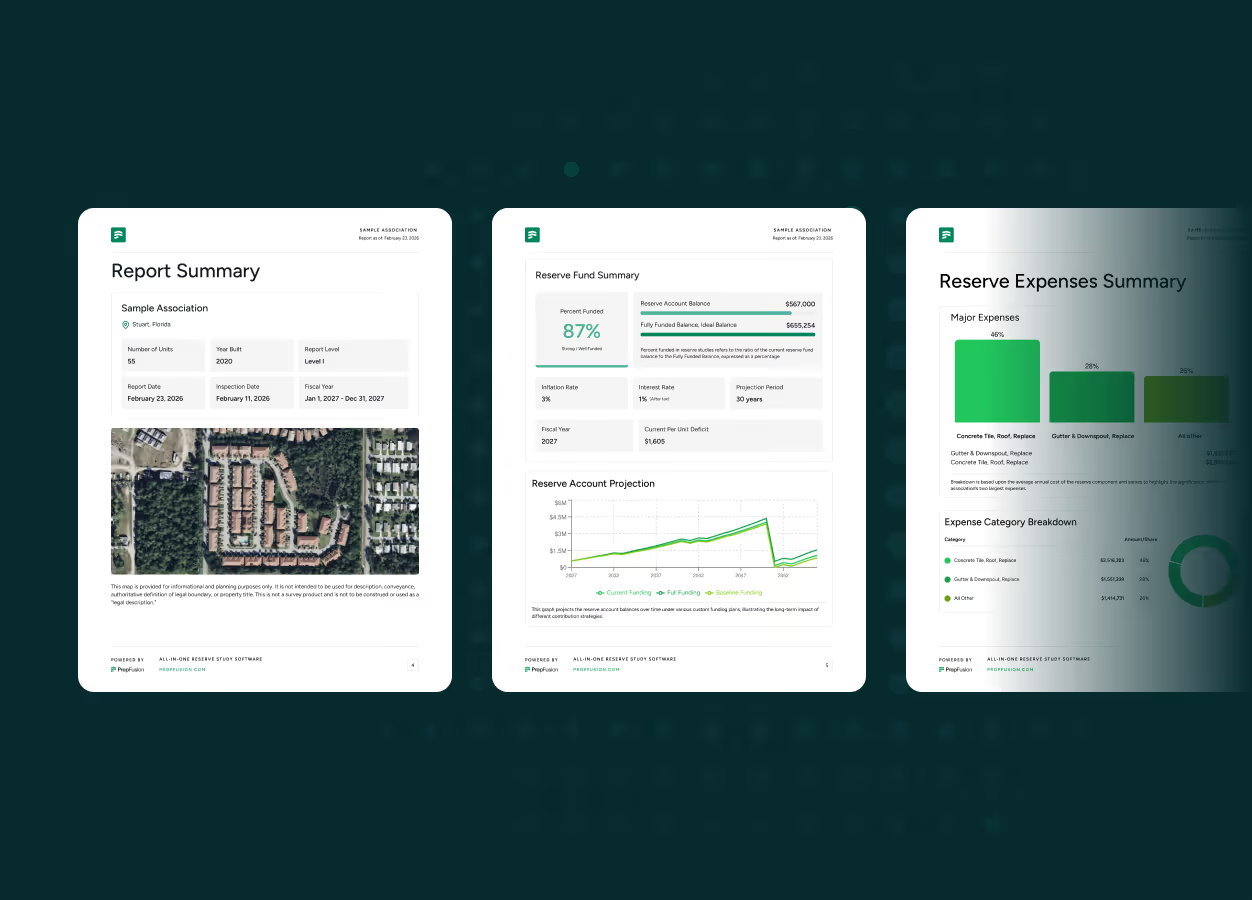
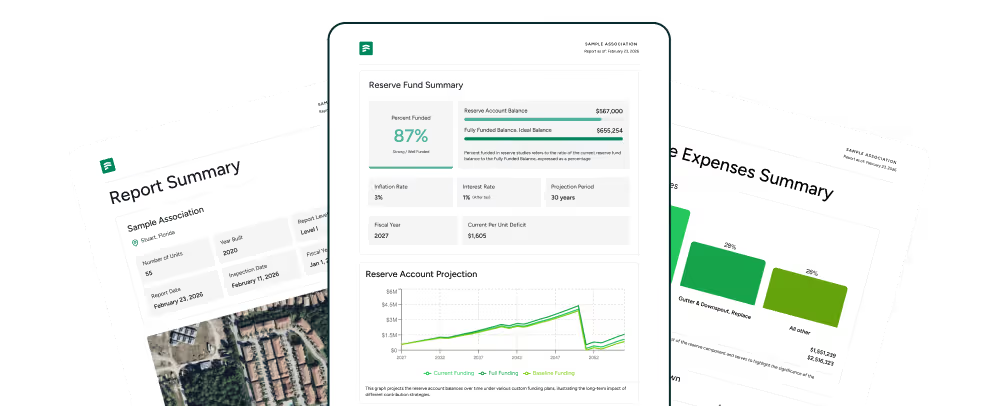
Get proposals from vetted reserve study professionals - with 30-year funding plans, powered by modern technology, and compared side by side for free.
The Davis-Stirling Act: California's reserve study framework
California's Davis-Stirling Common Interest Development Act is the legal foundation for every HOA and condo reserve study requirement in the state. Several Civil Code sections work together to create one of the most prescriptive reserve planning frameworks in the country.
The key statutes every board should know are:
- Civil Code 5550 — requires a reserve study with visual inspection at least every three years and sets out what the study must include
- Civil Code 5560 — requires the reserve funding plan to include a schedule of any assessment changes needed
- Civil Code 5565 — requires the annual reserve summary to include the percent funded ratio, replacement cost estimates, and remaining useful life for each component
- Civil Code 5570 — prescribes the Assessment and Reserve Funding Disclosure Summary form that must accompany every annual budget report
- Civil Code 5510 & 5515 — restrict how reserve funds can be used and set rules for temporary transfers to operating accounts
- Civil Code 5500 — requires the board to review reserve account financials at least quarterly
- Civil Code 5551 — SB 326 balcony and exterior elevated element inspection requirements
Together, these provisions create an ongoing compliance obligation that goes well beyond simply commissioning a study. For a deeper look at the three types of reserve studies (Level I, II, and III), see our detailed guide.
Are reserve studies mandatory in California?
Yes, for virtually all HOAs. Civil Code 5550 requires an association to perform a reserve study if the current replacement value of its major components equals or exceeds one-half of the association's gross budget, excluding reserves.
For most California communities with common area roofs, paving, mechanical systems, and amenities, that threshold is easily met. Even very small associations — including two-unit condominiums — often trigger the requirement once the total replacement value of shared components is tallied.
Associations that fall below the threshold still have fiduciary duties to plan for major expenses. In practice, most boards treat a full HOA reserve study as the standard of care, regardless of community size, so they can demonstrate responsible financial stewardship.
The requirement applies equally to condominiums, planned unit developments, stock cooperatives, and community apartment projects — every type of common interest development governed by the Davis-Stirling Act. For guidance on who should perform your reserve study, see our provider selection guide.
What must a California reserve study include?
Civil Code 5550(b) spells out the mandatory contents. At a minimum, the study must include:
- Component identification — all major components the association must maintain that have a remaining useful life of less than 30 years
- Remaining useful life estimates — the probable remaining life of each identified component as of the study date
- Cost estimates — projected repair, replacement, restoration, or maintenance cost for each component
- Annual contribution calculation — the total annual funding needed to cover future costs, after subtracting current reserve balances
- Reserve funding plan — a plan showing how the association intends to fund those obligations over 30 years or more
The reserve funding plan must also include a schedule of any assessment increases that would be needed to keep reserves on track, as required by Civil Code 5560. This plan must be adopted by the board at an open meeting.
The California Department of Real Estate's Reserve Study Guidelines for Homeowner Association Budgets (RE 25) provides additional practical guidance on structuring projections and testing whether reserve levels are adequate. Board members preparing for their first study should review our reserve study preparation checklist.
How often must a California HOA update its reserve study?
A full reserve study with a reasonably competent and diligent visual inspection of accessible common areas must be conducted at least once every three years under Civil Code 5550(a).
Between full studies, the board must review and adjust the reserve funding plan annually as part of the Annual Budget Report process. On the financial side, Civil Code 5500 requires the board to review reserve account statements, income and expense reports, the check register, and delinquency reports at least quarterly.
Many boards follow a practical cadence that satisfies every statutory requirement:
- Every 3 years: Full Level I study with on-site inspection
- Off-years: Level III financial update to adjust assumptions and contribution rates
- Quarterly: Board review of reserve account financials (Civil Code 5500)
- Annually: Reserve disclosures in the Annual Budget Report (Civil Code 5570)
This schedule keeps the board ahead of funding surprises and provides a defensible compliance record. For a full breakdown of how to interpret your study once it arrives, see our guide on how to read and use your reserve study.
Reserve funding disclosure requirements
California requires more transparency about reserve health than almost any other state. Under Civil Code 5565 and 5570, the annual budget report must include an Assessment and Reserve Funding Disclosure Summary containing:
- Current estimated replacement cost, remaining useful life, and estimated useful life for each major component
- The total amount of cash reserves that should be on hand (the fully funded balance)
- The actual cash reserve balance
- The percent funded ratio
- The per-unit reserve funding deficiency, if any
- Whether projected balances will be sufficient to meet obligations over the next 30 years
- A schedule of any additional assessments needed to close funding gaps
This disclosure must be printed in boldface type and accompany every annual budget report sent to homeowners. The level of detail ensures that owners can see exactly where their association stands financially — and that boards cannot avoid accountability by simply not calculating the numbers.
Rules for using, borrowing, and replenishing reserve funds
California treats reserve funds as restricted money. Civil Code 5510 states that reserves may be used only for the repair, restoration, replacement, or maintenance of the major components the fund was established to cover, or for related litigation costs.
Routine operating expenses must not be paid from reserves.
If the association temporarily needs cash, Civil Code 5515 allows a transfer from the reserve account to the operating account, but only if the board:
- Provides advance notice to members
- Adopts a written finding explaining why the transfer is necessary
- Sets out a plan for repayment, generally expected within one year
When reserve funds are used for litigation, Civil Code 5520 adds additional notice and accounting requirements. These rules are central to what many owners search for as "HOA reserve funds California" — they want to know what protections exist against misuse of their reserve contributions.
Understanding the consequences of underfunding is equally important. Our guide on recovery plans for underfunded reserves explains practical options when an association falls behind.
Common components in California HOA reserve studies
While every community is different, most California reserve studies include a core set of components. The specific inventory depends on building type, climate region, and amenity mix.
| Category | Typical Components | Useful Life Range |
|---|---|---|
| Roofing | Composition shingles, tile, flat roof membranes, flashing | 15–30 years |
| Paving & Hardscape | Asphalt roads, concrete sidewalks, parking lot seal coating, striping | 5–25 years |
| Building Exterior | Stucco, siding, paint, caulking, fascia boards | 7–25 years |
| Balconies & Decks (SB 326) | Exterior elevated elements, waterproofing, railings, structural supports | 10–25 years |
| Mechanical Systems | HVAC, boilers, pumps, fire suppression, generators | 10–25 years |
| Plumbing | Supply lines, drain lines, water heaters, irrigation systems | 15–30 years |
| Electrical | Site lighting, panel boards, transformers, EV charging stations | 15–30 years |
| Pool & Spa | Resurfacing, pumps, heaters, decking, fencing | 5–20 years |
| Landscaping | Tree trimming/removal, drought conversion, irrigation controllers | 5–20 years |
| Fencing & Gates | Perimeter fencing, gate operators, access control hardware | 10–25 years |
| Elevators | Cab interior, control system, hydraulics, door operators | 15–25 years |
In California, reserve professionals pay particular attention to items affected by wildfire risk (defensible space, fire-rated roofing), drought-related landscape replacement (irrigation conversions, drought-tolerant planting), and seismic joint conditions — all of which create large reserve components that vary by region. Coastal communities in Southern California face different component profiles than mountain or inland valley communities.
SB 326 balcony inspection law and reserve studies
Senate Bill 326 (codified as Civil Code 5551) requires associations with buildings containing three or more multifamily dwelling units to have their exterior elevated elements — balconies, decks, walkways, stairways, and railings — inspected by a licensed structural engineer or architect.
The inspection cycle is nine years, with the first round of inspections required by January 1, 2025.
SB 326 inspections are technically separate from the reserve study under Civil Code 5550, but the two are closely connected in practice. When an inspection identifies deterioration or structural concerns, those findings translate into large-dollar repair components that must be folded into the reserve study.
A community that budgeted $50,000 for future balcony repairs might discover after an SB 326 inspection that the actual scope is $300,000 or more. Boards should coordinate SB 326 inspection timing with their three-year reserve study cycle so findings are captured in the next update rather than sitting as unfunded liabilities.
For practical guidance on integrating inspection results into your budget, see our articles on turning SB 326 findings into budget action and funding balcony inspections and repairs in California.
DRE requirements for new developments
California's Department of Real Estate (DRE) imposes an additional reserve study requirement for newly created common interest developments. Under Business and Professions Code Section 11018.6, the developer must include a reserve study and a preliminary reserve funding plan as part of the initial budget submitted to the DRE before the first unit closes.
This developer-prepared study establishes the baseline reserve budget the association will inherit at turnover. However, developer studies are frequently optimistic — they may underestimate useful life degradation or omit components to keep initial assessments low.
Once the board transitions from developer control to homeowner control, commissioning an independent reserve study is strongly recommended. This establishes a realistic funding baseline and often reveals significant gaps between the developer's projections and actual conditions. For tips on evaluating your reserve study provider, see our guide on questions to ask a California reserve study provider.
How much does a California reserve study cost?
The cost of a reserve study in California depends on community size, building complexity, the number of shared amenities, and whether the study is a full Level I engagement or a financial-only update. For a comprehensive look at pricing across all community sizes and study types, see our nationwide reserve study cost guide.
| Community Size | Level I (Full Study) | Level II (Site Visit Update) | Level III (Financial Only) |
|---|---|---|---|
| Small (under 50 units) | $2,500 – $5,000 | $1,500 – $3,000 | $1,000 – $2,000 |
| Mid-size (50–150 units) | $4,000 – $8,000 | $2,500 – $5,000 | $1,500 – $3,000 |
| Large (150–500 units) | $8,000 – $15,000 | $5,000 – $10,000 | $2,500 – $5,000 |
| Complex (high-rise, 500+ units) | $15,000 – $25,000+ | $8,000 – $15,000 | $4,000 – $8,000 |
Level II updates (site visit with existing component inventory) and Level III updates (financial recalculation only) typically cost 40% to 60% less than a full Level I study.
Several factors push California costs higher than the national average. Construction and labor costs in metro areas like Los Angeles, San Francisco, and San Diego are among the highest in the country. Communities subject to SB 326 inspections may incur additional coordination costs when the reserve study provider incorporates those findings. Understanding the three types of reserve studies helps boards choose the right level for their situation.
Understanding percent funded in California
The percent funded ratio is one of the most important numbers in any reserve study. It measures how much money is actually in the reserve account compared to how much should ideally be there at that point in time. Understanding what fully funded reserves mean is essential context for evaluating this metric.
The formula is straightforward: divide the current reserve balance by the fully funded balance. A community with $500,000 in reserves and a fully funded balance of $1,000,000 is 50% funded.
| Percent Funded | Risk Level | What It Means |
|---|---|---|
| 70% – 100% | Healthy | Association is on track to meet projected repair and replacement costs without special assessments. |
| 60% – 69% | Moderate Risk | Reserve balance is below ideal. Gradual assessment increases may be needed to close the gap. |
| 50% – 59% | Elevated Risk | Significant underfunding. Special assessments or loans become likely if multiple components need attention. |
| Below 50% | Critical | Special assessments, borrowing, or large dues increases are nearly certain. Lenders may decline to certify the community. |
While the Davis-Stirling Act does not require a minimum funding percentage, Civil Code 5565 requires that the percent funded figure be disclosed to owners annually. This means the number is visible to homeowners, prospective buyers, and lenders.
The percent funded ratio also affects FHA certification, VA approval, and conventional mortgage underwriting. Lenders and buyers view communities below 50% funded as high-risk, which can reduce property values and make units harder to sell. Boards that fall below this threshold should treat it as an urgent priority.
Our guide on avoiding special assessment shock explains how California HOAs use reserve studies to keep funding steady and prevent sudden owner costs.
What happens if a California HOA ignores reserve study requirements?
Boards that fail to perform required reserve studies, update funding plans, or provide mandated disclosures may breach their fiduciary duties. The consequences compound over time:
- Special assessments — deferred maintenance eventually becomes unavoidable, and the cost falls on owners all at once
- Litigation exposure — owners may claim mismanagement if the board knew about deterioration and failed to plan for it
- Lending problems — FHA, VA, and conventional lenders may refuse to certify the community, making units difficult to finance
- Reduced property values — prospective buyers and their agents view missing or outdated reserve studies as a significant red flag
- Insurance complications — carriers may decline coverage or increase premiums for communities with documented deferred maintenance
Some boards attempt to minimize apparent problems by extending useful life estimates, lowering cost projections, or omitting components from the study entirely. These practices are not only professionally irresponsible — they can constitute evidence of mismanagement or fraud if owners later face large special assessments as a result.
Practical steps for California HOA boards
For a California board that wants to stay within the law and avoid surprises, a practical reserve planning process looks like this:
- Commission a full Level I reserve study with on-site inspection at least every three years
- Review and update the funding plan annually as part of the budget process
- Review reserve financials quarterly per Civil Code 5500
- Prepare and distribute the Assessment and Reserve Funding Disclosure Summary with every annual budget report
- Coordinate SB 326 inspections with the reserve study cycle for buildings with three or more units
- Target 70% or higher percent funded — treat anything below 50% as urgent
- Document all decisions in board minutes, including the rationale for any departure from the reserve analyst's recommendations
- Use the reserve study as a management tool, not just a compliance checkbox — review it before approving any major project
Following this cycle ensures the board can demonstrate it is meeting California HOA reserve study requirements and exercising sound business judgment. For boards looking for general benchmarks on how much to set aside, see our guide on HOA reserves rule of thumb.
Related resources
- California Reserve Study Companies — Compare Proposals for Free
- Funding Balcony Inspections and Repairs in California
- Questions to Ask a California Reserve Study Provider
- From SB 326 to Your Budget: Turning Reserve Studies into Action
- Special Assessments vs. Steady Funding in California
- How Much Does a Reserve Study Cost?
- What Does Fully Funded Reserves Mean?
- The Three Types of Reserve Studies (Level I–III)
Related reserve study resources for California
Compare reserve study laws in nearby states, or find help running one for your association:
Frequently asked questions
Do California HOAs have to perform a reserve study every year?
No. California law requires a full reserve study with a visual inspection at least once every three years under Civil Code 5550. However, the board must review and update the financial portions annually as part of the Annual Budget Report and reserve funding plan. Civil Code 5500 also requires quarterly review of reserve account statements, so while a full study is not annual, reserve oversight is a year-round obligation.
How much should a California HOA have in reserves?
California law does not mandate a specific dollar amount or funding percentage. However, industry benchmarks widely used by reserve professionals and lenders recommend at least 70% funded as a healthy target. Communities below 50% funded face near-certain special assessments, loans, or significant dues increases. The exact dollar amount depends on your community's component inventory, replacement costs, and remaining useful life estimates.
Are reserve studies required for California condominiums?
Yes. The Davis-Stirling Act applies broadly to all common interest developments, including condominiums, planned unit developments, stock cooperatives, and community apartment projects. If the development has major components and meets the cost threshold in Civil Code 5550, it must comply with reserve study requirements regardless of structure type.
Can reserve funds be used for legal fees or emergencies in California?
Reserve funds may be used for litigation involving the repair, restoration, replacement, or maintenance of reserve components, subject to specific notice and accounting rules under Civil Code 5520. For non-litigation emergencies, the board may temporarily transfer money from reserves to operations under Civil Code 5515 if it documents the reasons and adopts a repayment plan — generally expected within one year.
What happens if a California HOA fails to complete a reserve study?
Failing to perform required reserve studies may constitute a breach of fiduciary duty. Consequences include increased risk of emergency special assessments, heightened litigation exposure, difficulty obtaining FHA or VA certification, reduced property values, and potential insurance complications. Lenders and prospective buyers treat missing or outdated reserve studies as a significant red flag.
How should a California HOA choose a reserve study provider?
Prioritize professionals with recognized industry credentials such as the Professional Reserve Analyst (PRA) designation from APRA or the Reserve Specialist (RS) designation from CAI. Compare sample reports, check references from similar California communities, and confirm the provider builds reports around Civil Code 5550, 5560, 5565, and 5300. Providers who understand SB 326 requirements and California-specific construction costs will deliver a more accurate study.
How much does a reserve study cost in California?
A full Level I reserve study in California typically costs between $2,500 and $15,000 depending on community size and complexity. Small communities under 50 units pay $2,500 to $5,000. Mid-size communities of 50 to 150 units fall in the $4,000 to $8,000 range. Large communities with high-rises, parking structures, or extensive amenities can expect $10,000 to $20,000 or more. Level II and III updates cost 40% to 60% less.
What is the percent funded ratio and why does it matter?
Percent funded measures how much money is in the reserve account compared to the fully funded balance — the amount that ideally should be there at that point in time. California law requires this figure to be disclosed annually under Civil Code 5565. Communities above 70% funded are considered healthy. Those below 50% funded face near-certain special assessments or borrowing. The ratio also affects mortgage underwriting, FHA certification, and property values.
Does SB 326 affect reserve study requirements?
Yes. SB 326 (Civil Code 5551) requires buildings with three or more multifamily units to have balconies, decks, walkways, and railings inspected by a licensed engineer or architect every nine years. Inspection findings often reveal large repair costs that must be incorporated into the reserve study and funding plan. Boards should coordinate SB 326 inspection timing with their three-year reserve study cycle.
Can a California HOA choose to keep low reserves if owners agree?
The board's fiduciary duties cannot be waived by a simple owner vote. While the law does not require a specific funding percentage, the board must adopt a reserve funding plan, disclose any deficiencies annually, and exercise prudent fiscal management. Deliberately underfunding reserves can expose directors to liability, especially if it leads to avoidable special assessments, deferred maintenance, or safety issues.
The information contained on this page is provided for informational purposes only, and should not be construed as legal advice on any subject matter. You should not act or refrain from acting on the basis of any content included on this page without seeking legal or other professional advice. The contents of this page contain general information and may not reflect current legal developments or address your situation. We disclaim all liability for actions you take or fail to take based on any content on this report.
Get proposals from vetted reserve study professionals - with 30-year funding plans, powered by modern technology, and compared side by side for free.
Take the guesswork out of your reserve study
From site inspection to 30-year funding plan, PropFusion handles the entire reserve study - accurate, transparent, and built on modern technology that gives you full control over your reserves.