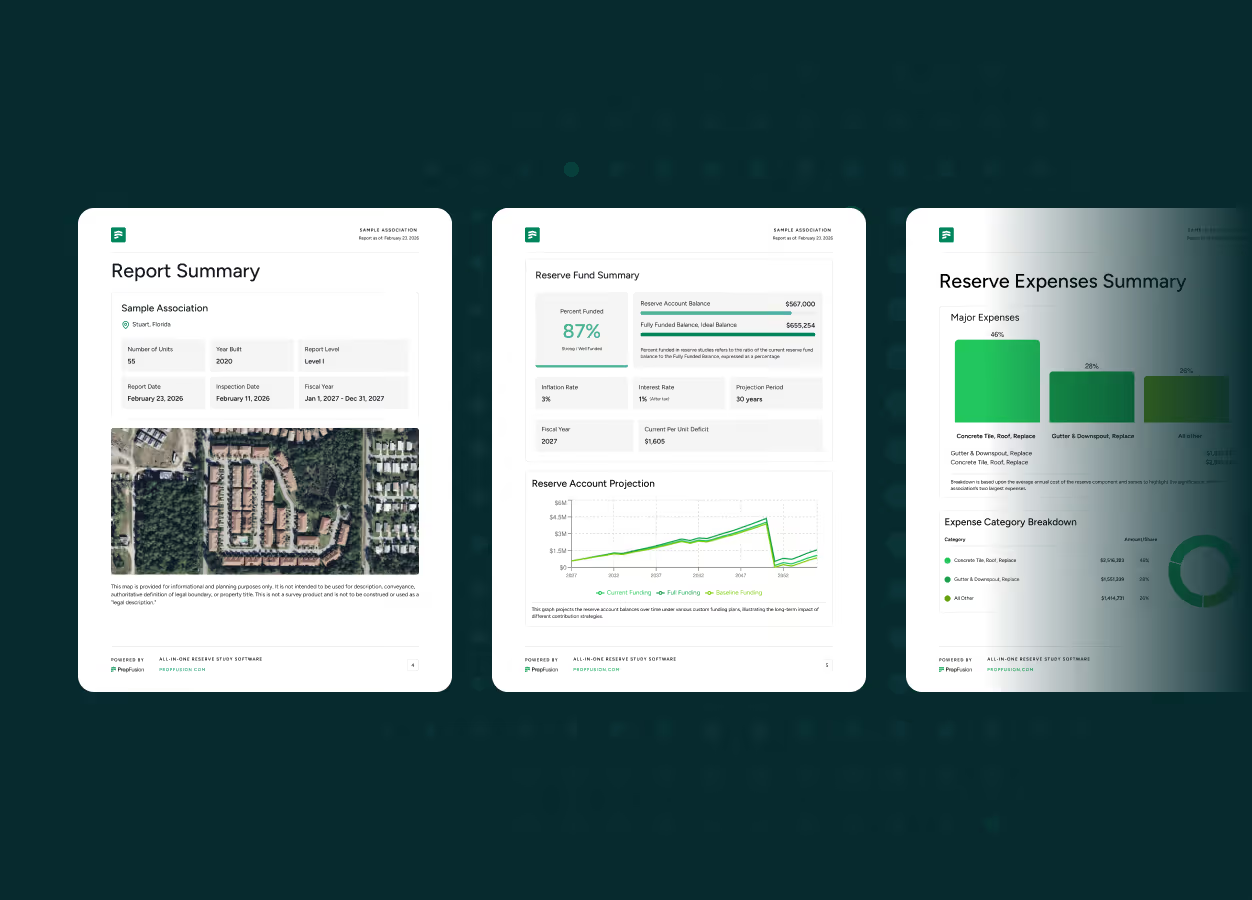
Maine Reserve Study Requirements (2026)
Maine’s laws on HOA and condo reserve funds are relatively light compared with states that mandate regular reserve studies or minimum funding levels. That does not mean Maine boards can ignore long term planning. It simply means the responsibility for setting standards falls squarely on the association, not the legislature.
See the full reserve study requirements by state guide
This guide explains what Maine law actually says about reserves and budgets, what it does not require, and how boards, managers, and developers can implement sound reserve study and funding practices anyway. We draw on the Maine Condominium Act, authoritative summaries of state reserve fund laws, and industry best practices to give Maine communities a practical roadmap for avoiding special assessments and protecting property values.
Legislation Link
Maine Condominium Act - Maine Revised Statutes Title 33, Chapter 31
Maine Condominium Act Law and Practice
Are reserve studies required by law in Maine for HOAs or condominiums? No. Maine state law does not currently require HOAs or condominium associations to commission reserve studies on any specific schedule or at all. Multiple national summaries confirm there is no statutory requirement to conduct a reserve study for Maine communities.
Does Maine law require associations to maintain a minimum reserve fund or contribution level? No. Maine does not impose a statutory minimum balance or contribution percentage for reserve funds. The Maine Condominium Act gives unit owners’ associations the power to “adopt and amend budgets for revenues, expenditures and reserves and collect assessments for common expenses,” but it does not set a formula for how much must be contributed.
Which Maine statute governs condominium reserve decisions? Reserve decisions for post-1982 condominiums are governed primarily by the Maine Condominium Act in Title 33, Chapter 31 of the Maine Revised Statutes. This Act defines the powers and duties of condominium unit owners’ associations, including their authority to adopt budgets that include reserves and to levy assessments to fund common expenses.
Do Maine HOA governing documents matter more than state law for reserves? In practice, yes. Because Maine statutes are largely silent on reserve studies and minimum reserve balances, the governing documents (declaration, bylaws, rules) often set the real standards. Many Maine communities choose to write their own reserve funding expectations into their documents, going beyond the minimal statutory framework.
Need a reserve study in Maine? Compare multiple reserve study proposals for free.
Get proposals from vetted reserve study professionals - with 30-year funding plans, powered by modern technology, and compared side by side for free.
Overview: Maine reserve fund and reserve study laws
Maine is in the group of states that recognise the importance of reserves but do not heavily regulate them. For HOAs and condominium associations, there is:
- No statutory requirement to perform reserve studies.
- No statutory requirement to fund reserves to any particular level.
- Clear statutory authority for condominium associations to adopt budgets that include reserves and to levy assessments to fund common expenses. (Justia Law)
That combination gives boards a great deal of discretion. Used wisely, it allows communities to tailor their funding strategies to their specific buildings, amenities, and demographics. Used poorly, it leaves owners exposed to sudden special assessments and deferred maintenance.
What Maine law actually says about reserves
The primary statute governing reserve decisions for modern condominiums is the Maine Condominium Act, codified in Title 33, Chapter 31 of the Maine Revised Statutes.
Among other things, the Act:
- Requires the formation of a unit owners’ association and an executive board.
- Empowers that association to adopt and amend budgets for revenues, expenditures, and reserves.
- Authorises the association to collect assessments for common expenses from unit owners.
Authoritative national summaries of state reserve fund laws distil Maine’s position in a single sentence: there is no statutory requirement to conduct a reserve study and no statutory requirement to fund reserves.
That means there is no Maine-specific mandate that you update a reserve study every three years, maintain a “fully funded” balance, or devote a fixed percentage of your annual budget to reserves.
For HOAs that are not condominiums, Maine relies on a mix of general association law, nonprofit corporation statutes, and governing documents rather than a dedicated HOA act with reserve provisions. Resources that summarise Maine HOA law consistently highlight the Maine Condominium Act and the Maine Nonprofit Corporation Act as the core framework, but they do not identify reserve study mandates or minimum reserve requirements. (HOA-USA)
Legal baseline vs. best practice
Because Maine law does not impose hard reserve rules, it is easy for boards to confuse “not required” with “not necessary.” In reality:
- The statutory baseline is permissive. Associations are allowed to adopt budgets that include reserves and to collect assessments to fund those reserves.
- Boards still owe fiduciary duties to act reasonably and prudently in maintaining common property, even without detailed reserve statutes.
- Mortgage lenders, buyers, and insurers increasingly expect to see documented reserve planning, even where not mandated by law.
In other words, a Maine board can technically operate with minimal reserves and no formal reserve study, but doing so is risky.
It increases the likelihood of large special assessments, may depress property values, and can make it harder to sell units when buyers or their lenders dig into the community’s financials.

Best practice reserve study approach for Maine communities
Without statutory instructions, Maine communities should borrow from national best practice standards that work in similar “light regulation” states:
- Treat reserve studies as essential, not optional - Commission a professional reserve study that inventories your common components, estimates their useful lives and replacement costs, and projects reserve needs over a 20- to 30-year horizon. Even though Maine does not require this, national guidance emphasises that such studies are critical to avoiding deferred maintenance and surprise assessments.
- Repeat a full study every 3 to 5 years - Maine statutes do not set a frequency, but many experts recommend a full on-site reserve study every three to five years, with annual “desk-update” reviews in between. Faster cycles make sense for older buildings, coastal properties, or communities with complex amenities such as elevators, pools, and marinas.
- Target a safe funding band, not a fixed number - In the absence of a legally defined “fully funded” requirement, boards can adopt a policy target, such as maintaining reserves within 70 to 100 percent of the fully funded level calculated in the study. This gives room for real-world fluctuations while keeping the association away from the danger zone of near-zero reserves.
- Align assessments with long term plans - Budgeting should start from the reserve study’s long range funding plan, not from last year’s assessment plus a small percentage. In Maine, where many communities are used to modest dues, this may mean phasing in increases over several years to close a funding gap in a manageable way.
- Put the approach in writing - Because Maine law does not spell out reserve standards, boards should document their chosen reserve funding policy in board resolutions and, if appropriate, in updated governing documents. This shows owners, lenders, and courts that funding decisions are deliberate and grounded in expert analysis, not guesswork.
How Maine HOAs and condos should use reserve studies
A reserve study is not just a number in the budget. Used correctly, it is a decision-support tool that helps Maine boards manage risk and communicate clearly with owners.
Key uses include:
- Long term capital planning: mapping major projects (roofs, siding, paving, mechanical systems) across 20-30 years so that no single year becomes unmanageable.
- Scenario analysis: testing what happens to reserve balances if inflation spikes, a project is delayed, or the association decides to upgrade rather than merely replace a component.
- Communication and transparency: showing owners the link between monthly assessments and predictable upcoming work, which is critical in a state where there is no external mandate forcing reserves.
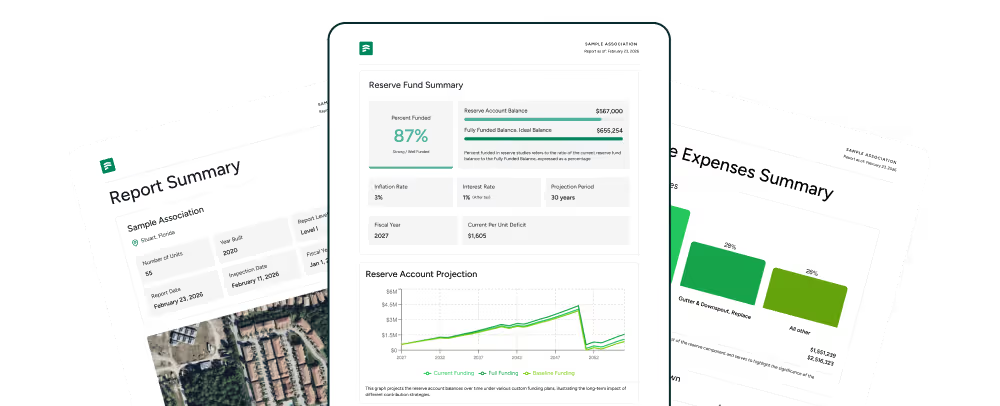
With software such as PropFusion’s Reserve Planner and Reserve Manager, Maine communities can turn a static reserve study into an ongoing planning environment.
Instead of filing the report away, boards can update actual balances, adjust assumptions, and generate updated funding scenarios as conditions change.
Special considerations for Maine communities
Several characteristics of Maine communities make disciplined reserve planning especially important:
- Harsh climate: Freeze-thaw cycles, snow loads, and coastal exposure accelerate wear on roofs, siding, pavement, and decks compared with milder climates.
- Smaller associations: Many Maine associations are relatively small, which means fewer owners to share the cost of large capital projects; this magnifies the impact of inadequate reserves.
- Mixed statutory regimes: Older condominiums may still be governed by the Unit Ownership Act, while newer ones fall under the Maine Condominium Act; either way, there is no detailed reserve funding framework.
These factors argue for more conservative funding and more frequent updates than the bare legal minimum (which, for reserves, is effectively zero).
Step-by-step action plan for Maine boards and manager
For a practical approach, Maine boards and association managers can work through the following steps:
- Map your legal and document framework
- Identify whether your community is a condominium governed by the Maine Condominium Act, an older condominium under the Unit Ownership Act, or another form of HOA or common interest community.
- Review your declaration, bylaws, and rules for any existing reserve or funding requirements.
- Assess your current financial position
- Gather current reserve and operating fund balances.
- List major common components and their approximate ages and conditions.
- Note any looming projects (e.g., roof replacements, paving, envelope repairs).
- Commission or update a reserve study
- Engage a qualified reserve study professional familiar with Maine conditions and regional construction costs.
- Work with them to develop a funding plan that meets your community’s risk tolerance and demographic realities (for example, whether owners prefer stable dues or are resigned to occasional special assessments).
- Adopt a formal reserve funding policy
- Decide on your target funding band and contribution strategy.
- Integrate reserve contributions into the annual budget based squarely on the reserve study, not on last year’s dues plus an arbitrary percentage.
- Communicate the plan to owners
- Share a straightforward summary explaining why changes in assessments are needed, what projects they will fund, and how the plan reduces the risk of large special assessments.
- Revisit this communication annually so that owners see consistent follow-through.
- Use software to monitor and adjust
- Load your reserve study into a system like PropFusion so you can track progress, update assumptions, and generate what-if scenarios without rebuilding spreadsheets from scratch.
- Use dashboards and reports to keep the board and owners aligned on the association’s long term financial health. (propfusion.com)
Related reserve study resources for Maine
Compare reserve study laws in nearby states, or find help running one for your association:
FAQ
Are Maine HOAs and condos legally required to have a reserve fund?
No. Maine statutes do not mandate that associations maintain a reserve fund at any specific level. The Maine Condominium Act empowers associations to adopt budgets that include reserves and collect assessments, but it does not prescribe how much they must contribute each year.
Does the Maine Condominium Act mention reserve studies?
The Maine Condominium Act does not specifically reference “reserve studies” or set a schedule for them. It focuses instead on the structure and powers of the unit owners’ association, including its authority to adopt budgets for revenues, expenditures, and reserves. The decision to commission reserve studies is left to the board and the community’s governing documents.
What is the biggest risk of not doing reserve studies in Maine?
The main risks are surprise special assessments and deferred maintenance. Without a professional long range plan, Maine associations are more likely to underfund reserves, only to be forced into large, urgent projects when roofs, roads, or building systems fail sooner than expected-especially in harsh coastal and winter conditions.
How often should a Maine association update its reserve study?
Because the law is silent, frequency is a policy choice. Many Maine communities adopt the widely accepted standard of a full reserve study every three to five years, with annual updates in between to reflect actual costs, inflation, and changes in component condition.
Do older Maine condos under the Unit Ownership Act have different reserve obligations?
Older condominiums created before the Maine Condominium Act may still be governed by the Unit Ownership Act unless they have opted into the newer statute. However, neither law currently imposes explicit reserve study or minimum funding mandates; reserve practices are driven primarily by documents and board policy in both regimes.
Can a Maine association choose to keep assessments low and rely on special assessments instead of reserves?
Legally, many Maine associations can take that approach if their governing documents allow it, but it is generally poor practice. Chronic underfunding increases financial volatility for owners, can make mortgages and refinancing harder, and may expose the board to criticism for failing to plan for foreseeable capital expenses.
How can PropFusion help our Maine community improve reserve planning?
PropFusion connects Maine boards and managers with experienced reserve study professionals, then provides software tools to store studies, model funding scenarios, track reserve balances, and communicate clearly with owners. That combination helps Maine communities go beyond the minimal statutory framework and implement disciplined, professional reserve planning.
The information contained on this page is provided for informational purposes only, and should not be construed as legal advice on any subject matter. You should not act or refrain from acting on the basis of any content included on this page without seeking legal or other professional advice. The contents of this page contain general information and may not reflect current legal developments or address your situation. We disclaim all liability for actions you take or fail to take based on any content on this report.
Get proposals from vetted reserve study professionals - with 30-year funding plans, powered by modern technology, and compared side by side for free.
Take the guesswork out of your reserve study
From site inspection to 30-year funding plan, PropFusion handles the entire reserve study - accurate, transparent, and built on modern technology that gives you full control over your reserves.