TN Reserve Study Requirements (2026)

Tennessee has moved into the group of states that regulate reserve studies for common-interest communities, but it does so in a very targeted way. Under Tenn. Code Ann. § 66-27-403, as amended by Public Chapter 205 (SB 863 / HB 750), condominium boards overseeing common elements with an aggregate replacement cost above 10,000 dollars must obtain a reserve study and keep it updated on a set cadence.
See the full reserve study requirements by state guide
At the same time, most traditional single-family HOAs in Tennessee still do not have a specific statutory mandate to perform reserve studies, even though boards remain responsible for prudent financial planning under the Tennessee Nonprofit Corporation Act and other general duties.
This guide explains exactly what the Tennessee reserve study law requires for condominiums, how it differs for HOAs, and how boards in both types of communities can use reserve studies and funding plans to protect owners, property values, and their own liability.
Legislation Link
Tennessee Public Chapter 205 (2023) - Amendment to Tenn. Code Ann. § 66-27-403
Tennessee House Bill 750 / Senate Bill 863 (113th General Assembly)
Tennessee Condominium Act of 2008 - Tennessee Condominium Act of 2008
Are reserve studies legally required in Tennessee? Yes, for many condominiums. If a condo board oversees common elements with an aggregate replacement cost over 10,000 dollars, Tenn. Code Ann. § 66-27-403(g) requires a reserve study and updates at least every five years, subject to certain exemptions.
How often must a Tennessee condo association update its reserve study? If the board has had a reserve study conducted on or after January 1, 2020, it must update the study within five years of that date and at least every five years thereafter. If no study has been conducted on or after January 1, 2020, the board must complete one by January 1, 2025 and then update it every five years.
Do Tennessee HOAs (single-family communities) have the same legal reserve study requirement? No. Current Tennessee law explicitly mandates reserve studies only for condominium associations under the Tennessee Condominium Act of 2008. There is still no specific statewide statute that requires reserve studies for traditional single-family HOAs, although boards are strongly encouraged to follow similar best practices.
Does Tennessee law require a specific reserve funding level or just the study itself? The statute requires boards to obtain and periodically update reserve studies and to review reserve funding annually for adequacy, but it does not prescribe an exact funding formula or percentage. Boards must use reasonable judgment, consistent with their fiduciary duties, to set contributions that align with the reserve study’s recommendations.
Need a reserve study in Tennessee? Compare multiple reserve study proposals for free.
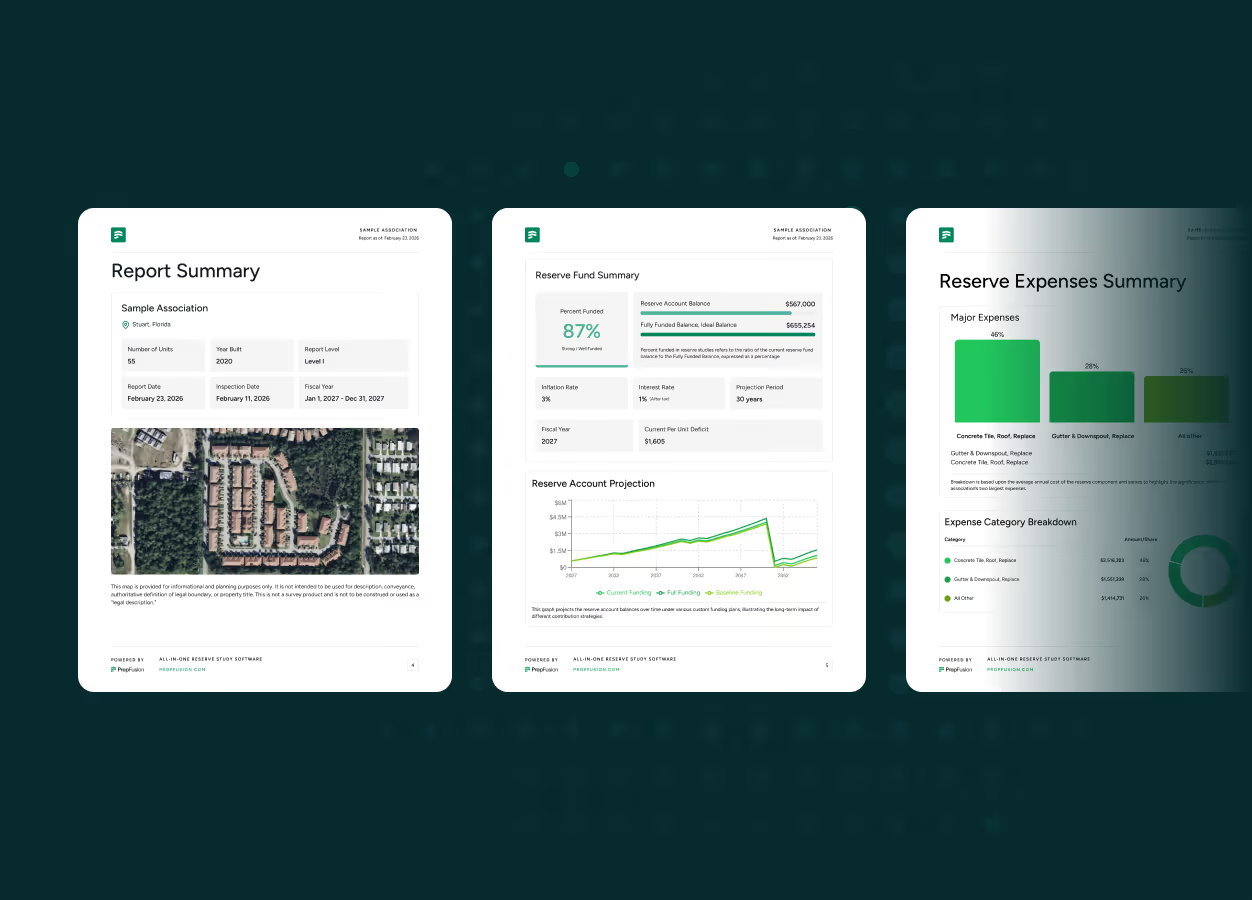
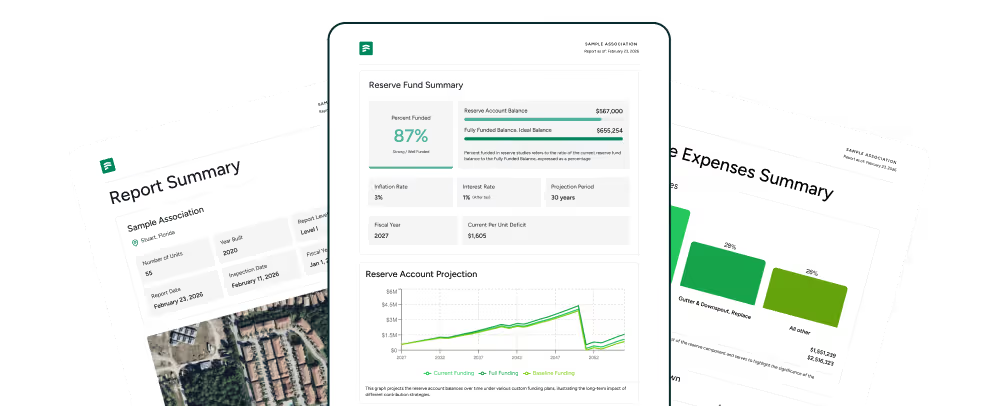
Get proposals from vetted reserve study professionals - with 30-year funding plans, powered by modern technology, and compared side by side for free.
Big-picture overview of Tennessee reserve study law
Tennessee’s reserve study framework is centered on condominiums, not on every HOA in the state. The key rule is found in Tenn. Code Ann. § 66-27-403(g), part of the Tennessee Condominium Act of 2008.
For any condominium association whose board oversees common elements with an aggregate replacement cost exceeding 10,000 dollars, the board must ensure a formal reserve study exists and is renewed on a fixed five-year cycle. (Justia)
This requirement was created by Public Chapter 205 in 2023, based on Senate Bill 863 and House Bill 750. Lawmakers adopted it in the wake of high-profile building failures nationally, with the clear intent of forcing condo boards to plan ahead for major repairs rather than relying on last-minute special assessments.
Who exactly must comply? Condos versus HOAs
The statute applies to “unit owners’ associations” under the Tennessee Condominium Act of 2008, meaning most modern Tennessee condominiums created on or after January 1, 2009. (Kaman & Cusimano)
If you sit on the board of a condominium association with shared roofs, façades, garages, elevators, or amenities, and the total replacement cost of those common elements is above 10,000 dollars (which is true for essentially every multi-unit building), you are within the law’s scope.
Older “horizontal property regime” condominiums formed under the Tennessee Horizontal Property Act may or may not be directly covered, depending on how they were structured and whether they subsequently adopted the 2008 Act’s provisions.
Boards of these legacy communities should obtain legal advice and often choose to follow the same reserve study practices to avoid falling behind best standards.
By contrast, most single-family HOAs and planned developments in Tennessee are governed by a patchwork of provisions in Title 66, Chapter 27 (Parts 6-8) and the Tennessee Nonprofit Corporation Act. There is still no explicit statute that commands these HOAs to commission reserve studies or maintain a particular reserve fund balance, even though industry and lender expectations increasingly assume they will.

Tennessee HOA Laws: Key Statutes Every Board Should Know
Tennessee HOA laws are governed by several statutes depending on how the community is organized:
- Tennessee Horizontal Property Act (T.C.A. Title 66, Chapter 27): Governs condominiums created before 2008. Covers unit owner rights, common element management, and association governance.
- Tennessee Condominium Act of 2008 (T.C.A. Title 66, Chapter 27, Part 4): Applies to condominiums created after January 1, 2008. Includes more detailed provisions for budgets, reserves, and disclosures.
- Tennessee Nonprofit Corporation Act (T.C.A. Title 48): Most Tennessee HOAs are incorporated as nonprofits. This act governs board duties, meetings, voting, and fiduciary responsibilities.
- HOA governing documents: Tennessee does not have a comprehensive standalone HOA statute like some states. CC&Rs, bylaws, and articles of incorporation are the primary governing authority for most HOAs.
Unlike states such as Florida or California, Tennessee does not mandate reserve studies or reserve funding by statute. However, well-managed Tennessee HOAs still commission professional reserve studies as a fiduciary best practice to avoid surprise special assessments and maintain property values.
What Tenn. Code Ann. § 66-27-403(g) actually requires
The condo reserve study rule contains several moving parts:
- Threshold for coverage: The association’s board must oversee “common elements with an aggregate replacement cost exceeding ten thousand dollars.” For any typical multi-unit condo, this threshold is effectively always met.
- Date-based triggers:
- If your board had a reserve study conducted on or after January 1, 2020, you must commission an updated reserve study within five years of that study’s date and continue updating at least every five years.
- If your board has not had a reserve study conducted on or after January 1, 2020, you must obtain a reserve study no later than January 1, 2025 and then update it at least every five years thereafter.
- Owner disclosure: The board must make a copy of the reserve study available to common interest owners either by email or by posting it on the community’s website.
- Ongoing oversight: Even between formal updates, the board must review reserve funding annually to determine whether contributions remain adequate in light of the reserve study and current conditions.
- Exemptions: The rule does not apply while the board is still controlled by the declarant, or where the condominium is titled to a single owner or a husband and wife as tenants by the entirety.
Separate legislative materials and practice commentary make clear that a “reserve study” is expected to be a structured analysis of the remaining useful life and estimated replacement cost of each major system and component of the common elements, not a quick internal spreadsheet. (BillTrack50)
Reserve study frequency and funding expectations
The five-year update requirement is the legal floor, not the ceiling. National reserve study guidance from engineering firms and community association institutes typically recommends a full study with site inspection every three to five years, with lighter annual updates in between.
Tennessee’s law aligns with the upper end of that range but adds the explicit obligation for the board to review funding every year.
Crucially, Tennessee does not fix a formula for “how much” you must keep in reserves. There is no percentage-of-budget rule or statutory funding target. Instead:
- The reserve study provides the technical forecast: remaining life, replacement costs, and a recommended funding trajectory.
- The board, acting under fiduciary duties of care and loyalty under nonprofit law and general association principles, must set contributions that reasonably follow that trajectory, or be prepared to justify deviations.
- Extremely low balances or repeated special assessments in the face of clear reserve study warnings can quickly become evidence that the board failed to act with reasonable care. (samgrayrealestate.com)
Implications for HOAs that are not expressly covered
Even though standard Tennessee HOAs do not yet face a direct reserve study mandate, the direction of travel is obvious. Nationally, more states are moving from “encouraged” to “required” reserve studies, particularly after structural failures and insurance market tightening.
In Tennessee specifically:
- Many HOAs are nonprofit corporations, meaning directors already owe duties of care, loyalty, and good faith in financial planning.
- Lenders and buyers increasingly look for evidence of a professional reserve study when evaluating a community’s financial health.
- TACIR and other policy bodies have highlighted risks where HOAs lack adequate reserves and long-term planning.
Practically, a Tennessee HOA board that ignores reserve planning altogether is taking a conscious risk, even if no statute explicitly spells out the obligation today.
Step-by-step compliance plan for Tennessee condo boards
For boards trying to translate the law into an action plan, a practical sequence looks like this:
Step 1: Confirm your status and applicability
Determine whether your community is a condominium under the Tennessee Condominium Act of 2008 and whether the common elements’ total replacement cost exceeds 10,000 dollars. If so, the reserve study law applies unless you are still under declarant control or fall into one of the narrow ownership exemptions.(Kaman & Cusimano)
Step 2: Check your current reserve study status
Identify whether a formal reserve study was conducted on or after January 1, 2020. If yes, note that date and schedule the update within five years. If no, plan to complete the initial study as soon as possible and no later than January 1, 2025.
Step 3: Engage a qualified reserve study professional
Tennessee’s legislative history and industry commentary point to using specialized reserve professionals, often licensed engineers or reserve specialists with relevant training. Using a reputable firm also provides board-level protection: you can point to independent expert recommendations if challenged.
Step 4: Complete the study and adopt a funding plan
Work with the preparer to inventory components, assess remaining life, and calculate replacement costs. Use the resulting funding plan as the backbone of your annual and multi-year reserve contributions, updating assessments as needed rather than postponing increases and relying on emergency special assessments.
Step 5: Communicate clearly with owners
Once the study is complete or updated, comply with the statute by sharing it via email or on the community website, and explain how it impacts assessments over the next several years.Transparency reduces pushback and helps owners understand why steady, predictable contributions are preferable to surprise bills.
Step 6: Build an annual review and five-year update cycle
Create a standing board agenda item each year to review reserve funding against the study and adjust contributions where needed. Also, calendar the five-year update deadline well in advance so you are not scrambling at the last minute.
Key takeaways for Tennessee boards
- Condos under the Tennessee Condominium Act of 2008 with common elements over 10,000 dollars in replacement cost must obtain and update reserve studies on a five-year cycle, share them with owners, and review funding annually.
- Traditional HOAs are not yet under the same statutory mandate but still face strong practical and fiduciary reasons to follow similar practices.
- Boards that take reserve studies seriously are far more likely to avoid disruptive special assessments, litigation risk, and depressed property values.
Related reserve study resources for Tennessee
Compare reserve study laws in nearby states, or find help running one for your association:
FAQ
What are the HOA laws in TN?
Tennessee does not have a single comprehensive HOA statute. Instead, HOA governance in Tennessee is shaped by a combination of the Tennessee Nonprofit Corporation Act (T.C.A. Title 48), the community's own CC&Rs and bylaws, and the Tennessee Horizontal Property Act or Condominium Act of 2008 for condo associations. Key areas covered include board elections, meeting notice requirements, financial disclosures, assessment collection, and common area maintenance. Tennessee law does not currently require HOAs to maintain reserve funds or conduct reserve studies, but many boards choose to do so as a best practice to plan for long-term capital expenses.
Does the Tennessee reserve study law apply to all condominiums or only larger ones?
The law applies when the board oversees common elements with an aggregate replacement cost over 10,000 dollars, which in practice captures virtually all multi-unit condominiums but may exclude very small or minimal-common-area buildings.
What happens if our condo association misses the January 1, 2025 deadline for its first reserve study?
The statute does not spell out a specific fine schedule, but missing the deadline could expose the board to claims that it failed to meet statutory and fiduciary duties, especially if major repairs arise without adequate reserves. Boards should treat the deadline as hard and work with professionals to get into compliance as quickly as possible.
Can a Tennessee HOA or condo board prepare its own reserve study in-house to save money?
The law focuses on the board’s obligation to have and update a reserve study; it does not explicitly forbid an internal study. However, legislative commentary and industry guidance strongly favor using qualified reserve professionals, both for technical accuracy and to show that the board relied on expert advice if its decisions are later challenged.
Are reserve funds themselves legally required in Tennessee, or can we just have a reserve study and stay underfunded?
Tennessee’s statute requires the study and an annual funding adequacy review but does not define “fully funded.” If the board consistently ignores the reserve study’s funding recommendations and keeps reserves at unsustainably low levels, it risks breaching its duty of care and facing owner pushback, lender concerns, or litigation when predictable failures occur.
How often should a Tennessee HOA without a legal mandate get a reserve study?
Best practice is similar to condos: commission a full reserve study every three to five years and update it annually, even if you are not yet legally required to do so. This cadence supports stable assessments and demonstrates that the board is taking long-term financial planning seriously.
Can PropFusion help our Tennessee community track multiple reserve study deadlines?
Yes. PropFusion’s platform can centralize your reserve studies, surface upcoming five-year deadlines, and let board members and managers see reserve funding status across all communities they oversee, reducing the risk of missing statutory update requirements.
The information contained on this page is provided for informational purposes only, and should not be construed as legal advice on any subject matter. You should not act or refrain from acting on the basis of any content included on this page without seeking legal or other professional advice. The contents of this page contain general information and may not reflect current legal developments or address your situation. We disclaim all liability for actions you take or fail to take based on any content on this report.
Get proposals from vetted reserve study professionals - with 30-year funding plans, powered by modern technology, and compared side by side for free.
Take the guesswork out of your reserve study
From site inspection to 30-year funding plan, PropFusion handles the entire reserve study - accurate, transparent, and built on modern technology that gives you full control over your reserves.