SD Reserve Study Requirements (2026)
South Dakota is a “no-mandate” state when it comes to reserve studies and reserve funds. There is no statute that requires homeowners associations or condominium associations to commission a reserve study or to maintain reserves at a specific level. Multiple national surveys of state reserve laws confirm that South Dakota has no statutory requirement to conduct a reserve study and no statutory requirement to fund reserves.
See the full reserve study requirements by state guide
That lack of a mandate does not mean reserves are optional in practice. Boards are still responsible for maintaining common property, budgeting responsibly, and avoiding avoidable financial shocks. This guide explains how South Dakota’s condominium and nonprofit corporation laws frame association governance, what “no statutory requirement” really means, and how to apply national best practices so your community remains financially stable.
Legislation Link
South Dakota Condominium Law
South Dakota Nonprofit Corporation Act
South Dakota Nonprofit Corporation Act Overview
Are HOA or condo reserve studies legally required in South Dakota? No. Community Associations Institute and multiple professional summaries agree that in South Dakota there is no statutory requirement to conduct a reserve study and no statutory requirement to fund reserves.
Does South Dakota law require HOAs to maintain a reserve fund at a specific level? No. South Dakota has no statute that mandates a minimum reserve balance, a fixed contribution percentage, or any specific reserve funding formula. Whether reserves are required and at what level depends on each association’s governing documents and board decisions.
What laws actually govern HOAs and condos in South Dakota? Condominium associations are governed by the South Dakota Condominium Law in Title 43, Chapter 15A, while most HOAs are organised as nonprofit corporations and governed by the South Dakota Nonprofit Corporation Act, along with their own declarations and bylaws. South Dakota does not have a separate, comprehensive HOA statute.
If there is no state mandate, why should our board bother with a reserve study? A reserve study is still the most reliable way to forecast major repairs, set realistic assessments, and avoid special assessments. It demonstrates prudent planning, supports resale and lending due diligence, and helps maintain property values, even if state law does not require it.
Need a reserve study in South Dakota? Compare multiple reserve study proposals for free.
Get proposals from vetted reserve study professionals - with 30-year funding plans, powered by modern technology, and compared side by side for free.
Legal landscape: South Dakota as a “no-mandate” state
From a statutory perspective, South Dakota is straightforward: there is no law that imposes HOA reserve study requirements, and no law that requires associations to fund reserves.
Multiple independent summaries - including CAI’s 2023-2024 reserve law charts and professional reserve study firms - explicitly note that “there is no statutory requirement to conduct a reserve study and no statutory requirement to fund reserves” in South Dakota.
That places South Dakota alongside a number of other states where the legislature has not yet codified detailed reserve obligations. Instead, reserve planning is driven by:
- The association’s governing documents (declaration, master deed, covenants, bylaws).
- General corporate duties under the Nonprofit Corporation Act.
- Market expectations from owners, buyers, and lenders.
Boards that treat “no mandate” as “no responsibility” are courting financial trouble. The legal framework may be light, but the practical expectations are not.
What governs associations in South Dakota?
Condominium associations
Condominiums in South Dakota are governed by the Condominium Law codified in Title 43, Chapter 15A. This chapter covers:
- How a condominium project is established via a master deed.
- The definition and ownership of common areas.
- The role and powers of the council of co-owners.
- Developer obligations, inspection rights, and certain consumer protections. (Justia Law)
The chapter addresses how condos are formed and managed, but it does not prescribe:
- A requirement to adopt a formal reserve study.
- A required reserve funding level.
- Any particular schedule for reviewing long-term capital needs.
Homeowners associations (non-condo communities)
Homeowners associations in South Dakota are not regulated by a single, dedicated HOA statute. Instead, they operate under:
- Their recorded covenants and bylaws.
- The South Dakota Nonprofit Corporation Act (Title 47, Chapters 22-28), because most HOAs are organised as nonprofit corporations.
The Nonprofit Corporation Act establishes:
- How nonprofit corporations are formed and dissolved.
- Director and officer duties and powers.
- Requirements for records, fiscal affairs, and reporting.
Again, it does not impose specific reserve study or reserve funding obligations. But it frames the duties of directors, who must manage the corporation’s assets prudently and in the association’s best interests.

Confirming there is no statutory reserve mandate
Because South Dakota’s own code does not mention reserve studies or funding minimums, boards often rely on compiled state-law charts produced by CAI and others. Those charts, updated as of 2023, clearly state for South Dakota:
- There is no statutory requirement to conduct a reserve study.
- There is no statutory requirement to fund reserves.
Other industry resources aimed at boards and managers repeat the same conclusion: there is no law that imposes HOA reserve study requirements in South Dakota, though individual CC&Rs or bylaws may do so.
The bottom line is that, at the state level, reserve practices in South Dakota are a matter of governance, not statutory compliance.
Governing documents: where your real obligations live
In a no-mandate state, your declaration, master deed, and bylaws take centre stage. It is common to see language that:
- Authorises or requires the association to establish reserve funds for capital repairs and replacements.
- Requires annual budgets to include allocations to reserves.
- Sets conditions for borrowing from reserves or using reserves for non-capital purposes.
- Limits board discretion to slash reserve contributions without member approval.
Boards in South Dakota should:
- Have association counsel review the governing documents for any references to “reserves,” “capital replacement funds,” “major repairs,” or “long-term maintenance.”
- Map those clauses to the annual budget process, ensuring that reserve contributions align with what the documents require.
- Document in board minutes how reserve funding decisions were reached and how they comply with the governing documents.
Where the documents are silent or vague, the board’s fiduciary duty under nonprofit law still requires it to act in the association’s long-term interests, which includes planning for foreseeable major expenses.
Why reserve studies still matter in South Dakota
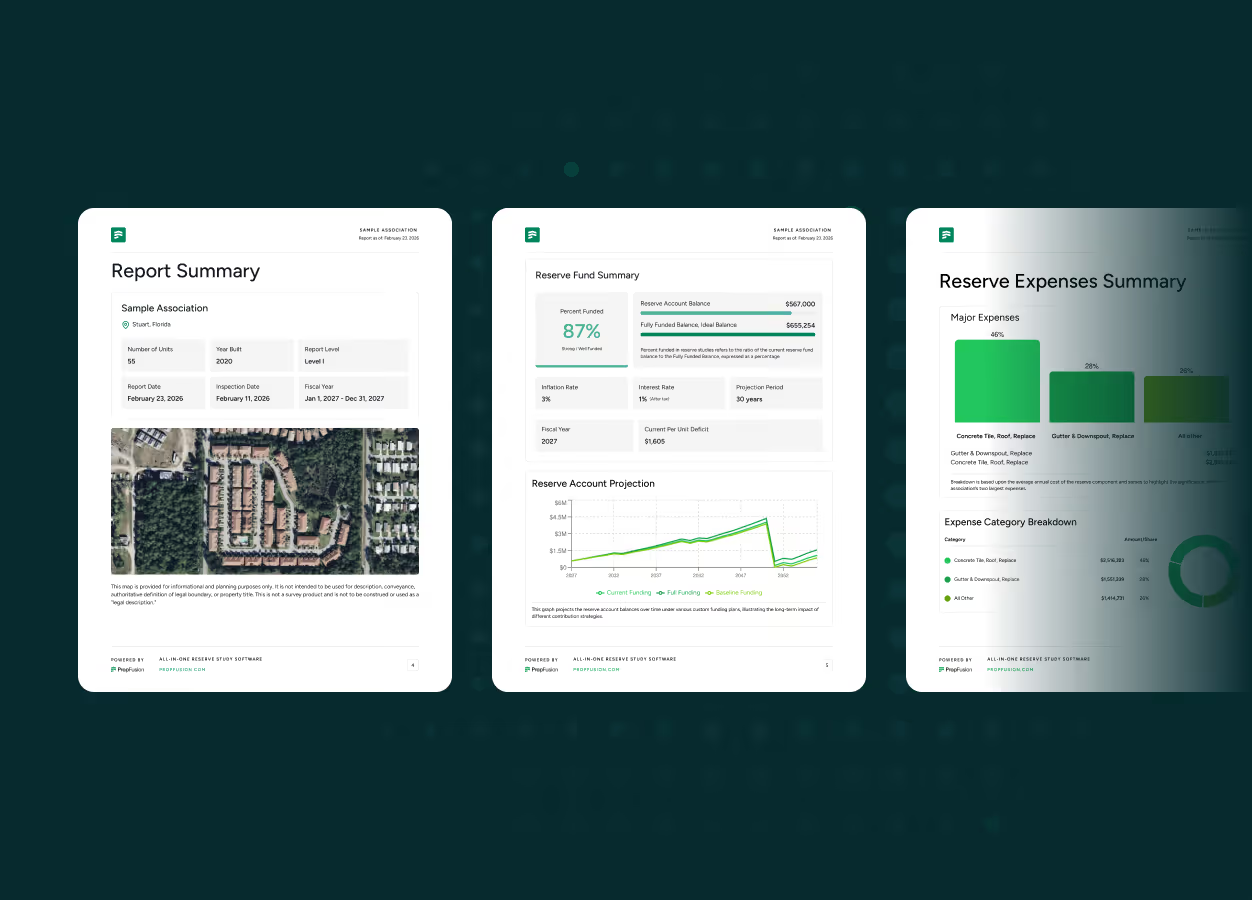
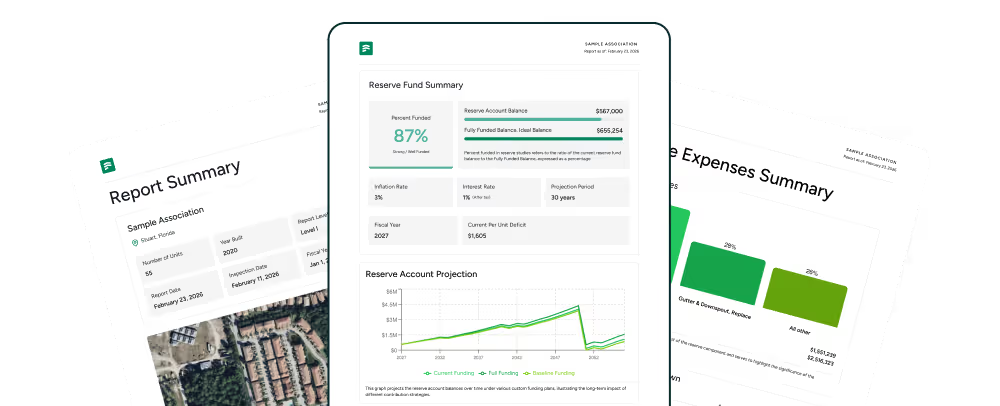
Even without a statutory requirement, reserve studies remain the best available tool for South Dakota associations that want to avoid financial shocks. A professional reserve study:
- Catalogues all major common components the association must maintain (roofs, siding, paving, mechanical systems, amenities).
- Estimates each component’s remaining useful life and replacement cost.
- Builds a multi-year funding plan that spreads contributions fairly over current and future owners.
- Demonstrates to owners, buyers, and lenders that the board is managing long-term obligations responsibly
Reserve studies also support more accurate disclosure. Even though South Dakota’s property disclosure framework for HOAs focuses primarily on the existence of the HOA, governing documents, and fees, sophisticated buyers and lenders will almost always look deeper into the association’s financial statements and reserve position. Well-documented reserves make those conversations easier.
Best-practice funding strategies for South Dakota associations
Without statutory numbers to follow, boards need internal targets and discipline. Common best practices in states like South Dakota include:
- Targeting a healthy “percent funded” level: Many reserve professionals consider an association “weak” below about 30-40% funded, “fair” in the middle range, and “strong” above roughly 70% funded. While South Dakota law does not reference percent funded, this concept helps boards gauge risk.
- Using budget percentages as an interim rule of thumb: Until a formal study is completed, some communities contribute 15-25% of their total annual assessment income to reserves as a placeholder. This mirrors guidance already used informally on your existing South Dakota page and provides a starting point, not a final answer.
- Keeping reserves segregated: Even though there is no statutory requirement to hold reserves in a separate account, doing so improves transparency and reduces the risk of accidental misuse of funds.
- Avoiding the temptation to “plug” budget gaps by cutting reserves: In a state without mandates, it is especially easy to justify underfunding reserves to keep dues low. Boards should explicitly recognise that this trades short-term popularity for long-term financial risk.
The most sustainable strategy is to set contributions based on a professional reserve study and then adjust gradually as conditions change.
How often should South Dakota HOAs and condos update a reserve study?
Because there is no statutory schedule in South Dakota, boards should align with national standards and lender expectations. Typical practice is:
- Full reserve study with site visit every 3-5 years.
- Interim financial updates in between full studies to reflect changed costs, inflation, and completed projects.
- An annual check-in during budget season to confirm that reserve contributions still align with the plan.
Communities with complex infrastructure or a history of underfunding may choose the more conservative three-year cycle for full updates.
Practical risks of underfunded reserves in a no-mandate state
The absence of legal mandates can lull boards into complacency. In reality, the core risks of underfunded reserves in South Dakota are the same as anywhere else:
- Frequent or large special assessments that anger owners and hurt affordability.
- Deferred maintenance that visibly degrades the community and depresses property values.
- Difficulties in resale when buyers or lenders see weak reserves in financial statements.
- Potential claims that board members breached their fiduciary duty by ignoring foreseeable major repairs.
Well-run South Dakota communities treat reserve planning as a governance issue, not a compliance checkbox. They behave as though the state had a mandate, even though it does not.
Related reserve study resources for South Dakota
Compare reserve study laws in nearby states, or find help running one for your association:
FAQ
Are reserve studies or reserve funds required by South Dakota law?
No. Current CAI charts and multiple professional summaries confirm that South Dakota has no statutory requirement to conduct a reserve study and no statutory requirement to fund reserves. Any obligations come from your governing documents and general fiduciary duties, not from a specific reserve statute.
If there is no specific HOA statute, what laws apply to our South Dakota association?
Condominium associations are governed by the South Dakota Condominium Law in Title 43, Chapter 15A. Most non-condo HOAs are organised as nonprofit corporations and governed by the South Dakota Nonprofit Corporation Act in Title 47, plus their recorded covenants and bylaws. These laws define governance and director duties but are silent on reserve study mandates.
Can members vote to reduce or skip reserve contributions in South Dakota?
Because there is no state-imposed minimum, members in some associations may be able to approve budgets with lower or even no reserve contributions, if the governing documents allow it. However, doing so increases the risk of special assessments and deferred maintenance and may be inconsistent with directors’ duty to act in the long-term best interests of the association.
What is a reasonable starting point for reserve contributions in South Dakota?
Until you have a professional reserve study, many boards use an interim rule of thumb such as contributing 15-25% of annual assessment income to reserves. This is not a legal standard and may be too high or too low for your community, but it is generally safer than contributing nothing while you arrange a proper study.
How often should our South Dakota community commission a reserve study?
Best practice is a full on-site reserve study every 3-5 years, with interim financial updates and an annual budget review. There is no legal schedule in South Dakota, so boards should choose a cadence that matches their risk profile and infrastructure complexity.
Do lenders or buyers in South Dakota care about reserve studies?
Yes. Even though state law does not require reserve studies, many lenders and sophisticated buyers will examine your financials, reserve balances, and any existing reserve studies as part of their due diligence. Strong reserves and a documented plan can make it easier to sell units and obtain financing.
Does this guide replace advice from a South Dakota attorney?
No. This guide summarises the legal framework and industry best practices for reserves in South Dakota, but it is not legal advice. Boards should consult qualified South Dakota counsel and professional reserve
The information contained on this page is provided for informational purposes only, and should not be construed as legal advice on any subject matter. You should not act or refrain from acting on the basis of any content included on this page without seeking legal or other professional advice. The contents of this page contain general information and may not reflect current legal developments or address your situation. We disclaim all liability for actions you take or fail to take based on any content on this report.
Get proposals from vetted reserve study professionals - with 30-year funding plans, powered by modern technology, and compared side by side for free.
Take the guesswork out of your reserve study
From site inspection to 30-year funding plan, PropFusion handles the entire reserve study - accurate, transparent, and built on modern technology that gives you full control over your reserves.