South Carolina HOA Reserve Study & Fund Requirements (2026)

South Carolina is one of the many states where homeowners’ associations (HOAs) and condo associations are not legally required to commission reserve studies or maintain a minimum reserve fund balance. That does not mean reserves are optional in practice. Boards are still responsible for maintaining common elements, budgeting responsibly, and avoiding preventable special assessments and deferred maintenance.
See the full reserve study requirements by state guide
This guide explains how South Carolina’s HOA and condo laws intersect with reserve funds and reserve studies, what is and is not required by statute, and what boards should do in practice to protect their communities. It is written for board members, association managers, and owners who want a clear, practical explanation of the rules and best practices rather than dense legal commentary.
Legislation Link
South Carolina Homeowners Association Act
South Carolina Horizontal Property Act (Condominiums)
Homeowners Association (HOA) Information
Are reserve studies legally required for HOAs in South Carolina?
No. South Carolina state law does not currently require HOAs or condominium associations to conduct formal reserve studies. Whether your association must have one depends on your governing documents (CC&Rs, bylaws, or master deed), not on a specific reserve study statute.
Does South Carolina law require associations to fund a reserve account?
No. There is no statute that obligates HOAs or condo associations in South Carolina to fund reserves to a specified level or even to maintain a separate reserve account. However, boards still have a fiduciary duty to maintain common elements and budget responsibly, and many associations voluntarily establish and fund reserves to avoid special assessments.
What do South Carolina HOA laws require related to budgets and financial transparency?
The South Carolina Homeowners Association Act requires associations to prepare an annual budget, provide proper notice before budget increases, and allow homeowners to inspect the annual budget and other association records. These requirements push boards toward transparent planning, even though the statutes do not dictate specific reserve study or funding levels.
How often should South Carolina associations update a reserve study if they choose to have one?
Because there is no statutory schedule, most associations follow industry best practice and update a full reserve study about every three to five years, with annual reviews in between. In years without a full update, boards typically revisit component costs, expected remaining useful life, and reserve contributions during the budget process.
Need a reserve study in South Carolina? Compare multiple reserve study proposals for free.
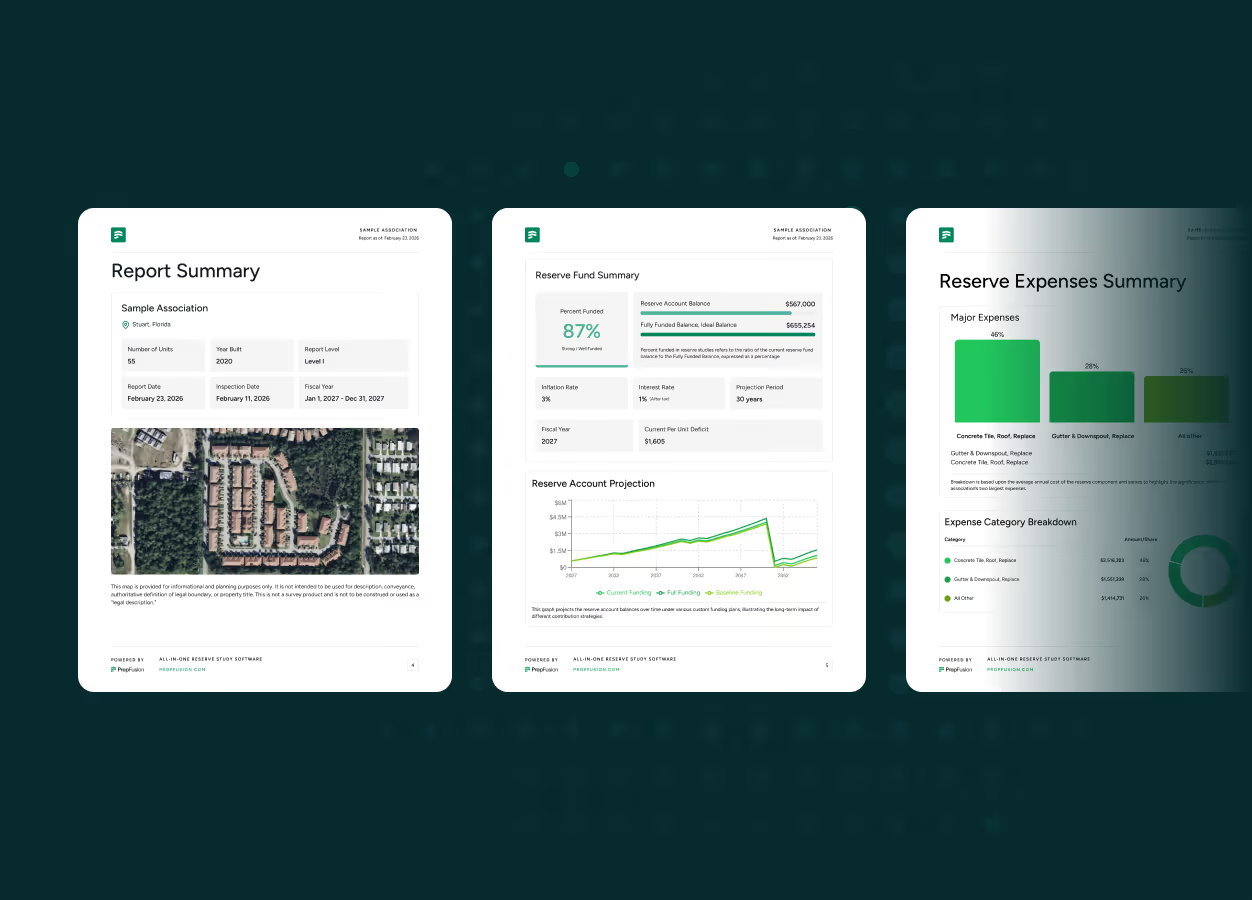
Get proposals from vetted reserve study professionals - with 30-year funding plans, powered by modern technology, and compared side by side for free.
Legal framework for HOAs and condos in South Carolina
South Carolina has joined a growing group of “no-mandate” states when it comes to reserve studies and reserve fund laws. There is no statute that explicitly compels HOAs or condo associations to commission a reserve study, adopt a particular funding model, or maintain reserves at a minimum percentage of the budget. Instead, the legal framework centers on governance, budgets, disclosures, and access to information. Boards that understand that framework can still build disciplined reserve programs even without a state mandate.
Two main statutes shape community association governance in the state:
- The South Carolina Homeowners Association Act, found in Title 27, Chapter 30 of the South Carolina Code, sets baseline rules for HOAs, including definitions, recording requirements for governing documents, rules for adopting and increasing annual budgets, and homeowner access to association records.
- The South Carolina Horizontal Property Act, in Title 27, Chapter 31, provides the legal structure for condominium and other horizontal property regimes, defining apartments, common elements, and the powers of the council of co-owners.
Neither statute mentions the phrase “reserve study,” and neither establishes a mandatory reserve funding formula. That is fundamentally different from states like Nevada, Hawaii, or Florida, where statutes explicitly tie budgets to reserve studies and require boards to maintain reserves at a “reasonable” or calculated level.
South Carolina HOA and Condo Reserve Study Requirements: Overview
In South Carolina, reserve studies are not legally required but are highly recommended for effective financial planning and long-term maintenance of community assets. Here’s why reserve studies matter:
- Best Practices: Reserve studies help South Carolina associations plan for future maintenance needs and establish clear funding strategies.
- Financial Stability: A well-maintained reserve fund reduces the risk of unexpected fee increases or special assessments.
- Transparency: Sharing reserve study findings fosters trust and accountability among homeowners.
- Property Value Protection: Properly maintained assets help preserve and enhance property values within the community.
What the law actually says about reserve studies and reserve funds
Authoritative surveys of state reserve study laws are explicit: South Carolina has no statutory requirement to conduct a reserve study and no statutory requirement to fund reserves.
Industry commentary reinforces the same point; multiple professional management and reserve firms note that neither North Carolina nor South Carolina requires associations to commission professional reserve studies, though they strongly recommend doing so as a matter of good governance. (CAMS Management)
That does not mean reserves are irrelevant. The Horizontal Property Act requires condominium apartment owners, acting through their council of co-owners or association, to maintain common elements such as roofs, structural components, elevators, and shared infrastructure.
Those obligations inevitably create long-term capital expenses even if the statute does not prescribe exactly how to budget for them.
Similarly, the Homeowners Association Act focuses on transparency and process: governing documents must be recorded; rules and regulations must be accessible; annual budget increases require advance notice to owners; and homeowners have the right to inspect the annual budget and certain records.
When owners can see that little or nothing is being set aside for roof replacements, paving, or clubhouse systems, boards quickly feel the pressure to explain their long-term capital plan.

Governing documents: where reserve obligations usually live
Because state law is silent on exact reserve funding levels, the real obligations often live in the association’s own declaration, master deed, and bylaws. These documents may:
- Require the association to maintain “adequate reserves” or a “capital reserve fund.”
- Specify that annual budgets must include a line item for reserves.
- Authorize the board to levy special assessments when reserves are inadequate.
- Set procedural hurdles (such as owner votes) for borrowing or using reserves for non-capital purposes.
Boards in South Carolina should treat their governing documents as the primary source of reserve funding requirements, and the state statutes as the framework that governs how they adopt budgets, communicate decisions, and keep records accessible.
Why reserve studies still matter in a no-mandate state
Even though the law does not force reserve studies, the financial and operational logic is the same as in mandated states. Reserve studies help boards:
- Identify every major component the association must maintain or replace over a multi-decade horizon (roofs, siding, elevators, pools, asphalt, mechanical systems, etc.).
- Estimate remaining useful life and replacement cost for each component, using professional engineering or reserve-specialist input.
- Translate those cost curves into an annual reserve contribution that spreads the burden fairly across current and future owners.
- Demonstrate to owners, lenders, and buyers that the community has a plan and is not relying on constant special assessments.
In practical terms, that means reserve studies are often the difference between a community that can handle a million-dollar roof project without panic and one that has to scramble for loans or emergency assessments.
Recommended reserve study frequency for South Carolina associations
Without a statutory schedule, the safest approach is to follow industry norms. Most professional reserve planners recommend:
- A full, on-site reserve study every 3 to 5 years.
- Interim updates in the years between full studies, at minimum reviewing inflation, construction costs, and any components that have significantly aged or been replaced.
- An annual check-in during the budget process to confirm that reserve contributions still align with updated cost and timing assumptions.
For rapidly aging communities, those with extensive amenities (complex pools, elevators, garages, high-rise systems), or associations that have historically underfunded reserves, the shorter end of the range (every 3 years) is more appropriate.
Budgeting, assessments, and disclosures: practical implications
South Carolina’s Homeowners Association Act requires boards to prepare an annual budget, give owners proper notice before raising that budget, and allow access to annual budgets and membership lists.
The state’s Department of Consumer Affairs also maintains educational materials and law outlines that highlight the HOA Act, Horizontal Property Act, and Nonprofit Corporation Act as key legal anchors for HOA governance.
In practice, this means:
- Boards should incorporate reserve contributions directly into the annual budget rather than treating them as an afterthought.
- When proposing a budget increase, boards should clearly explain how much of the change is driven by reserve funding needs versus day-to-day operating costs.
- Owners who inspect the budget should be able to see a line item for reserves, backed by an explanation of how the amount was calculated (ideally referencing a recent reserve study or at least a documented internal analysis).
- When real estate is sold, buyers, lenders, and their advisors will often ask for financial statements and budgets. Even though South Carolina’s disclosure framework focuses on HOA status and governing documents rather than reserves, sophisticated buyers will scrutinize reserve balances and capital plans.
Underfunded reserves do not violate a specific statute, but they create real risk: deferred projects, emergency assessments, reputational damage to the community, and potential disputes over whether the board fulfilled its fiduciary duties.
Best-practice funding strategies for South Carolina HOAs and condos
In a state with no statutory benchmarks, boards need internal targets. Common best-practice approaches include:
- Setting a long-term “percent funded” goal, aiming to be at least 70-100 percent funded for major components over time, based on a professional reserve analysis.
- Avoiding the habit of balancing the budget by cutting reserve contributions; instead, treating reserves as a non-negotiable cost of responsible ownership.
- Adopting clear policies for when reserves may be used (for capital repairs and replacements only, not day-to-day operating expenses).
- Planning for inflation and construction cost volatility rather than assuming today’s prices will hold.
Boards should document these policies in board resolutions, budget notes, or governance guidelines so that future boards understand the rationale and owners can see the long-term plan.
Step-by-Step Guide to Conducting a Reserve Study
Reserve studies can be broken down into manageable steps for accuracy and effectiveness. Here’s how:
Hire a Certified Reserve Study Professional
Use PropFusion’s Network to connect with experienced reserve study specialists who understand South Carolina’s unique community needs.
Compile an Asset Inventory
List all shared assets, such as roofs, HVAC systems, and recreational facilities, that require maintenance or replacement.
Assess Asset Conditions and Lifespans
Evaluate the current condition and projected lifespan of each asset to plan effectively for future repair and replacement costs.
Develop a Funding Plan
Create a financial strategy to maintain reserve fund levels covering 70-100% of anticipated costs, reducing reliance on special assessments.
Communicate Findings to Homeowners
Share the reserve study results with homeowners to explain the financial outlook and future plans, fostering transparency and trust.
Update Regularly
While South Carolina has no legal requirement, it’s recommended to revisit reserve studies every 3–5 years to adjust to changing financial and maintenance needs.
How PropFusion helps South Carolina associations manage reserves
While South Carolina does not dictate how you must handle reserves, the expectations from owners, buyers, and lenders increasingly resemble those in mandated states. PropFusion’s reserve management tools are designed to close that gap by giving boards and managers:
- A clear asset inventory, useful life assumptions, and cost projections for major components.
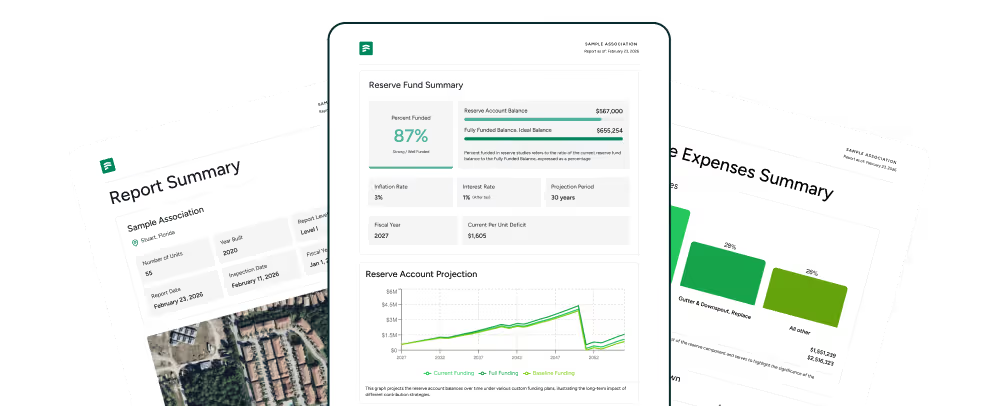
- Funding plan tools that let you compare different contribution strategies and see their impact on cash flow and “percent funded” status.
- Scenario planning to test the effect of deferring a project, phasing a major replacement, or smoothing assessment increases over several years.
- Reporting and dashboards that make it simple to communicate your plan to owners and prospective buyers.
When combined with a professionally prepared reserve study, these tools help South Carolina communities operate as if the state had a mandate-without waiting for the legislature to act. The result is fewer surprises, more stable assessments, and better-maintained neighborhoods.
Related reserve study resources for South Carolina
Compare reserve study laws in nearby states, or find help running one for your association:
FAQ
Are reserve studies mandatory for South Carolina HOAs or condos?
No. South Carolina law does not require HOAs or condominium associations to conduct reserve studies. Any obligation to obtain one comes from your governing documents or lender requirements, not from a specific reserve study statute.
Does South Carolina law require a minimum level of reserve funding?
No. There is no statute that mandates a particular reserve funding level, percentage of the budget, or minimum balance. Boards are still expected to maintain common elements and budget responsibly, but the law does not prescribe a formula for how much must be held in reserves.
What statutes should South Carolina HOA and condo boards be familiar with?
Boards should understand the South Carolina Homeowners Association Act (Title 27, Chapter 30), the Horizontal Property Act (Title 27, Chapter 31) for condominiums and horizontal property regimes, and, where applicable, the South Carolina Nonprofit Corporation Act. The Department of Consumer Affairs provides helpful summaries and links to these laws.
If there is no mandate, why should our association pay for a reserve study?
A reserve study is the most reliable way to forecast capital projects, spread costs fairly over time, and avoid emergency assessments. It supports your fiduciary duty to maintain common elements and gives buyers, lenders, and owners confidence that the community is financially stable. In the long run, a good study and disciplined funding plan often cost less than repeated crises.
How often should we revisit our reserves in South Carolina?
Most boards in South Carolina that follow best practices update their reserve study every three to five years, with an annual review during the budget cycle. Fast-changing communities, or those catching up from years of underfunding, may need more frequent updates and adjustments to contributions.
Do buyers in South Carolina see our reserve levels when purchasing a home?
Statewide law focuses more on HOA status, governing documents, and budget access than on explicit reserve disclosures. In practice, however, buyers and their advisors routinely request budgets, financial statements, and reserve information as part of their due diligence, and weak reserves can hurt marketability or negotiating power.
Can our HOA decide not to fund reserves at all?
Legally, a South Carolina association can operate with minimal or no reserves, unless your governing documents say otherwise. The board must still fulfill its duty to maintain common property, so choosing not to fund reserves typically shifts the burden to larger special assessments, loans, or deferred maintenance, all of which carry significant financial and reputational risks.
The information contained on this page is provided for informational purposes only, and should not be construed as legal advice on any subject matter. You should not act or refrain from acting on the basis of any content included on this page without seeking legal or other professional advice. The contents of this page contain general information and may not reflect current legal developments or address your situation. We disclaim all liability for actions you take or fail to take based on any content on this report.
Get proposals from vetted reserve study professionals - with 30-year funding plans, powered by modern technology, and compared side by side for free.
Take the guesswork out of your reserve study
From site inspection to 30-year funding plan, PropFusion handles the entire reserve study - accurate, transparent, and built on modern technology that gives you full control over your reserves.