RI Reserve Study Requirements (2026)

Rhode Island does not have a statute that explicitly requires homeowners associations or condominium associations to perform reserve studies or to maintain a specific minimum reserve fund balance. That can tempt boards to underfund long-term repairs or postpone planning altogether, but doing so exposes the association-and individual directors-to significant financial and legal risk.
See the full reserve study requirements by state guide
This guide explains how Rhode Island law treats reserves today, where the gaps are, and what prudent boards should do to protect their communities.
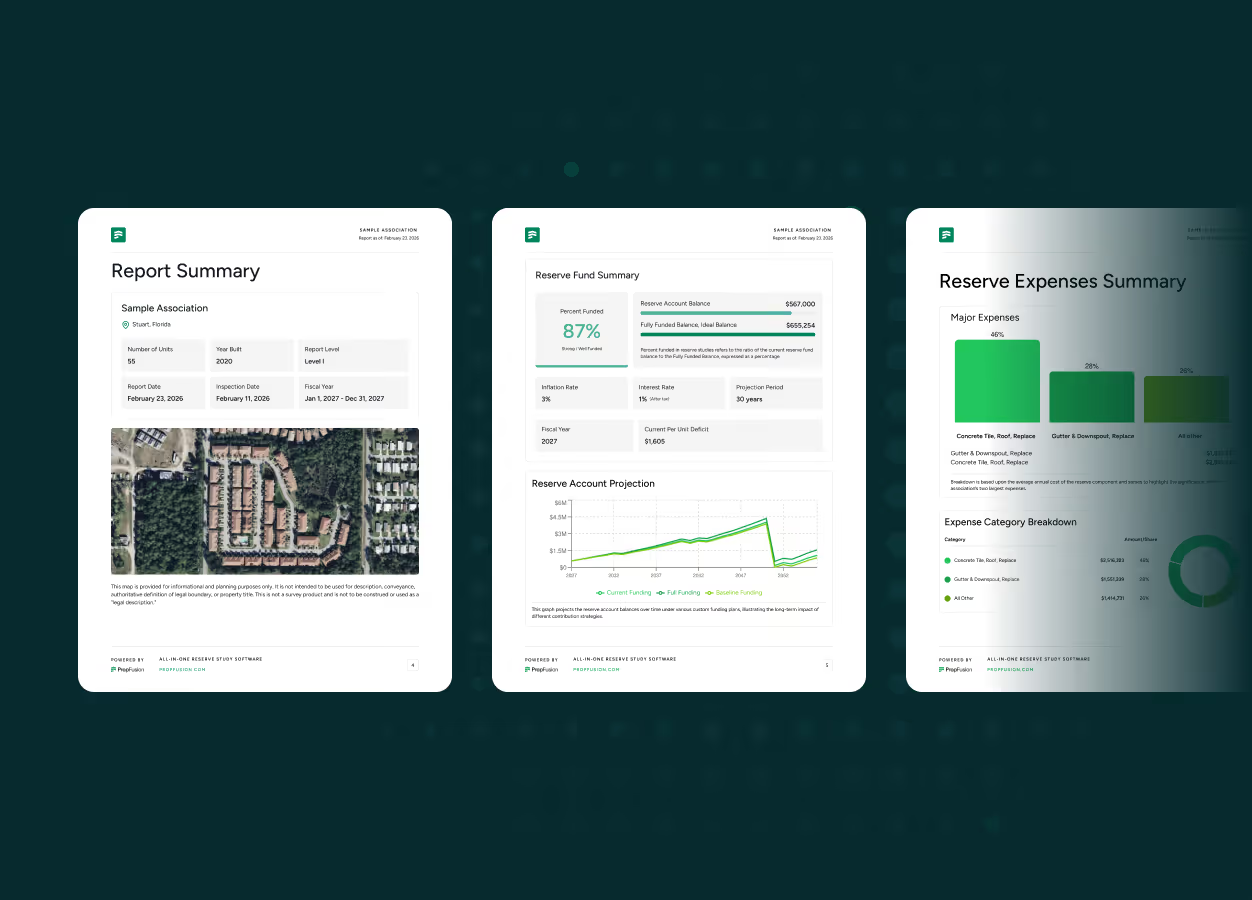
We break down the Rhode Island Condominium Act provisions that touch reserves, boards’ fiduciary obligations, and practical reserve study best practices tailored to Rhode Island.
Legislation Link
Rhode Island Condominium Act - Article III: Management of Condominium
Rhode Island Condominium Act - Article IV: Protection of Condominium Purchasers
Are reserve studies legally required in Rhode Island?
No. Rhode Island law does not currently require HOAs or condominium associations to commission reserve studies or to follow a particular reserve study schedule. The statutes give associations the power to budget for reserves, but they do not mandate formal studies or minimum funding levels.
Does Rhode Island law require associations to maintain a reserve fund?
The Rhode Island Condominium Act requires developers’ public offering statements to disclose a budget that includes reserves for key common elements, but ongoing associations are not given a statutory minimum reserve amount or funding formula. In practice, boards are expected to use their budgeting authority prudently and maintain reserves appropriate for their community.
How often should a Rhode Island association update its reserve study?
While no statute sets a frequency, most Rhode Island communities that follow industry standards commission a full reserve study and then update it every 3 to 5 years, with more frequent updates after major projects or if the community has complex building systems.
Are condos and non-condo HOAs treated differently under Rhode Island law?
Most of the explicit statutory language on reserves and budgets is found in the Rhode Island Condominium Act, so condominium associations have clearer statutory guardrails. Many planned community HOAs without a condominium structure rely on their governing documents, general nonprofit law, and fiduciary duties to guide reserve planning.
Need a reserve study in Rhode Island? Compare multiple reserve study proposals for free.
Get proposals from vetted reserve study professionals - with 30-year funding plans, powered by modern technology, and compared side by side for free.
Overview: No statutory reserve study mandate, but real obligations
Rhode Island is in a category of states where the law recognizes that associations may adopt budgets and establish reserves, but it stops short of requiring formal reserve studies or setting minimum funding levels.
That gap can create confusion. Boards sometimes assume that “no statute” means “no responsibility.” In reality, the absence of a detailed reserve statute puts even more weight on the board’s general duties of care and loyalty and on the budgeting and disclosure provisions in the Rhode Island Condominium Act.
For boards and managers, the practical question is not “What is the bare legal minimum?” but “What would a prudent, informed board do to protect owners, maintain the property, and avoid avoidable financial shocks?”
This guide answers that question in a Rhode Island context.
What Rhode Island law actually says about reserves
Two provisions of the Rhode Island Condominium Act are especially important for reserve planning:
First, the Act empowers unit owners’ associations to adopt and amend budgets for revenues, expenditures, and reserves, and to collect assessments for common expenses.This language appears in § 34-36.1-3.02 and confirms that boards have explicit statutory authority to build reserve funding into their annual budgets.
Second, in the public offering statement for a new condominium, the declarant must provide a budget that includes reserves sufficient for specified major items such as exterior painting, roof replacement, road resurfacing, and other capital components, as well as life expectancy information for shared elements. That requirement lives in § 34-36.1-4.03 and is aimed at giving buyers an honest picture of future obligations at the time of purchase.
Taken together, these sections show the legislature expects reserves to exist and to be disclosed. However, they do not require that established associations maintain any particular reserve balance, follow a standard reserve funding formula, or obtain a professional reserve study at defined intervals.
Boards are given authority and an implied expectation of care, but not a detailed checklist.
No reserve study law today - but active legislative interest
As of late 2025, Rhode Island has not enacted a law that expressly mandates reserve studies or prescribes minimum reserve funding for HOAs or condos. Recent legislative sessions have, however, looked closely at updating the Condominium Act and related statutes.
Proposals have included commissions to study the Act and bills that would impose more formalized reserve planning and inspection requirements, similar in spirit to Florida’s post-Surfside reforms, but key bills have stalled or died in committee. (LegiScan)
For boards, the take-away is simple: even if specific reserve study mandates are not yet law, Rhode Island is watching national trends, and the regulatory bar is unlikely to go down over time.
Boards that already plan with professional reserve studies will be better positioned if and when lawmakers tighten requirements in the future.
How fiduciary duty fills the gap
In the absence of a detailed reserve statute, Rhode Island associations are governed by the fiduciary duties owed by directors under nonprofit and condominium law, plus any duties described in their governing documents. Boards must act in good faith, in the best interests of the association, and with the level of care that an ordinarily prudent person in a similar position would exercise.
In practical terms, that means:
- Anticipating predictable capital projects such as roof replacement, pavement resurfacing, exterior painting, mechanical equipment replacement, and structural repairs.
- Avoiding “willful blindness” toward obvious deterioration, deferred maintenance, or known risks.
- Treating owners equitably by spreading long-term costs across current and future owners through regular assessments rather than relying on crisis-driven special assessments.
If a major component fails and the association has little or no reserve planning, owners facing a sudden special assessment may argue that the board breached its duty of care.
A professional reserve study is one of the strongest pieces of evidence a board can point to when showing that it planned based on data, not guesswork.
Recommended reserve study cadence in Rhode Island
Industry standards, including those promoted by national community association organizations, typically recommend:
- One initial “Level I” or full reserve study including a site inspection, component inventory, and funding model.
- Periodic updates with a site visit every 3 to 5 years.
- Financial-only updates in the interim years, especially after large projects or material changes in costs.
Rhode Island’s climate and building stock support that cadence. Many communities face freeze-thaw cycles, coastal exposure, and aging infrastructure-conditions that accelerate deterioration.
Older condo buildings with limited documentation or complex systems (elevators, structured parking, coastal reinforcement, etc.) may justify more frequent physical inspections and funding adjustments.
Even for small associations, a basic professional study updated every few years is usually far cheaper than a single large special assessment or the legal costs of disputes with owners.
How much should a Rhode Island HOA keep in reserves?
Rhode Island statutes do not set a fixed percentage of the budget that must be allocated to reserves, nor do they define “adequate” reserves. Many lenders, insurers, and reserve specialists consider both:
- The absolute size of the reserve balance relative to upcoming projects, and
- A “percent funded” metric that compares actual reserve holdings to the theoretical ideal reserve level based on asset age and cost.
While each community is different, a common industry rule of thumb is that associations should aim for a funding level that keeps them out of the “high-risk” zone where any major project would trigger a special assessment or borrowing.
Often, this aligns with reserve contributions in the range of 15-25 percent of the operating budget for many communities, and a long-term target of being at least moderately funded on a percent-funded scale. Your reserve professional will model scenarios specific to your assets and risk tolerance.
The important point for Rhode Island boards is that “we have some money in savings” is not enough. You should be able to show that your reserve contribution levels follow a documented plan prepared or validated by a qualified professional.
Practical steps for Rhode Island boards this year
A Rhode Island board or manager looking to tighten up reserve planning can follow a straightforward playbook:
Step 1: Gather your documents
Collect your declaration, bylaws, any existing reserve studies, capital project history, recent budgets, and current reserve account statements. Confirm which components the association is contractually responsible for maintaining.
Step 2: Commission or update a professional reserve study
Engage a credentialed reserve specialist (e.g., RS or PRA) who routinely works with New England communities and is familiar with Rhode Island’s legal and climatic context. Provide full access to prior reports, project history, and site information so the study reflects reality, not theory.
Step 3: Adopt a funding plan that matches your risk tolerance
Review the study’s funding scenarios-typically full funding, threshold funding, or baseline funding. As a rule, baseline “just above zero” funding is aggressive and higher risk; for many Rhode Island communities, a threshold or near-full funding plan better balances dues stability with risk management. Document the board’s rationale for the chosen path.
Step 4: Integrate reserves into your annual budget and disclosures
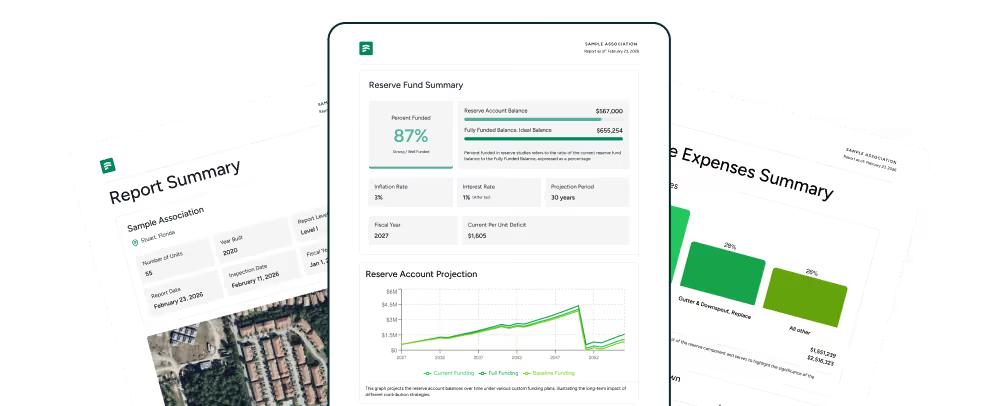
Update your budget to match the recommended reserve contributions and explain the change clearly to owners. Use the reserve study’s charts and projections to show how today’s contributions prevent future financial shocks and protect property values.
Step 5: Revisit the study regularly
Calendar the next update (typically 3-5 years out, or sooner after major projects) and build that cadence into your board’s governance practices. Treat the reserve study as a living planning document, not a one-time consultant report.
Key takeaways for Rhode Island boards and managers
- Rhode Island does not yet mandate reserve studies or minimum reserve balances, but its Condominium Act expects reserves to be part of honest budgeting and disclosure.
- Your real constraint is fiduciary duty: boards must make informed, prudent decisions about long-term upkeep and finances, even without a detailed statute telling them exactly how.
- A professional reserve study, updated every 3-5 years, is the most defensible way to show that your funding levels are based on evidence rather than guesswork.
Related reserve study resources for Rhode Island
Compare reserve study laws in nearby states, or find help running one for your association:
FAQ
If Rhode Island does not require reserve studies, why should our board pay for one?
Because your board is still legally required to act prudently and in the best interests of the association. A reserve study gives you credible data on upcoming capital costs and a funding plan to match. Without it, decisions about dues and projects are guesswork, which makes it much harder to defend the board’s actions if owners challenge a special assessment or neglected maintenance.
Does the Rhode Island Condominium Act apply to every association in the state?
The Rhode Island Condominium Act governs condominiums created after July 1, 1982, and can be voluntarily adopted by certain older projects. Pre-1982 condos that have not opted in, as well as non-condominium HOAs, may be governed by earlier statutes, corporate law, and their governing documents. In all cases, boards still owe duties of care and loyalty that make reserve planning essential.
Could Rhode Island introduce mandatory reserve study laws in the future?
Yes. Recent legislative activity and national trends show increasing attention to building safety, reserve funding, and long-term capital planning for shared-ownership communities.While no such mandate is in force today, boards that already follow reserve study best practices will have a much easier transition if requirements tighten.
How do lenders view Rhode Island associations with weak reserves?
Many lenders, including those selling loans to Fannie Mae and FHA, review an association’s reserve health during underwriting. Associations with no reserve study and chronically underfunded reserves can face scrutiny, and in some cases homes in those communities may become harder to finance. That directly affects marketability and resale values, even though state law does not set a numeric reserve minimum.
We are a small, self-managed HOA. Is a reserve study still worth it?
Yes. Smaller communities often have fewer homes over which to spread costs, which can make special assessments even more painful. A modestly priced reserve study tailored to your assets can prevent a single roof or road project from becoming a financial crisis for your owners.
The information contained on this page is provided for informational purposes only, and should not be construed as legal advice on any subject matter. You should not act or refrain from acting on the basis of any content included on this page without seeking legal or other professional advice. The contents of this page contain general information and may not reflect current legal developments or address your situation. We disclaim all liability for actions you take or fail to take based on any content on this report.
Get proposals from vetted reserve study professionals - with 30-year funding plans, powered by modern technology, and compared side by side for free.
Take the guesswork out of your reserve study
From site inspection to 30-year funding plan, PropFusion handles the entire reserve study - accurate, transparent, and built on modern technology that gives you full control over your reserves.