NC Reserve Study Requirements (2026)
North Carolina gives community associations broad authority to adopt budgets, collect assessments, and maintain reserve funds, but it stops short of requiring reserve studies or mandating a specific reserve funding level. For HOAs and condominium associations, the Planned Community Act and Condominium Act authorize budgets for revenues, expenditures, and reserves, while condo public offering statements must disclose whether reserves for repairs and replacements are included in the budget and in what amount.
See the full reserve study requirements by state guide
Because there is no statutory requirement to conduct reserve studies or fund reserves, financial outcomes vary widely between communities. Well-run associations in North Carolina still treat reserve planning as essential: they commission periodic reserve studies, keep contributions at levels that avoid chronic underfunding, and clearly communicate the plan to owners. This guide explains the current law, clarifies common misconceptions, and outlines practical steps for North Carolina boards that want stable, predictable reserve funding without waiting for the legislature to step in.
Legislation Link
North Carolina Planned Community Act
North Carolina Condominium Act
Are reserve studies legally required for HOAs and condos in North Carolina? No. Current summaries from the Community Associations Institute and other authoritative sources agree that North Carolina does not require associations to conduct reserve studies or to allocate funds for reserves under state law.
Does North Carolina law require HOAs or condos to fund a minimum level of reserves? No. The statutes authorize associations to adopt budgets with reserves but do not impose a specific minimum funding level. Reserve contributions are driven by governing documents, board policy, and best practice rather than a fixed statutory percentage.
What does North Carolina require about disclosure of reserves in condo public offering statements? For condominiums, the public offering statement must disclose the amount included in the budget as a reserve for repairs and replacements, or clearly state that nothing is included, and must also disclose the amount and purpose of any other reserves. This is intended to give purchasers a transparent view of how the developer has planned for future capital expenses.
If reserve studies are not mandated, how often should a North Carolina association get one? Most North Carolina communities follow industry norms and update reserve studies every three to five years or after major projects, even though there is no statutory cycle. This cadence keeps costs and component conditions current and supports more accurate budgets.
Need a reserve study in North Carolina? Compare multiple reserve study proposals for free.
Get proposals from vetted reserve study professionals - with 30-year funding plans, powered by modern technology, and compared side by side for free.
Legal framework: what North Carolina law actually says
North Carolina regulates community associations primarily through two statutes: the North Carolina Condominium Act (Chapter 47C) and the North Carolina Planned Community Act (Chapter 47F). Both give associations clear authority to budget for reserves, but neither forces them to do so or to perform reserve studies.
Under § 47C-3-102, a condominium unit owners’ association may “adopt and amend budgets for revenues, expenditures, and reserves and collect assessments for common expenses from unit owners.” (Justia)
The Planned Community Act mirrors this language for HOAs in § 47F-3-102, authorizing the owners’ association to adopt budgets that include reserves and to assess owners accordingly.
For condominiums, the developer’s public offering statement must also disclose the association’s projected budget and specifically state how much, if anything, is being allocated as a reserve for repairs and replacements, along with the amount and purpose of any other reserves.
This gives buyers visibility into whether long-term needs have been planned for or largely ignored at the outset.
Crucially, multiple independent summaries confirm that there is no statutory requirement in North Carolina to perform a reserve study and no statutory requirement to fund reserves at any particular level. That legal gap is the starting point for smart boards: the state is not forcing you to act, but the market will punish you if you do nothing.
What is required vs. what is best practice
From a purely legal perspective today:
- Associations must prepare annual budgets and follow statutory notice and ratification procedures under the Planned Community Act and Condominium Act.
- Condominium developers must disclose whether reserves are included in the initial budget and in what amount, plus any other reserves.
- Associations may, but are not compelled to, budget for reserves and conduct reserve studies.
Best practice goes far beyond these minimums:
- Commission a professional reserve study to identify all major components, estimate remaining useful lives, and project replacement costs.
- Use that study to build a long-range (20-30 year) funding plan, not just a one-year budget.
- Target at least lender-friendly contribution levels (often around 10 percent of the operating budget) unless your study justifies a different approach.
Without this kind of planning, North Carolina associations tend to rely on special assessments, deferred maintenance, or short-term borrowing, all of which create owner frustration and reputational risk.

Reserve funds for HOAs (planned communities)
Most non-condo subdivisions fall under the Planned Community Act. Here, § 47F-3-102 gives the owners’ association the explicit power to adopt budgets with reserves and collect corresponding assessments.
Key implications for HOAs:
- You are allowed, but not required, to create and fund a reserve account.
- The statute does not set a minimum reserve percentage, leaving room for board judgment and owner expectations.
- Annual budgets must still be prepared and submitted to owners for ratification, so owners will see whether you are funding reserves or not.
For a typical North Carolina HOA with streets, roofs, clubhouses, pools, and landscaping, failing to fund reserves is technically permissible but practically reckless. Components will still age, and replacement costs will still arrive; reserves are simply the mechanism to spread those costs fairly over time.
Reserve funds for condominiums
Condominiums are governed by Chapter 47C. The powers of the unit owners’ association mirror those of HOAs: budgets may include reserves, and assessments may be levied accordingly.
Where condos differ is at the sales stage. The public offering statement must:
- Include the association’s projected budget.
- Show the amount, if any, included as reserves for repairs and replacements.
- Provide a statement of the amount and purpose of any other reserves.
If the developer sets reserves at zero, that decision must be plainly disclosed. Purchasers then walk in knowing whether the community has a head start on future roof, façade, and mechanical work or whether they are effectively starting from scratch.
After turnover, condo boards face the same choice as HOAs: either continue or enhance reserve contributions based on a formal reserve study, or risk significant special assessments later. In multi-story buildings or coastal communities facing higher structural and weather-related risks, the cost of underfunding can be severe.
North Carolina and reserve studies: why “not required” doesn’t mean “not needed”
CAI’s state law charts and several national summaries are clear: North Carolina does not require reserve studies and does not require a specific reserve funding level.
However, reserve studies still matter because:
- Lenders and insurers increasingly scrutinize reserves and deferred maintenance before extending loans or coverage.
- North Carolina’s climate (humidity, storms, and in some areas coastal exposure) accelerates wear on roofs, siding, decks, and infrastructure.
- Owners are more sensitive to surprise assessments and want predictable dues.
Industry standards for communities without a statutory requirement generally recommend:
- A full reserve study every three to five years, with lighter updates in between if needed.
- Reserve contributions that align with the study’s cash-flow projections, often in the range of 10-25 percent of the operating budget depending on the age and complexity of the property.
The fact that the statute is silent simply means the responsibility for prudence rests squarely on the board and its advisors.
Practical steps for North Carolina boards
To make this concrete, a North Carolina HOA or condo board can follow a straightforward process:
Step 1: Confirm your baseline
- Review your declaration, bylaws, and any existing reserve schedules to see whether reserves or studies are already required internally.
- Ask association counsel how the Planned Community Act or Condominium Act applies to your specific community and whether any pre-1999 or transition provisions affect you.
Step 2: Commission a reserve study
- Engage a reserve study provider or engineering firm with North Carolina experience.
- Provide financial statements, prior budgets, and any capital project history so the study reflects real conditions.
Step 3: Adopt a realistic funding plan
- Use the study’s recommended contribution range as your target.
- Stress-test scenarios: What happens if you defer a major project? What if inflation is higher than assumed?
Step 4: Integrate reserves into the annual budget
- Include reserve contributions as a non-negotiable line item, not a leftover.
- Follow statutory notice and ratification procedures so owners can see the plan and understand why contributions are at their chosen level.
Step 5: Communicate clearly with owners
- Share a summary of the reserve study, the big upcoming projects, and how your funding plan avoids shock assessments.
- Remind owners that strong reserves protect property values and make it easier for buyers to obtain financing.
Related reserve study resources for North Carolina
Compare reserve study laws in nearby states, or find help running one for your association:
FAQ
Does North Carolina require HOAs or condos to perform reserve studies?
No. Current state law does not mandate reserve studies for HOAs or condominium associations. Boards are free to commission studies as a matter of best practice, but there is no statutory requirement to do so.
Are North Carolina associations required to maintain a specific reserve fund level?
No. The Planned Community Act and Condominium Act authorize associations to adopt budgets with reserves and collect assessments, but they do not set a minimum reserve percentage or balance. Funding levels are determined by governing documents, board judgment, and market expectations.
What must condominium developers disclose about reserves in North Carolina?
Condo public offering statements must disclose the association’s budget and specifically show the amount, if any, allocated as reserves for repairs and replacements, as well as the amount and purpose of any other reserves. If no reserves are funded, that fact must be stated clearly.
How often should a North Carolina HOA or condo update its reserve study?
Most communities without statutory mandates, including those in North Carolina, follow an industry standard of a full reserve study every three to five years, with interim updates as needed after major projects or cost changes.
Can a North Carolina association decide not to fund reserves at all?
Legally, state law does not force you to fund reserves, but choosing not to do so can lead to large special assessments, deferred maintenance, and lender concerns. Before significantly reducing or eliminating reserve contributions, boards should consult legal counsel and their reserve professional to understand the risks.
How does reserve planning in North Carolina compare with states that have reserve study laws?
Unlike states such as Washington, Oregon, or Utah that impose reserve analysis requirements, North Carolina relies entirely on best practice and market pressure. Boards that proactively commission studies and fund reserves to recommended levels can match or exceed the financial stability seen in those more heavily regulated states
How can PropFusion help North Carolina boards manage reserves more effectively?
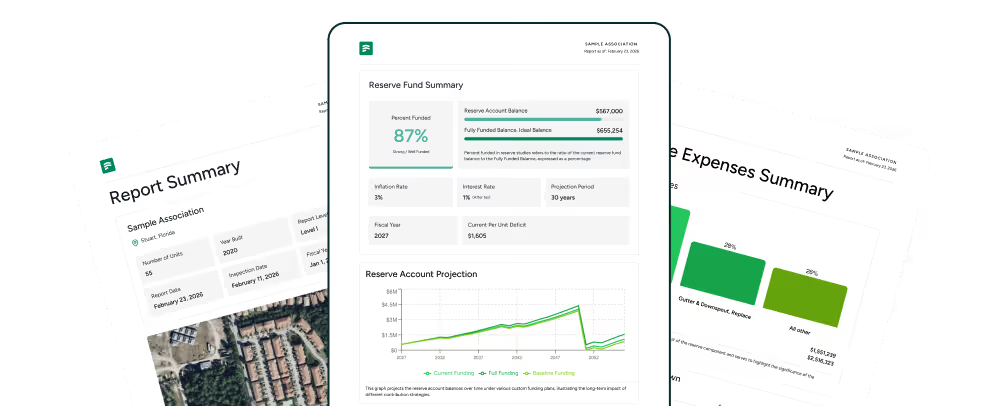
PropFusion lets North Carolina HOAs and condos centralize their reserve data, run funding scenarios, and connect with experienced reserve study providers. That makes it easier to move from a one-off PDF study to an ongoing reserve planning process that aligns with your annual budgets and owner expectations.
The information contained on this page is provided for informational purposes only, and should not be construed as legal advice on any subject matter. You should not act or refrain from acting on the basis of any content included on this page without seeking legal or other professional advice. The contents of this page contain general information and may not reflect current legal developments or address your situation. We disclaim all liability for actions you take or fail to take based on any content on this report.
Get proposals from vetted reserve study professionals - with 30-year funding plans, powered by modern technology, and compared side by side for free.
Take the guesswork out of your reserve study
From site inspection to 30-year funding plan, PropFusion handles the entire reserve study - accurate, transparent, and built on modern technology that gives you full control over your reserves.