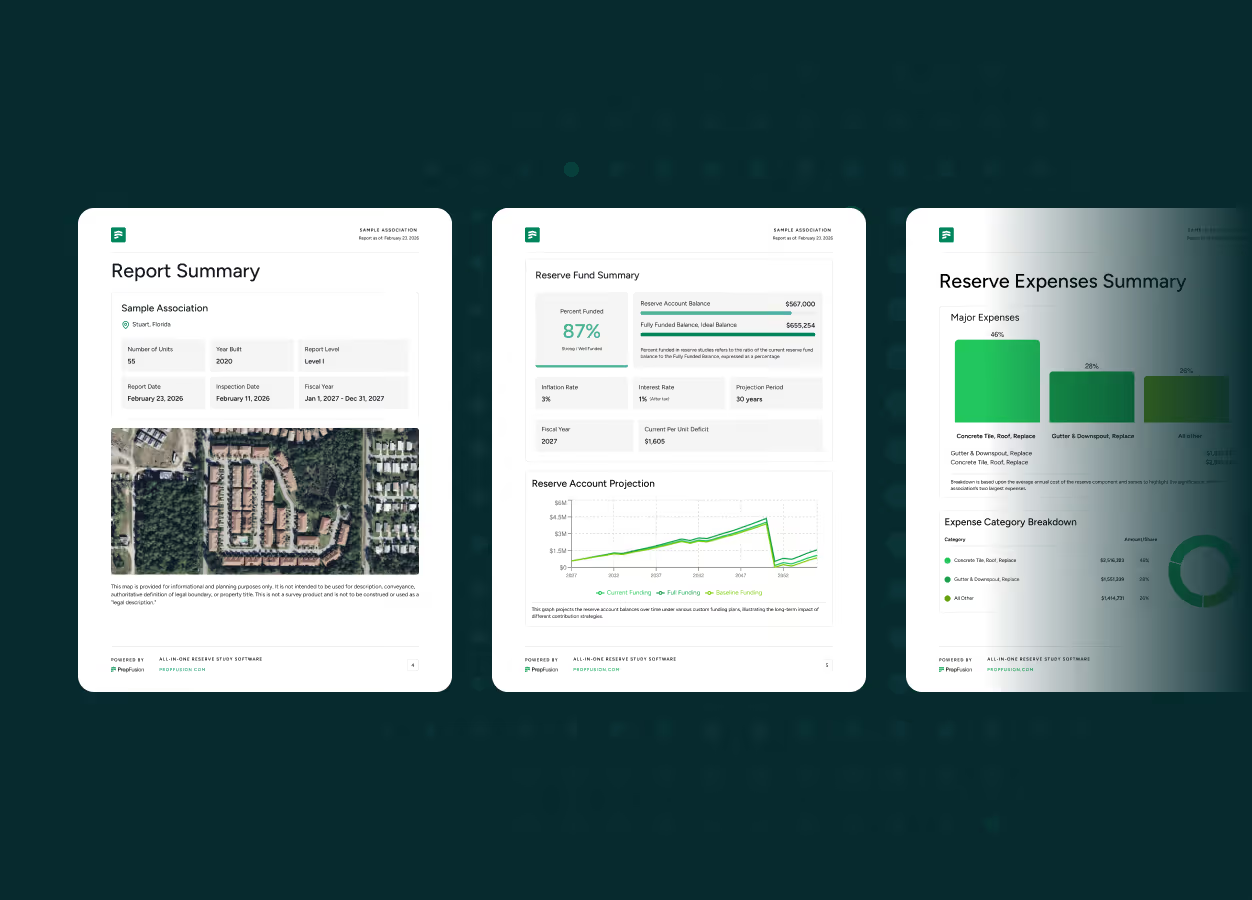
NM Reserve Study Requirements (2026)
New Mexico’s laws give homeowner and condominium associations broad authority over their budgets and reserve funds but stop short of requiring formal reserve studies or specific minimum reserve balances. That can leave boards wondering how much they are expected to set aside and what “good practice” looks like in this state.
See the full reserve study requirements by state guide
This guide explains how the New Mexico Condominium Act and the Homeowner Association Act affect reserve planning, what is and is not legally required, and how boards can still use professional reserve studies to manage long term capital projects responsibly. It builds on the high level overview from your current New Mexico law page and goes deeper into statutes, disclosure obligations, and practical planning steps for boards and managers.
Legislation Link
New Mexico Homeowner Association Act
Are reserve studies legally required for HOAs or condominiums in New Mexico? No. New Mexico does not require HOAs or condominium associations to commission reserve studies or update them on a fixed schedule. State law focuses on budgets, disclosure, and governance rather than prescribing how reserves must be calculated or funded. Industry standards, however, strongly recommend periodic reserve studies to manage long term repair and replacement costs.
Does New Mexico law require associations to maintain a certain level of reserve funding? No. Neither the New Mexico Condominium Act nor the Homeowner Association Act sets minimum reserve balances or contribution formulas. Associations may adopt budgets that include reserves and must disclose whether reserves are being funded, but the specific funding level is left to the board’s judgment under its fiduciary duty.
Which statutes govern HOAs and condominiums in New Mexico for reserve planning purposes? Condominiums are primarily governed by the New Mexico Condominium Act, N.M. Stat. §§ 47-7A-1 to 47-7D-20, while planned communities and single family subdivisions are governed by the Homeowner Association Act, N.M. Stat. §§ 47-16-1 et seq. Many associations are also organized as nonprofit corporations, so the New Mexico Nonprofit Corporation Act (N.M. Stat. §§ 53-8-1 et seq.) shapes board fiduciary duties that apply to reserve decisions.
How often should a New Mexico association update its reserve study if it decides to have one? While New Mexico law is silent on frequency, most reserve professionals recommend a full reserve study every three to five years, with lighter updates in between, or sooner if there are major changes in components, project costs, or the association’s financial condition. Following these standards helps boards show that they acted prudently even without a statutory mandate.
Need a reserve study in New Mexico? Compare multiple reserve study proposals for free.
Get proposals from vetted reserve study professionals - with 30-year funding plans, powered by modern technology, and compared side by side for free.
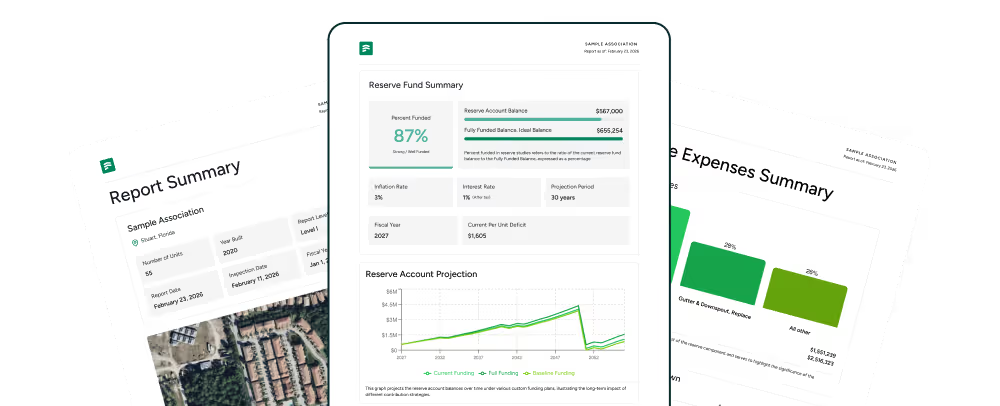
Overview of New Mexico HOA and Condo Reserve Laws
New Mexico is a “best practices” state for reserves rather than a “mandate” state. There is no statute that forces homeowner or condominium associations to conduct reserve studies, fund reserves to a particular percentage, or follow a specific funding model.
Instead, the law gives associations broad authority to adopt budgets, collect assessments, and disclose their financial condition to owners and purchasers.
For condominiums, the New Mexico Condominium Act (N.M. Stat. §§ 47-7A-1 to 47-7D-20) governs how associations are formed, how common expenses are allocated, and what must be disclosed to buyers. For planned communities and typical HOAs of single family homes, the Homeowner Association Act (N.M. Stat. §§ 47-16-1 et seq.) sets out duties of the association and board, budget processes, disclosure requirements, and enforcement mechanisms.
Many associations are also organized as nonprofit corporations under the New Mexico Nonprofit Corporation Act, which adds a general duty of care and loyalty for board members when they make financial decisions, including reserve funding.
The result is that while no one is forcing your board to commission a reserve study, the legal framework still expects you to plan ahead, disclose honestly, and manage the association’s finances prudently. That is where reserve studies and disciplined reserve funding come in.
What the New Mexico Condominium Act Says About Reserves
Although the Condominium Act does not use the term “reserve study,” it contains several provisions that directly affect reserve planning for condominiums.
First, the Act gives the unit owners’ association broad powers to adopt and amend budgets for revenues, expenditures, and reserves, and to collect assessments to fund those budgets. In other words, it explicitly authorizes you to build reserves into your financial plan.
Second, the Act requires disclosure to purchasers. The disclosure statement and resale certificates must state the amount, or absence, of any money included in the budget as a reserve for repairs and replacements and any other reserves.
If an association chooses not to fund reserves, that decision is not hidden in the fine print. Buyers are entitled to see that the budget either does or does not include reserve contributions.
These provisions do not force you to fund reserves, but they make clear that:
- You may and should consider reserves as part of your budget.
- You must disclose your reserve practices to purchasers, which means underfunded or unfunded reserves can directly affect marketability and perceived risk.

New Mexico Homeowner Association Act and Board Duties
The Homeowner Association Act applies to most non-condominium HOAs in New Mexico. It addresses the creation of associations, the content of governing documents, record keeping, budgets, board composition, meetings, and the enforcement of covenants. While it does not set specific rules for reserves, there are several provisions that matter for reserve planning.
Key points for reserves include:
- The association must keep financial records and make them available to members.
- The board is responsible for adopting budgets and managing common expenses.
- Board members must exercise ordinary and reasonable care and avoid undisclosed conflicts of interest when handling association finances.
If your HOA chooses to ignore obvious long term capital needs and chronically underfunds reserves, it may be difficult to argue that the board exercised “ordinary and reasonable care” when large special assessments become necessary. Tying your budget decisions to a professional reserve study and updating it periodically is one of the strongest ways to demonstrate that the board acted prudently.
Are Reserve Studies or Reserve Funds Required in New Mexico?
From a statutory perspective, the answer is currently no. Multiple national and state level surveys, including the Community Associations Institute’s summary of state reserve fund laws, confirm that New Mexico does not require HOAs or condominium associations to prepare reserve studies or to fund reserves to any specific threshold.
However, “not required” is not the same as “unnecessary.” The absence of a mandate simply means the legislature has left these decisions to boards and owners, guided by fiduciary duty, industry standards, and the association’s governing documents.
Many declarations and bylaws already require some form of reserve funding, even when the statutes do not. If your community documents contain language about reserves, you must follow those requirements unless the documents are properly amended.
How Often Should New Mexico Associations Update a Reserve Study?
Because New Mexico law is silent on frequency, boards should follow widely recognized industry standards:
- Commission a full reserve study with a site inspection every three to five years.
- Obtain interim “update” studies in between, particularly after major projects or changes in costs.
- Revisit funding plans annually when you adopt the budget.
This cadence is consistent with guidance from reserve study professionals and national best practices. It helps you keep component inventories, useful life estimates, and cost projections in line with reality so that budgets and reserve contributions remain credible.
In fast growing or aging communities, three years is often preferable to five. Associations with very large common element inventories or amenities (elevators, pools, roofs, roadways) should err on the side of more frequent updates, even though the statute does not compel it.
Reserve Funding Levels and Budget Strategy in New Mexico
Without a statutory formula, boards must decide how much to contribute to reserves each year. Common best practices include:
- Targeting a funding level where reserves are at least 70 percent of the “fully funded” level, recognizing that some communities may need to aim higher depending on risk tolerance.
- Planning contributions so that there are no major spikes in regular assessments, even as big projects (roof replacements, paving, mechanical systems) come due.
- Avoiding the trap of balancing the operating budget by slashing reserve contributions. Short term savings almost always translate into larger special assessments and deferred maintenance later.
Budget transparency is critical in New Mexico because of the disclosure obligations under both the Condominium Act and the Homeowner Association Act. Buyers and lenders increasingly ask to see reserve balances and funding plans, even without a statutory requirement.
Lenders on condominium loans often look for evidence that reserves are being funded and may require a certain percentage of the budget to be allocated to reserves as a condition for underwriting.
Fiduciary Duty and Risk for New Mexico Boards
Even in a state without reserve mandates, board members owe fiduciary duties to the association. Under the Homeowner Association Act and the Nonprofit Corporation Act, directors must act in good faith, in the best interests of the association, and with the care that an ordinarily prudent person would exercise in a similar position.
Courts interpreting the New Mexico Condominium Act have treated the association as responsible for managing and assessing common expenses consistently with the declaration and statutory framework.
Practically, that means:
- Ignoring obvious deterioration in roofs, roads, or building systems can be risky.
- Making budget decisions without any long term capital planning exposes the community to avoidable special assessments.
- A reasonable reliance on professional advice (such as an engineer prepared reserve study) is one of the clearest ways to show that the board acted prudently.
If an association repeatedly opts for short term savings at the expense of predictable funding, owners who face large emergency assessments may question whether the board met its duty of care, even if there is no explicit reserve statute to point to.
Practical Steps to Commission a Reserve Study in New Mexico
For boards ready to move beyond a minimal compliance mindset, the process typically looks like this:
- Gather documents: governing documents, past budgets, financial statements, maintenance records, construction drawings, and any prior reserve analyses.
- Define scope: clarify whether you want a full study with site inspection, an update of a prior study, or a focused review of a subset of components.
- Select a qualified provider: look for a firm experienced with New Mexico associations and the types of buildings and amenities your community has. Check credentials, sample reports, and references.
- Schedule the site visit: accompany the analyst so you can discuss known problem areas, prior repairs, and your long term goals for the community.
- Review the draft report: verify that major components are included, cost assumptions are realistic for New Mexico markets, and the recommended funding plans align with your risk tolerance.
- Integrate into your budget: use the recommended funding plan as the backbone of your annual and multi year budgets, adjusting as needed for owner affordability and external constraints.
- Communicate with owners: explain clearly why reserves matter, how the study was prepared, and what it means for assessments and long term community health.
Following a structured process like this positions the board as proactive and transparent, not reactive and opaque, which aligns well with the disclosure goals of New Mexico law even in the absence of reserve mandates.
How PropFusion Helps New Mexico Boards and Managers
Because New Mexico law leaves so much discretion to associations, your processes and tools make the difference between disciplined capital planning and guesswork. A platform like PropFusion can help by:
- Centralizing your reserve study, component list, and funding plans so board members can see the long term picture in one place.
- Allowing you to run what-if scenarios when costs change, projects are delayed, or owners push back on assessment increases.
- Tracking reserve contributions and balances against the targets recommended in your study.
- Making it easier to share key reserve and budget information with owners, managers, and prospective buyers in a clear, professional format.
That combination of statutory understanding and strong tooling is often what separates communities that glide through major projects from those that lurch from crisis to crisis.
Quick Checklist for New Mexico Associations
For a New Mexico HOA or condominium association, a practical approach is:
- Confirm which statutes apply to your community (Condominium Act, Homeowner Association Act, Nonprofit Corporation Act).
- Review your declaration and bylaws for any language requiring reserve funding.
- Commission a professional reserve study if you do not already have one, or if your current study is older than five years.
- Use the study to build a multi year funding plan and integrate it into your budget process.
- Disclose your reserve practices clearly in owner communications and resale documents.
- Revisit the study and funding plan regularly as projects are completed and costs change.
Related reserve study resources for New Mexico
Compare reserve study laws in nearby states, or find help running one for your association:
FAQ
If New Mexico does not require reserve studies, why should our association pay for one?
A reserve study is a planning tool, not a legal box to tick. It helps you identify major common element costs before they become emergencies, smooth out assessments over time, and show owners and lenders that the board is acting prudently. In a state where the law leaves decisions to the association, having a professional study is one of the strongest ways to demonstrate that the board met its duty of care.
Our governing documents say we should maintain a reserve fund. Can we simply vote not to do it?
Probably not without amending the documents. If your declaration or bylaws obligate the association to maintain reserves or fund them in a particular way, the board is expected to follow that requirement. Choosing to ignore it could conflict both with your own governing documents and with the duty of care and good faith imposed by New Mexico law.
Do New Mexico resale disclosures have to show our reserve balance?
For condominiums, the disclosure statement and resale certificates must state the amount included in the budget as a reserve for repairs and replacements or clearly state that there is no such amount. For HOAs governed by the Homeowner Association Act, the association must provide various financial disclosures to purchasers. In practice, buyers and their lenders often ask specifically about reserve balances, so underfunded reserves can affect marketability even if the statute does not require a specific number.
Are there any New Mexico laws that limit how we can invest our reserve funds?
New Mexico’s HOA and condominium statutes do not provide detailed investment rules for reserves. Many associations instead follow a conservative policy adopted in their governing documents or board resolutions, focusing on safety and liquidity, such as FDIC insured accounts or ladders of short term CDs or Treasuries. Boards should avoid speculative investments and, when in doubt, consult with legal and financial advisors familiar with New Mexico associations.
How do lenders view reserve funding for New Mexico condominiums?
Even without state mandates, many mortgage lenders and secondary market players look at reserves when deciding whether to finance units in a condominium. They may ask for reserve balances, the percentage of the budget going to reserves, and whether the association has a current reserve study. Weak reserve practices can lead to extra scrutiny, conditions, or even denials, which ultimately affects property values and owner satisfaction.
Does the New Mexico Homeowner Association Act apply to older communities that predate it?
Generally, the Homeowner Association Act applies to homeowner associations in New Mexico, including many that existed before the Act, although there are nuances around partial applicability and specific sections. Associations should review their situation with New Mexico counsel, but as a practical matter, most boards assume that the Act’s governance and disclosure provisions apply and manage their finances, including reserves, accordingly.
How often should a small New Mexico association with limited common elements revisit its reserve planning?
Even in smaller communities, it is wise to review reserve needs annually during the budget process and to obtain a professional reserve study at least every five years, or sooner if there are major changes in components, construction quality, or costs. The fact that common elements are fewer does not eliminate long term obligations; it simply makes it more important to plan carefully because a single failure can be financially disruptive.
The information contained on this page is provided for informational purposes only, and should not be construed as legal advice on any subject matter. You should not act or refrain from acting on the basis of any content included on this page without seeking legal or other professional advice. The contents of this page contain general information and may not reflect current legal developments or address your situation. We disclaim all liability for actions you take or fail to take based on any content on this report.
Get proposals from vetted reserve study professionals - with 30-year funding plans, powered by modern technology, and compared side by side for free.
Take the guesswork out of your reserve study
From site inspection to 30-year funding plan, PropFusion handles the entire reserve study - accurate, transparent, and built on modern technology that gives you full control over your reserves.