Nevada Reserve Study Requirements (2026)

Nevada is one of the strictest states in the U.S. when it comes to HOA and condominium reserve funding. Under Nevada’s Common-Interest Ownership Act, most common-interest communities must maintain “adequate” reserve funds and commission regular reserve studies to make sure there is enough money to repair, replace, and restore major common-area components over time.
See the full reserve study requirements by state guide
This guide explains the key Nevada reserve study and reserve fund requirements in plain language. You will learn which associations must comply, how often reserve studies are required, what must be included in the study, how “adequate reserves” are defined, what deadlines apply for filing Form 609 with the Nevada Real Estate Division, and how tools like PropFusion can help you stay compliant and avoid special assessments or regulatory issues.
Legislation Link
Nevada Revised Statutes, NRS 116.31152
Nevada Revised Statutes, NRS 116.3115
Are reserve studies required for all HOAs and condos in Nevada? In most cases, yes. Nevada Revised Statutes require the executive board of a common-interest community governed by NRS 116 to conduct a reserve study of major common-area components at least once every five years, with annual reviews of the study’s sufficiency. Small associations in certain rural counties may be allowed to use a qualified non-permitted preparer, but they are still required to have a study.
How often must a Nevada HOA update its reserve study? Nevada law requires a full reserve study at least every five years, starting from the date of the prior on-site inspection. The board must also review the study at least annually, and Nevada regulations clarify that a new full study must be adopted within five years of the adoption of the previous one.
Who can prepare a reserve study in Nevada? As a rule, reserve studies must be prepared by a person holding a Nevada “reserve study specialist” permit under Chapter 116A, unless the association has 20 or fewer units and is located in a county below the statutory population threshold, in which case the executive board may select a qualified person it deems competent.
What does “adequate reserves” mean under Nevada law? “Adequate reserves” means the association has set aside reserve funds, on a reasonable basis, to cover the long-term repair, replacement, and restoration costs of major components the association is obligated to maintain. Nevada law allows boards to adopt an actuarially sound funding plan and to levy reasonable assessments to achieve adequacy, and professional commentary stresses that reserves must not be used as a secondary operating account.
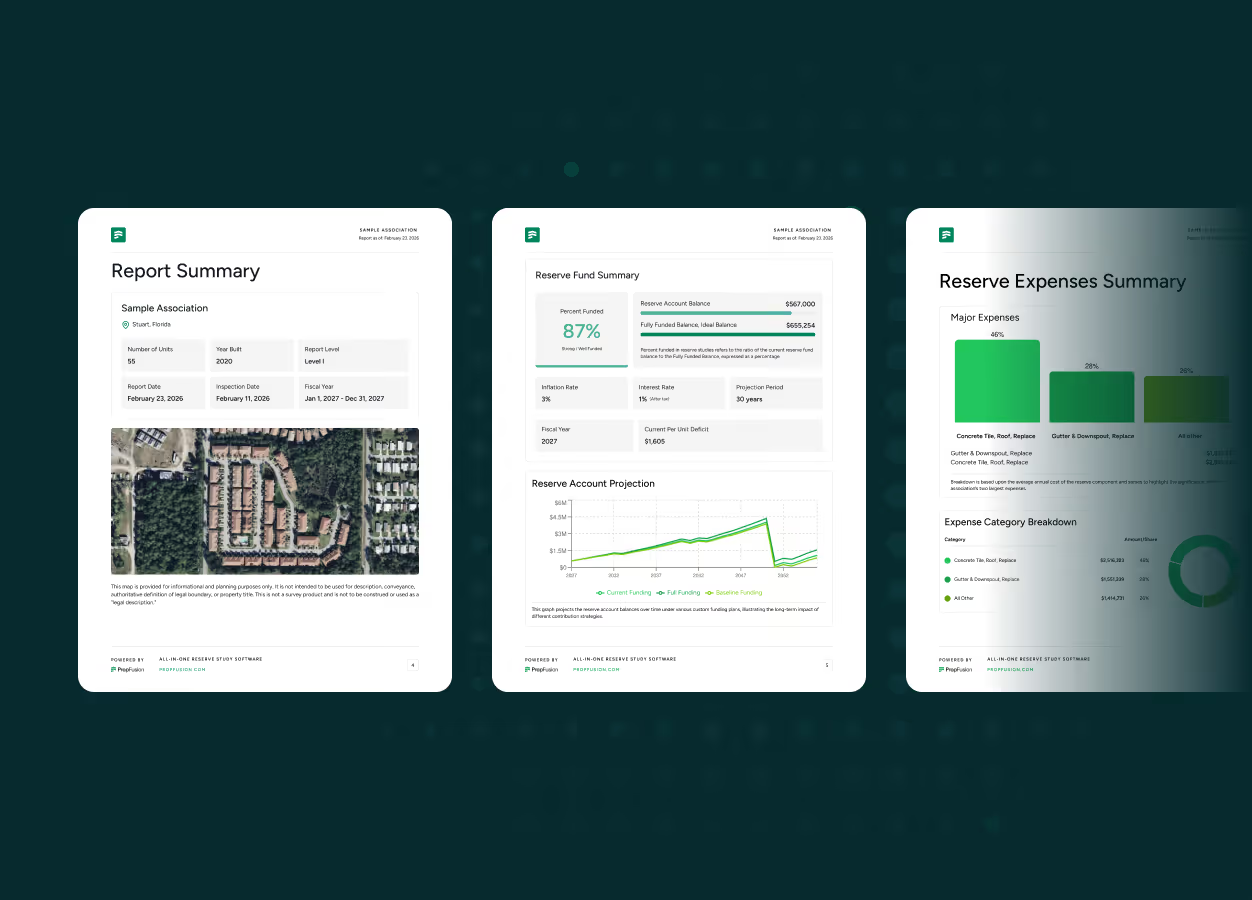
Need a reserve study in Nevada? Compare multiple reserve study proposals for free.
Get proposals from vetted reserve study professionals - with 30-year funding plans, powered by modern technology, and compared side by side for free.
Overview of Nevada’s reserve study and reserve fund framework
Nevada’s Common-Interest Ownership Act (NRS 116) sets out a detailed framework for how common-interest communities - including most HOAs and condominium associations - must plan and pay for long-term capital repairs. Two statutes sit at the center of that framework:
- NRS 116.3115, which requires associations to establish adequate reserves for major components and limits how reserve money may be used.
- NRS 116.31152, which requires the executive board to commission regular reserve studies, review those studies annually, and adjust the funding plan as needed.
Nevada Administrative Code Chapter 116 and Real Estate Division guidance fill in the details by defining “reserve study,” specifying timing for future studies, and explaining how associations must file a summary with the Division on Form 609 and report reserve information to owners and buyers.
Which associations must comply
Most planned communities and condominium associations in Nevada fall under NRS 116. If your community is a “common-interest community” with shared common elements, a recorded declaration, and an association that levies assessments, it is very likely subject to these reserve requirements, whether it is a traditional HOA, condo association, townhome community, or master-planned community.
There are limited exemptions and nuances for very small associations or certain types of developments. Because the consequences of getting this wrong can be significant, boards should confirm with association counsel or a Nevada-licensed community manager whether their community is fully subject to NRS 116 reserve provisions.
How often Nevada HOAs must conduct reserve studies
Under NRS 116.31152, the executive board must:
- Cause a study of the reserves to be conducted at least once every five years, covering the major components of the common elements and any other portions of the community the association must maintain, repair, replace, or restore.
- Review the results of that study at least annually to determine whether reserve levels are sufficient.
- Make any necessary adjustments to the association’s funding plan to provide adequate funding for required reserves.
NAC provisions and Real Estate Division guidance provide additional timing detail. After a full reserve study with a site visit is conducted, the next full study must be commenced on or as close as practical to the same month and date as the previous on-site inspection, effectively locking associations into a consistent five-year cycle.
In practice, Nevada boards should treat the five-year window as a hard outer limit, not a target. Starting the process early gives room for site inspections, draft reviews, budget integration, and Form 609 filings without scrambling against statutory deadlines.
What must be included in a Nevada reserve study
Nevada law does not treat the reserve study as a simple “rule of thumb” schedule; it prescribes specific elements that must appear in the study. At minimum, the study must include:
- A summary of an inspection of the major common-area components and any other elements the association must maintain.
- Identification of major components with a remaining useful life of less than 30 years.
- An estimate of the remaining useful life for each of those components.
- An estimate of the cost to maintain, repair, replace, or restore each component during and at the end of its useful life.
- An estimate of the total annual assessments needed to cover those costs, factoring in existing reserve balances, and a funding plan that will provide adequate reserves over time.
Nevada Administrative Code also defines “reserve study” and outlines required disclosures, including the qualifications of the person conducting the study, assumptions used, limitations of the inspection, and any components excluded from the funding projection. This ensures boards and owners can understand both the numbers and the underlying methodology.
Adequate reserves and acceptable funding plans
Under NRS 116.3115, the association must establish adequate reserves, funded on a reasonable basis, for the repair, replacement, and restoration of major components.
Reserve money may only be used for those long-term capital purposes (e.g., roofs, roads, sidewalks, mechanical systems) and may not be treated as a backup operating or “slush” fund.(Justia Law)
The statute explicitly allows the board to comply via an actuarially sound funding plan that spreads costs over a period of years, as long as the plan ensures sufficient money is available when those components must be repaired or replaced.
In other words, Nevada does not require 100 percent funding overnight, but it does expect a rational, data-driven plan tied to the reserve study.
Importantly, NRS 116.3115 permits the board to levy necessary and reasonable assessments to carry out that funding plan, even without owner approval, when needed to establish adequate reserves. That means boards cannot simply ignore underfunding because owners dislike increases; the law gives boards the authority and responsibility to correct the problem.
Recent commentary and enforcement attention in Nevada highlight that regulators are increasingly focused on whether reserves are truly adequate rather than just whether a study exists.(Las Vegas Review-Journal)
Handling the reserve account and withdrawals
Nevada law also regulates how the reserve account is handled. Associations must maintain a separate reserve account and a separate reserve budget. Money in that account can be used only for the reserve purposes identified in the study and may not be diverted for routine operating costs.
NRS 116.31153 limits how money can be withdrawn from the reserve account, typically requiring the signatures of designated officers or directors and restricting who can initiate transfers.
These safeguards are designed to prevent misuse of reserve funds and to ensure that withdrawals align with the adopted reserve plan and component list. (FindLaw Codes)
Boards should adopt internal controls around reserve account access, including clear signatory policies, dual-control requirements, and regular reconciliations, and should confirm that any transfers or expenditures are traceable back to items in the reserve study.
Filing Form 609 and reporting reserve information
After the board receives a draft reserve study, Nevada regulations require the board to adopt the study and submit a summary of its results to the Nevada Real Estate Division on Form 609 within statutory deadlines.
Guidance from the Division indicates that associations must have a new reserve study performed every five years and that the board must both adopt the study and file the Form 609 summary within a fixed period after receiving the draft, with the statute also referencing a 45-day filing window after adoption.(red.nv.gov)
The Division’s “Understanding Reserve Studies” brochure further emphasizes that reserve information should be reviewed regularly at board meetings and included in resale packages, giving potential buyers a clear view of the community’s reserve “strength” before they purchase.(red.nv.gov)
In practical terms, Nevada boards should build a recurring calendar: commission the study early in the cycle, review drafts with management and the preparer, formally adopt the study, file Form 609, and then incorporate the updated funding plan into the annual budget and owner communications.
Common compliance pitfalls in Nevada
Despite the clarity of Nevada’s statutes, several recurring issues show up in enforcement actions and professional commentary:
- Treating the reserve study as a one-time exercise rather than a living planning tool reviewed annually.
- Letting the five-year cycle slip, especially after board or management turnover.
- Using reserve funds for operating shortfalls or projects not identified in the reserve study.
- Ignoring the funding plan and keeping assessments artificially low, resulting in chronic underfunding.
- Failing to submit Form 609 or to integrate reserve information into budgets and resale packages.
Addressing these issues is not just about avoiding fines or complaints; it is about preventing large special assessments, protecting property values, and demonstrating transparent, responsible governance to owners and buyers.
Practical checklist for Nevada boards and managers
To operationalize Nevada’s reserve requirements, boards and community managers can follow a simple workflow:
- Confirm that your community is subject to NRS 116 and that you understand any special provisions in your governing documents.
- Locate your current reserve study and Form 609 filing; note the date of the last on-site inspection and the adoption date.
- If you are approaching (or have passed) the five-year mark, schedule a new full reserve study with a Nevada-permitted reserve study specialist.
- Provide complete component inventories, maintenance history, and cost information to the preparer to improve accuracy.
- Review the draft study at the board level, focusing on component list, useful life, cost assumptions, and recommended funding levels.
- Adopt the study at an open board meeting and document the decision in the minutes.
- File the Form 609 summary with the Real Estate Division within the required time frame.
- Integrate the recommended funding plan into your annual budget and owner assessment schedule, and update your disclosures and resale packages.
- Each year, review the study, compare actual reserve balances to the plan, and adjust funding if necessary.
How PropFusion helps Nevada HOAs and condos stay compliant
While Nevada law does not require you to use software, trying to manage all of these requirements with spreadsheets and email chains is risky. PropFusion is designed to make compliance with Nevada’s reserve study framework simpler and more transparent.
Using PropFusion, Nevada associations and their managers can:
- Centralize all past and current reserve studies and component inventories in one place.
- Track five-year study deadlines and annual review dates with automated reminders.
- Model different funding scenarios (e.g., gradual increases versus front-loaded assessments) while staying aligned with “adequate reserve” requirements.
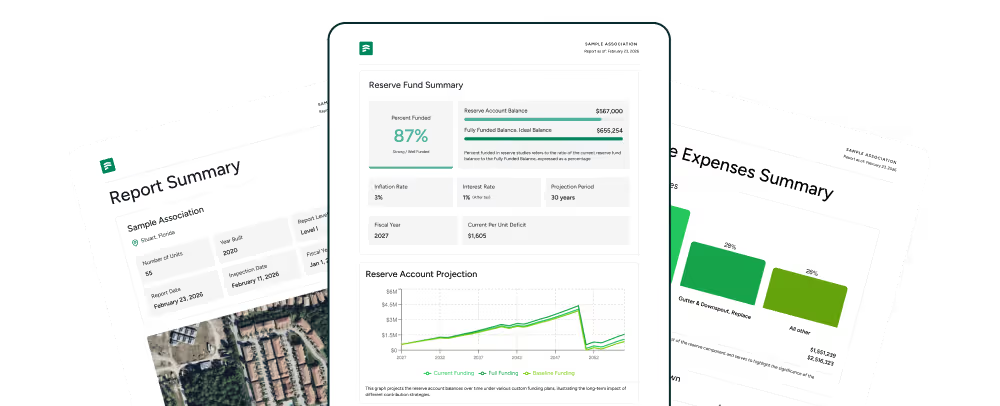
- Share clear dashboards and reports with board members and owners showing funding status and projected future needs.
By combining a solid understanding of Nevada’s legal requirements with a purpose-built platform, Nevada HOAs and condos can move beyond bare-minimum compliance and proactively manage their long-term capital obligations, reducing surprises and strengthening community finances.
Related reserve study resources for Nevada
Compare reserve study laws in nearby states, or find help running one for your association:
FAQ
Do Nevada reserve rules apply to both HOAs and condominiums?
Yes. The reserve study and reserve funding requirements generally apply to common-interest communities governed by NRS 116, which includes most planned communities and condominium associations in Nevada. Specific exemptions are narrow, so most boards should assume the statutes apply unless counsel advises otherwise.
Can owners vote to waive or delay reserve funding in Nevada?
No. While owners can certainly provide feedback through meetings and budget ratification processes, the statutes place the duty to establish adequate reserves on the executive board. The board may adopt an actuarially sound funding plan and levy reasonable assessments to carry it out; it cannot simply ignore underfunding because owners prefer lower dues.
What happens if our association skips a reserve study or stays underfunded?
Persistent non-compliance can draw scrutiny from the Nevada Real Estate Division and the Commission for Common-Interest Communities, particularly where underfunded reserves lead to large special assessments or disputes. Even without regulatory action, failing to follow NRS 116.3115 and NRS 116.31152 exposes the association to financial stress, owner dissatisfaction, and potential claims of breach of fiduciary duty.
Does Nevada specify a particular funding method (full, threshold, baseline)?
Nevada law does not mandate a specific funding label such as “full” or “threshold.” Instead, it requires that reserves be “adequate” and funded on a reasonable basis, and that the funding plan be actuarially sound and derived from the reserve study. Many Nevada reserve professionals will still describe plans using industry terms like full or threshold funding, but the legal test is whether your plan will provide sufficient money when components need to be replaced.
How should we choose a reserve study specialist in Nevada?
You should confirm that the preparer holds the required Nevada reserve study specialist permit (unless your association qualifies for the narrow small-association exception), has experience with communities similar to yours, follows Nevada Real Estate Division guidance, and provides clear, actionable funding recommendations. Using a specialist already familiar with Nevada’s legal framework and Form 609 requirements will make compliance much easier.
Can PropFusion replace our reserve study specialist?
No. PropFusion does not replace the statutory requirement to use a qualified reserve study specialist. Instead, it complements that work by storing your studies and Form 609 summaries, tracking deadlines, modeling funding scenarios, and connecting you with established Nevada professionals when you need a new study or update.
The information contained on this page is provided for informational purposes only, and should not be construed as legal advice on any subject matter. You should not act or refrain from acting on the basis of any content included on this page without seeking legal or other professional advice. The contents of this page contain general information and may not reflect current legal developments or address your situation. We disclaim all liability for actions you take or fail to take based on any content on this report.
Get proposals from vetted reserve study professionals - with 30-year funding plans, powered by modern technology, and compared side by side for free.
Take the guesswork out of your reserve study
From site inspection to 30-year funding plan, PropFusion handles the entire reserve study - accurate, transparent, and built on modern technology that gives you full control over your reserves.