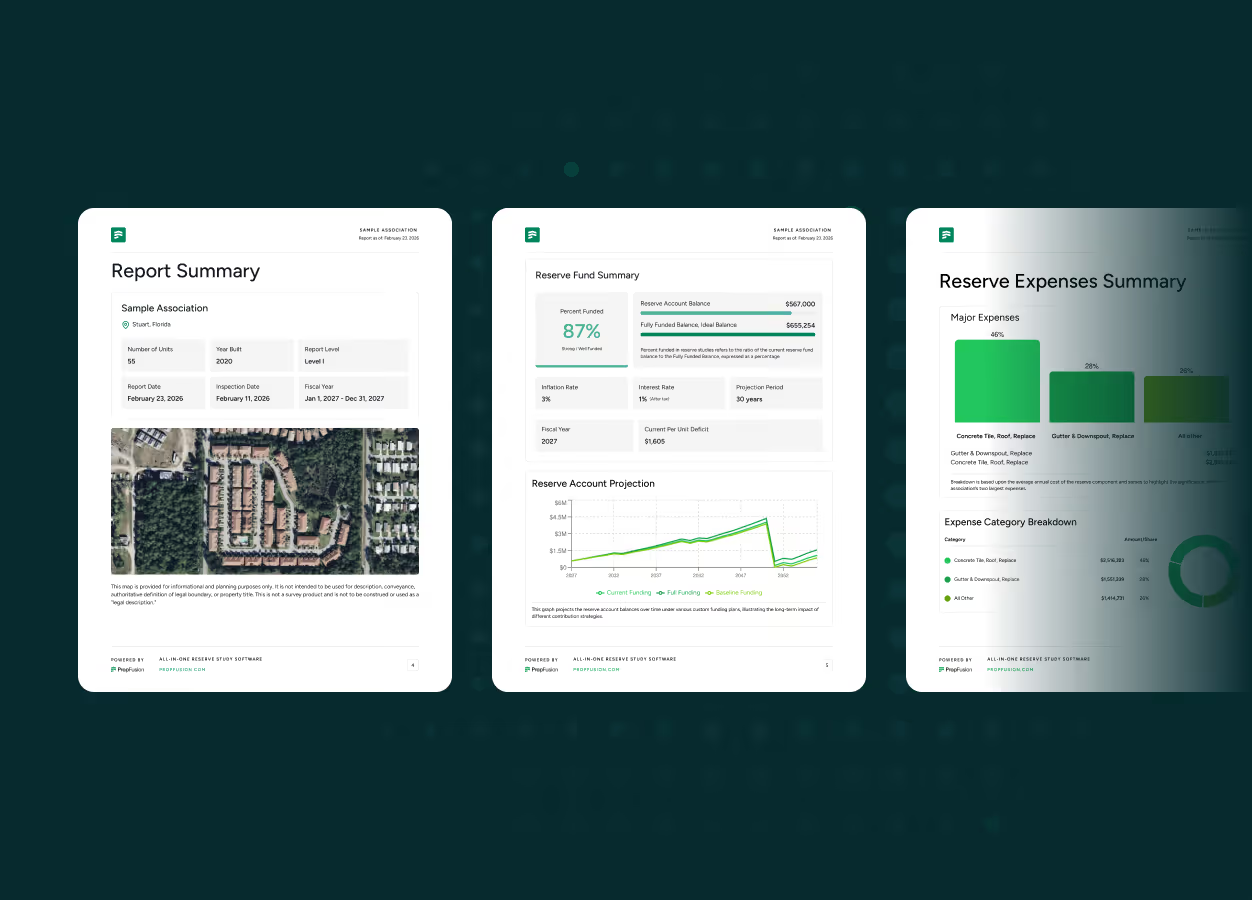
Nebraska Reserve Study Requirements (2026)
Nebraska law is straightforward on one key point: there is no statutory requirement for HOAs or condominium associations to conduct reserve studies or to fund reserves at any specific level. State statutes give unit owners associations the power to adopt budgets that include reserves, but they stop short of mandating how those reserves must be calculated or maintained.
See the full reserve study requirements by state guide
That does not mean reserves are optional in practice. Boards in Nebraska still operate under the Nebraska Condominium Act and the Nebraska Nonprofit Corporation Act, both of which expect directors to manage the association’s affairs prudently. This guide builds on PropFusion’s existing Nebraska reserve fund page and provides a deeper look at what the law actually says, what it does not say, and how to design a professional reserve study and funding plan that protects your community over the long term.
Legislation Link
Nebraska Condominium Act - Neb. Rev. Stat. §§ 76-825 to 76-894
Neb. Rev. Stat. § 76-860 - Unit owners association; powers
Nebraska Nonprofit Corporation Act - Neb. Rev. Stat. § 21-1901 et seq.
Are reserve studies required by law in Nebraska? No. Community Associations Institute’s latest summaries confirm that Nebraska has no statutory requirement to conduct reserve studies and no statutory requirement to fund reserves.
Does Nebraska law require HOAs or condos to keep a minimum reserve fund? No. Nebraska statutes do not set any minimum reserve balance or contribution formula. They give unit owners associations the power to adopt budgets that include reserves, but they do not prescribe an amount.
Which laws govern Nebraska HOAs and condominium associations? Most Nebraska HOAs are organized as nonprofit corporations subject to the Nebraska Nonprofit Corporation Act, while condo associations are governed by the Nebraska Condominium Act. These laws define association powers and board duties but are silent on reserve study frequency or mandatory reserve levels.
How often should a Nebraska community update its reserve study? Because Nebraska law is silent on timing, associations follow industry standard guidance: complete a full reserve study at least once and then update it every 3 to 5 years, or sooner after major projects or cost spikes.
Need a reserve study in Nebraska? Compare multiple reserve study proposals for free.
Get proposals from vetted reserve study professionals - with 30-year funding plans, powered by modern technology, and compared side by side for free.
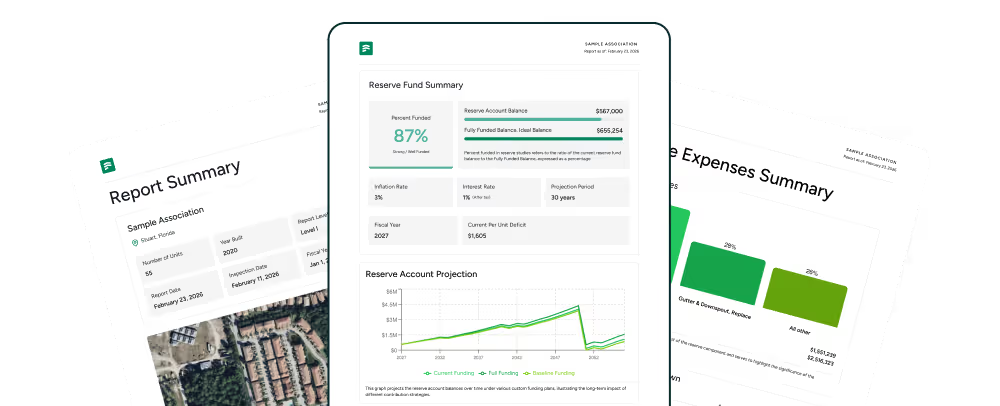
Nebraska’s legal framework for reserves
In Nebraska, there is no single “HOA Act” that sets reserve funding rules. Instead, community associations operate under a combination of:
- The Nebraska Condominium Act (Neb. Rev. Stat. §§ 76-825 to 76-894) for condominium properties, which governs creation, management, common expenses, and association powers.
- The Nebraska Nonprofit Corporation Act (Neb. Rev. Stat. § 21-1901 et seq.) for most incorporated HOAs and condo associations, which defines director duties and general corporate governance but does not mention reserve studies specifically.
Under the Nebraska Condominium Act, “common expenses” are defined to include expenditures and financial liabilities of the association, together with any allocations to reserves. (FindLaw Codes)
Section 76-860 then gives unit owners associations broad authority to adopt and amend budgets for revenues, expenditures, and reserves and to collect assessments for common expenses from unit owners.
The key takeaway is that Nebraska law expects associations to be able to budget for reserves and to levy assessments to fund them, but it does not dictate how much must be set aside or how often a reserve plan must be updated.
What “no reserve law” really means in Nebraska
Multiple authoritative surveys of state law confirm that Nebraska has no statutory requirement to conduct reserve studies and no statutory requirement to fund reserves at a particular level.
Boards sometimes misinterpret that as “we do not need reserves.” In reality, the absence of a specific reserve statute shifts responsibility back to the board’s general fiduciary duty under the Nonprofit Corporation Act and the governing documents.
Directors are expected to manage the association’s financial affairs prudently. Running a community with aging roofs, roads, mechanical systems, or amenities and no plan to fund their replacement is hard to reconcile with that duty, even if the statutes never mention the word “reserves.”
Practically, this means:
- Owners will still expect the board to have a long-term plan.
- Lenders and insurers may review reserve balances and planning in their risk assessments.
- Sudden large special assessments can damage owner trust and property values.
So while the law does not mandate reserve studies, the risk of not having one is very real.
How Nebraska’s Condominium Act shapes reserve planning
For condos created after January 1, 1984, the Nebraska Condominium Act applies. It does not contain a reserve funding formula, but several provisions matter for reserve planning:
- Common expenses expressly include allocations to reserves.
- The declaration must allocate shares of common expenses (and therefore reserve responsibilities) to each unit. (Justia Law)
- The association’s powers include adopting and amending budgets for revenues, expenditures, and reserves and collecting assessments from unit owners.
In plain language, the Act:
- Confirms that reserves for common elements are part of “common expenses.”
- Confirms that the board is the body expected to budget for and collect money to cover those expenses.
The Act is silent on how the board should determine reserve needs. That is where reserve studies and industry standards come in.
HOAs versus condos: similar funding challenge, different structures
Most detached-home or townhome HOAs in Nebraska are not created under the Condo Act but still share a similar challenge: they maintain private streets, entry features, clubhouses, pools, fences, stormwater infrastructure, or other common facilities.
They are often organized as nonprofit corporations governed by their declaration, bylaws, and the Nonprofit Corporation Act.
For these HOAs:
- The declaration and bylaws typically authorize the board to levy assessments and sometimes mention “replacement reserves” or “capital reserves.”
- The statutes again do not specify reserve formulas.
- Lenders and buyers may still ask for budgets and financials, and underfunded reserves can make sales and refinances harder.
In both condos and HOAs, Nebraska’s statutory silence means the board must proactively set a reserve policy rather than waiting for a legal requirement.
Best-practice reserve study standards for Nebraska
To move from general recommendations to a concrete plan, Nebraska boards can adopt the following standards:
- Commission an initial full reserve study - For any community that has never had a reserve study, this is the starting point. A full study includes a site inspection, component inventory, condition assessment, and long-term funding projections (typically 20 to 30 years).
- Update the study every 3 to 5 years - State law does not specify a frequency, but national reserve specialists and managers typically recommend a full update every 3 to 5 years, with interim updates if costs or projects change significantly.
- Choose a funding objective - Instead of running reserves close to zero, boards should adopt a target “percent funded” range. For many Nebraska communities, aiming to move toward 70 to 100 percent funded over time is realistic and materially reduces the risk of emergency assessments.
- Use contributions, not special assessments, as the primary tool - Heavy reliance on special assessments is risky and unpopular. Predictable reserve contributions, built into the annual budget, are far easier for owners to handle and easier to explain to buyers and lenders.
How much should Nebraska associations set aside in reserves?
Because no statute provides a formula, Nebraska boards must combine professional advice with local judgment. Common rules of thumb include:
- Setting aside 10 to 20 percent of the total annual budget for reserves as a starting point, then refining based on a formal study.
- Paying particular attention to big-ticket items such as roofs, roads, siding, elevators, pools, and mechanical systems.
- Recognizing that communities with heavier infrastructure (for example, private roads, garages, or extensive amenities) will require higher contributions than minimalist communities with only a sign and some landscaping.
Reserve study providers that work in Nebraska frequently emphasize that the actual contribution level should follow the funding plan that comes out of the study, not a generic percentage.
A practical reserve planning roadmap for Nebraska boards
Boards and managers in Nebraska can follow a straightforward process to move from “no reserve statute” to “robust reserve plan”:
Step 1: Inventory assets and documents
- Gather your declaration, bylaws, prior budgets, and bank statements for operating and reserve accounts.
- Map which components are association responsibilities versus individual owner responsibilities.
Step 2: Commission or refresh a reserve study
- Use a qualified reserve professional who has experience with Nebraska’s building types and climate.
- Ask for multiple funding scenarios so you can see the tradeoffs between higher contributions now and potential special assessments later.
Step 3: Adopt a reserve funding policy
- Decide on how often you will update the study and what funding objective (such as a target percent funded) you will pursue.
- Approve this policy via board resolution and document it in meeting minutes.
Step 4: Align the annual budget
- Translate the funding recommendations into reserve contribution line items in the annual budget.
- If you cannot reach the recommended contribution level in one year, approve a multi-year plan to ramp up contributions.
Step 5: Communicate with owners
- Share key findings of the reserve study in clear language.
- Explain the risks of underfunding and the benefits of predictable contributions over surprise assessments.
Step 6: Monitor and adjust
- Review reserve balances and major projects each budget cycle.
- Adjust contributions and project timing as inflation, construction costs, or community priorities change.
Related reserve study resources for Nebraska
Compare reserve study laws in nearby states, or find help running one for your association:
FAQ
If Nebraska does not require reserve studies, can our association legally skip them?
Yes, you can legally operate without a reserve study, because Nebraska statutes do not mandate them. However, doing so makes it much harder to plan for predictable major expenses and to demonstrate that the board is managing association finances prudently. The risk of unexpected special assessments and owner disputes goes up significantly without a documented plan.
Does Nebraska law require us to keep a separate reserve bank account?
Nebraska statutes do not explicitly require a separate reserve account, but best practice is to maintain reserves in an account distinct from operating funds. This improves transparency, supports internal controls, and makes it easier to show owners and auditors how much is actually set aside for capital projects. Your governing documents may also require separate accounting even if state law is silent.
How often should a Nebraska board review reserve funding, even if it does not update the full study?
At a minimum, boards should revisit reserve funding each budget cycle. This means comparing current reserve balances and recent project costs against the reserve study projections and adjusting contributions as needed. If inflation spikes, a major component fails early, or a new facility is added, that is a trigger for a more detailed review or an updated study.
Can owners vote to reduce reserve contributions in Nebraska if they think dues are too high?
In many communities, owners can influence budget decisions through member votes or by electing different directors. However, reducing reserve contributions without a clear replacement plan simply trades today’s lower dues for tomorrow’s special assessments. Boards should carefully document the long-term impact of any reduction and, where possible, anchor decisions to professional reserve study recommendations rather than short-term pressure.
How do reserve expectations differ between urban Nebraska condos and smaller rural HOAs?
Urban condos in Omaha or Lincoln may have more complex buildings and systems, which usually require higher contributions and more detailed reserve analysis. Smaller rural HOAs often have fewer components but still face expensive items like private roads, wells, or shared septic systems. Both types of communities benefit from reserve studies; the difference is in scale, not in the need for planning.
Will lenders or insurers ever ask about reserves in Nebraska if there is no law?
Yes. Some lenders and insurers look at reserve balances and long-term planning regardless of statutory requirements. Inadequate reserves can result in tougher underwriting standards, higher insurance costs, or loan conditions for certain buyers. Having a current reserve study and a documented funding plan makes those conversations much smoother.
Is this guide legal advice for Nebraska associations?
No. This guide is for general informational purposes only and is based on publicly available summaries and statutes. It is not legal advice. Associations in Nebraska should consult with their own Nebraska-licensed attorney for guidance on specific legal questions about reserves, assessments, or governance.
The information contained on this page is provided for informational purposes only, and should not be construed as legal advice on any subject matter. You should not act or refrain from acting on the basis of any content included on this page without seeking legal or other professional advice. The contents of this page contain general information and may not reflect current legal developments or address your situation. We disclaim all liability for actions you take or fail to take based on any content on this report.
Get proposals from vetted reserve study professionals - with 30-year funding plans, powered by modern technology, and compared side by side for free.
Take the guesswork out of your reserve study
From site inspection to 30-year funding plan, PropFusion handles the entire reserve study - accurate, transparent, and built on modern technology that gives you full control over your reserves.