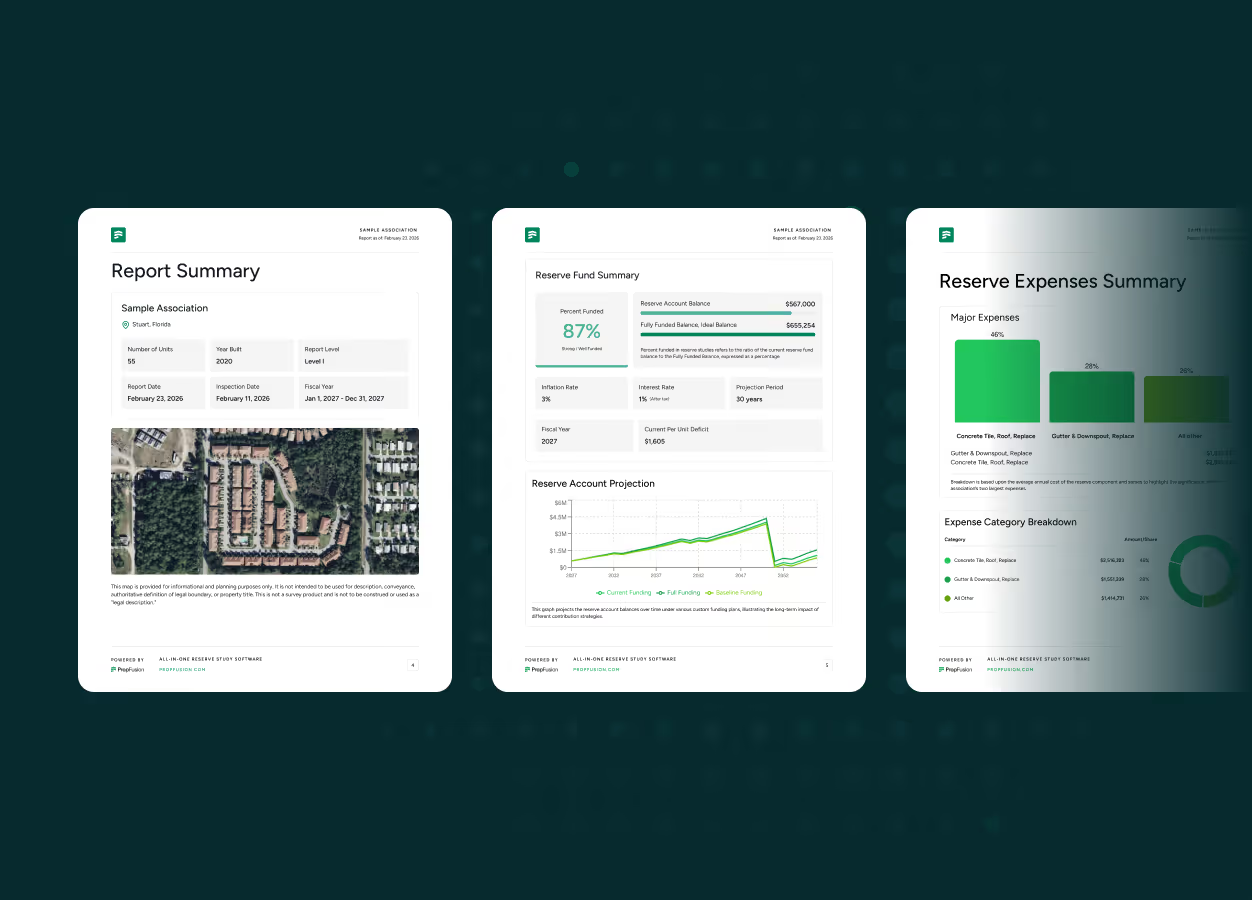
Montana Reserve Study Requirements (2026)
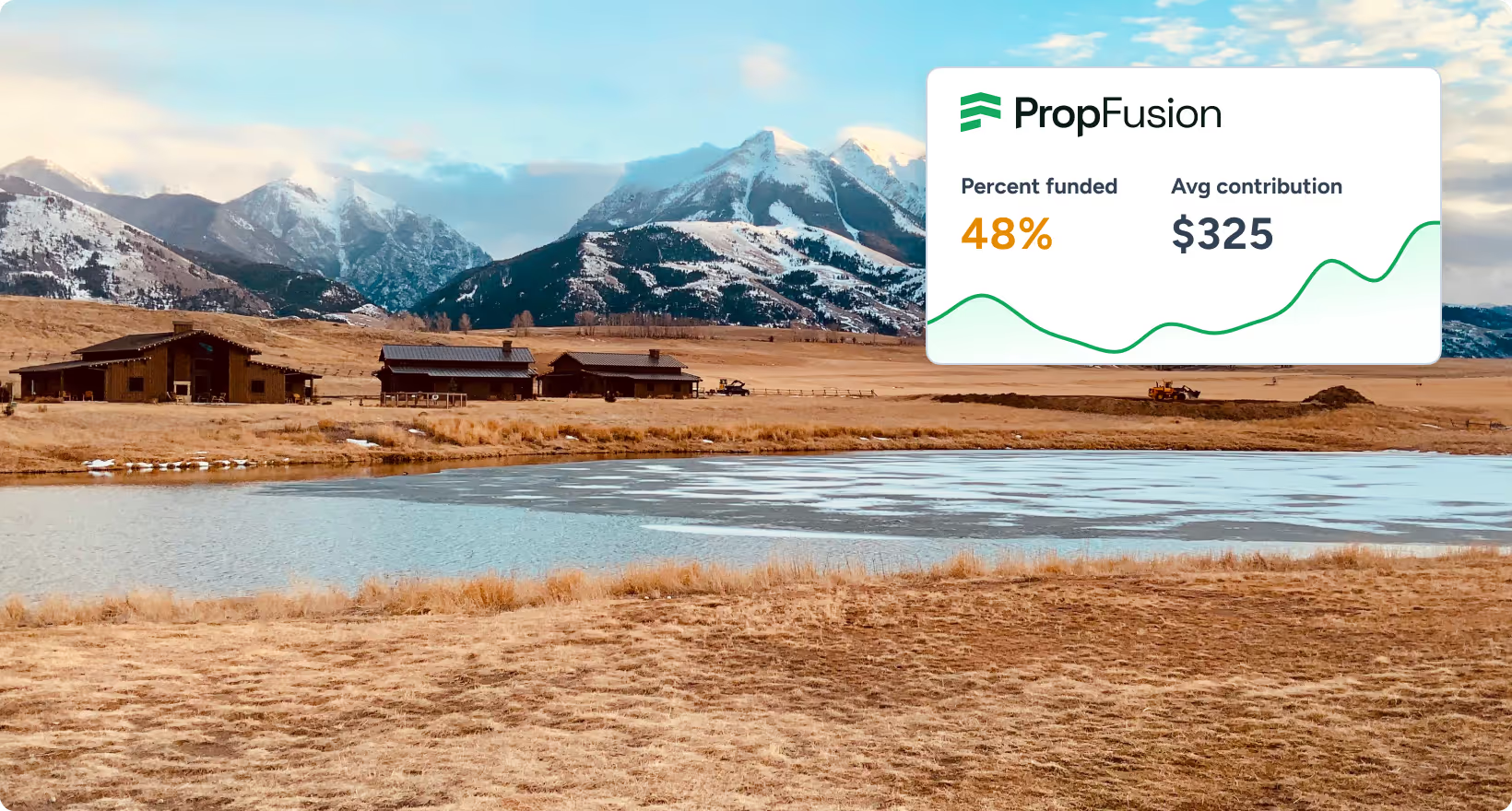
Montana law does not spell out formal reserve study or reserve funding requirements for homeowners associations or condominium associations. That can leave boards wondering how much they are expected to save, whether a reserve study is really necessary, and what “good practice” looks like in a state with minimal statutory guidance.
See the full reserve study requirements by state guide
This guide pulls together Montana’s core statutes that affect community associations, the latest national summaries of reserve fund laws, and industry best practices. It is designed to help Montana boards, managers, and developers decide how often to commission reserve studies, how much to contribute to reserves, and how to communicate long-term funding plans to owners.
Legislation Link
Montana Unit Ownership Act - Condominiums
Montana Nonprofit Corporation Act
Are reserve studies required for HOAs or condos in Montana? No. According to national summaries of state reserve fund laws, Montana has no statutory requirement to conduct reserve studies for community associations and no requirement to fund reserves.
Does Montana law require HOAs to maintain a reserve fund? No. Current summaries indicate there is no statutory obligation in Montana for associations to maintain or fund a reserve account, leaving the specifics of reserve funding largely to each association’s governing documents and board decisions.
Which laws govern Montana HOAs and condominium associations? Most Montana HOAs are organized as nonprofit corporations under the Montana Nonprofit Corporation Act, while condominium associations are governed by the Montana Unit Ownership Act. These statutes cover formation, powers, and governance but do not impose detailed reserve study or reserve funding mandates.
How often should a Montana association update its reserve study? Because Montana law is silent, boards follow industry standards. Many reserve professionals recommend a full study when the community is new or has never had one done, with updates every 3-5 years or more frequently if there are major projects or cost changes.
Need a reserve study in Montana? Compare multiple reserve study proposals for free.
Get proposals from vetted reserve study professionals - with 30-year funding plans, powered by modern technology, and compared side by side for free.
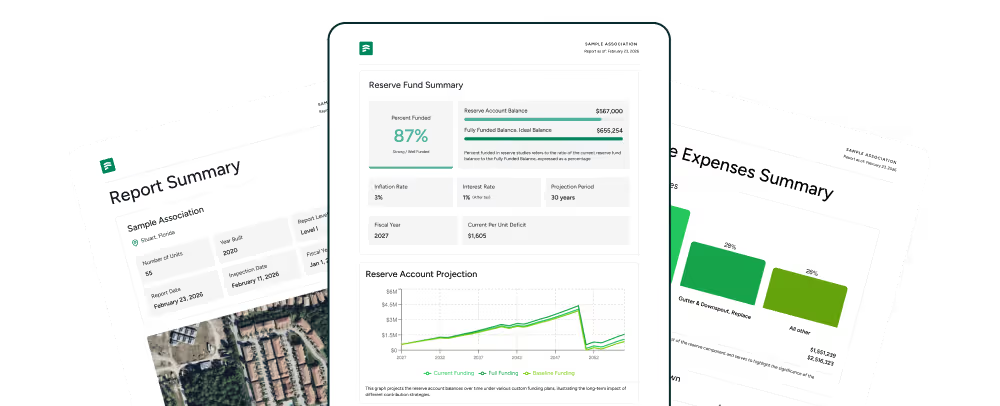
Montana’s reserve study landscape: what the law does and does not say
Montana is one of the states where the legislature has not yet stepped in with detailed rules around reserve studies or reserve funding.
The Community Associations Institute’s most recent summary of state reserve fund laws explicitly notes that there is no statutory requirement in Montana either to conduct a reserve study or to fund reserves.
At the same time, Montana HOAs and condo associations are not operating in a vacuum. Most are formed as nonprofit corporations and are therefore governed by the Montana Nonprofit Corporation Act, which sets out board duties, corporate governance standards, and expectations around prudent financial management.
Condominium associations are also subject to the Montana Unit Ownership Act (Title 70, Chapter 23, MCA), which governs creation, declarations, bylaws, common expenses, and the association’s responsibility to maintain common elements. (Montana State Legislature)
None of these statutes specify formulas for reserve contributions, required study frequencies, or particular funding goals. That lack of detail means Montana boards must rely more heavily on their fiduciary duty, their governing documents, and industry standards when deciding how to plan for major repairs and replacements.
What “no reserve law” means in practice for Montana boards
Because there is no reserve-specific statute, some boards are tempted to treat reserves as optional. That is a mistake. Even in the absence of a legal mandate, failing to plan for predictable capital projects creates obvious financial and governance risks:
- Higher likelihood of surprise special assessments when roofs, roads, siding, or mechanical systems fail.
- Increased owner dissatisfaction and pushback due to sudden fee spikes.
- Potential challenges to the board’s decision-making if owners argue that the board ignored clear, foreseeable financial needs.
- Depressed property values if buyers or lenders see inadequate reserves or no evidence of long-term planning.
Legislative materials on HOA governance in Montana emphasize that the Code has historically been largely silent on HOAs but that boards still carry real responsibilities around budgeting, transparency, and compliance with broader property and nonprofit statutes.
In other words, “no reserve law” does not mean “no standard.” A board that never reviews common-element lifecycles, never sets aside funds, and never communicates a plan is taking on avoidable risk.
How state statutes and governing documents fit together
In Montana, the legal framework for reserves is a combination of:
State statutes
- Montana Unit Ownership Act (Title 70, Chapter 23, MCA) for condo associations and some townhome projects that elect to submit to it.
- Montana Nonprofit Corporation Act (Title 35, Chapter 2, MCA) for most incorporated HOAs and condo associations.
Governing documents
- Declaration (or CC&Rs) often defines common elements and may set expectations around assessments and long-term maintenance.
- Bylaws may describe reserve policies, budgeting processes, and whether member approval is needed to change funding levels.
- Board-adopted policies and budgets, which show how the association is actually implementing its obligations year to year.
If your declaration or bylaws reference “replacement reserves,” “capital reserves,” or “reserve funds,” the board is expected to treat these provisions seriously, even without a state-level reserve statute.
Ignoring clear language in the governing documents is likely to create more legal exposure than the absence of a statewide reserve law.
Why reserve studies still matter in Montana
The existing PropFusion Montana guide correctly highlights that reserve studies, while not required, are strongly recommended for effective financial management and long-term asset preservation.
A well-prepared reserve study helps Montana communities:
- Identify which components (roofs, paving, siding, elevators, pools, clubhouses, etc.) are shared and therefore the association’s responsibility.
- Estimate remaining useful life and replacement costs based on local conditions and construction types.
- Build a funding plan that spreads those costs across current and future owners, rather than relying on last-minute special assessments.
- Provide a clear, defensible rationale for assessment levels when owners ask, “Why are our dues this high?”
Even small, rural Montana associations with modest common areas benefit from having a structured look at long-term repairs. A basic reserve study can be scaled to the size of the community while still giving the board a credible tool for planning.
Recommended reserve study practices for Montana communities
Because there is no statutory mandate, Montana associations should adopt a written reserve policy that references recognized industry standards. A practical approach for many boards is:
- Commission an initial “full” reserve study
- For established communities that have never had a study done.
- For new developments as common elements are completed and turned over from the developer.
- This study should include a site visit, component inventory, and detailed funding scenarios.
- Update the study regularly
- Light updates every 3-5 years are typical industry practice in states without formal laws, and many professionals recommend more frequent reviews if there are major projects or cost changes. (montanareservestudy.com)
- Boards should document in minutes when a study is reviewed and how the funding recommendations were considered.
- Set a clear funding objective
- Many Montana associations target 70-100 percent “percent funded” over time for major components, recognizing that reaching 100 percent immediately is often unrealistic.
- At a minimum, boards should avoid patterns where no money is set aside until a failure is imminent.
- Tie reserves directly into the annual budget
- Reserve contributions should appear as a recurring line item in the budget, not as whatever is “left over” after operating expenses.
- The board should show owners how reserves stabilize assessments over a 10-20 year horizon compared with repeated special assessments.
How much should a Montana association contribute to reserves?
There is no one-size-fits-all formula. However, in the absence of statutory guidance, many boards use rules of thumb to sanity-check their funding:
- A starting point of 10-20 percent of the total annual budget allocated to reserves is common for associations with typical common elements.
- Communities with heavy infrastructure (roads, extensive roofs, elevators, garages) may need higher contributions, as documented by reserve professionals operating specifically in Montana.
- Rather than relying solely on a percentage, boards should lean on the funding projections in a professionally prepared reserve study; these projections reflect actual asset lifespans and costs.
Practical steps for Montana boards and managers
For a Montana HOA or condo board looking to tighten up its long-term planning without a state mandate, a pragmatic roadmap looks like this:
- Gather your documents and data
- Declaration, bylaws, articles, prior budgets, any existing reserve schedules, and major project history.
- Current bank balances for operating and reserve accounts (if they exist).
- Commission or update a reserve study
- Engage a qualified reserve study professional with experience in Montana’s climate and construction types.
- Provide full access to your common areas and historical cost information.
- Adopt a reserve funding policy
- Decide, by board resolution, how often you will update the study and what funding objective you will target.
- Document any short-term constraints (for example, phased step-up contributions over a few years).
- Integrate the funding plan into your budget
- Align annual reserve contributions with the study recommendations as closely as possible.
- If you cannot match the recommendation in year one, adopt a plan that gets you there over 3-5 budget cycles.
- Communicate clearly with owners
- Explain in plain language what is being funded, what the long-term outlook is, and how this reduces the risk of sudden special assessments.
- Use summary charts and timelines where possible to make the information easy to understand.
- Monitor, review, and adjust
- Track major projects and compare actual costs against the reserve study.
- Adjust assumptions and funding as costs, inflation, and community priorities change.
Related reserve study resources for Montana
Compare reserve study laws in nearby states, or find help running one for your association:
FAQ
If Montana has no reserve study or reserve funding law, why bother with a reserve study at all?
Even without a legal mandate, boards have a fiduciary duty to manage the association’s finances prudently. A reserve study is the most credible way to identify future capital projects, estimate costs, and spread those costs fairly over time, reducing the risk of lawsuits, special assessments, and owner dissatisfaction.
Can owners vote to stop contributing to reserves in a Montana association?
Montana statutes do not dictate reserve contribution levels, so in many communities the answer depends on the declaration, bylaws, and any existing board policies. Owners may have the power to amend governing documents or override budgets, but doing so without a replacement plan significantly increases the risk of large, sudden assessments later.
What percentage of our budget should go into reserves for a typical Montana HOA or condo?
There is no statutory percentage. Many associations start with 10-20 percent of the total annual budget going into reserves, then refine that number based on a professional reserve study that models actual component lifespans and costs. Heavier infrastructure or aging buildings often require higher contributions.
How should small or rural Montana associations approach reserve studies?
Smaller communities with limited common elements can still benefit from a scaled-down reserve study that focuses on roofs, paving, fencing, and any shared mechanical systems. The study can be simpler and less expensive but still provides a structured plan and a clear explanation to owners of why reserves are necessary.
Do lenders or insurers in Montana care about reserve studies and reserve balances?
Yes. Even where the law is silent, some lenders and insurers review reserve balances and, in the case of condos, may expect evidence of long-term planning. Poorly funded reserves can lead to financing issues for buyers or less favorable insurance terms for the association.
How often should our Montana board revisit the reserve funding plan?
At a minimum, the board should review the reserve study and funding plan alongside each annual budget. If construction costs, interest rates, or project timing change materially, or if a major component fails earlier than expected, the board should adjust contributions and, where needed, commission an updated study.
What documentation should we keep to show we are acting prudently on reserves?
Boards should keep board minutes showing that the reserve study was reviewed, the funding recommendations were discussed, and specific decisions were made about contribution levels. Copies of the study, budgets, owner communications, and any long-term funding schedule should be retained as part of the association’s permanent records.
The information contained on this page is provided for informational purposes only, and should not be construed as legal advice on any subject matter. You should not act or refrain from acting on the basis of any content included on this page without seeking legal or other professional advice. The contents of this page contain general information and may not reflect current legal developments or address your situation. We disclaim all liability for actions you take or fail to take based on any content on this report.
Get proposals from vetted reserve study professionals - with 30-year funding plans, powered by modern technology, and compared side by side for free.
Take the guesswork out of your reserve study
From site inspection to 30-year funding plan, PropFusion handles the entire reserve study - accurate, transparent, and built on modern technology that gives you full control over your reserves.