MS Reserve Study Requirements (2026)
Mississippi takes a light touch approach to regulating homeowners associations and condominium associations. There is no single HOA statute and, importantly for boards and managers, there is no state law that specifically requires associations to conduct reserve studies or maintain reserve funds. That does not mean reserves are optional in practice. It simply means the “how much” and “how often” questions are left to your governing documents and board judgment.
See the full reserve study requirements by state guide
This guide explains the current legal backdrop for reserve funds and reserve studies in Mississippi, highlights the key statutes that frame association governance, and then moves into practical, best practice guidance for boards and managers. Whether you operate a condominium in Oxford or a single-family HOA on the Gulf Coast, you will find actionable steps to build a predictable long term funding plan and avoid special assessments.
Legislation Link
Mississippi Condominium Law - Mississippi Code 1972, Title 89, Chapter 9
Mississippi Nonprofit Corporation Act - Mississippi Code 1972, Title 79, Chapter 11
Are reserve studies required by law in Mississippi? No. Community Associations Institute’s summary of state laws confirms that Mississippi has no statutory requirement to conduct reserve studies and no statutory requirement to fund reserves.
Does Mississippi law require HOAs or condos to maintain a reserve fund? No. Mississippi does not mandate reserve funds for HOAs or condominiums at the state level. Boards are governed instead by their own declarations, bylaws and general fiduciary duties under the Nonprofit Corporation Act and condominium statutes.
What statutes govern HOAs and condominiums in Mississippi? Most HOAs are organized as nonprofit corporations and operate under the Mississippi Nonprofit Corporation Act and their recorded covenants. Condominiums are governed by the Mississippi Condominium Law in Title 89, Chapter 9 of the Mississippi Code.
How often should a Mississippi association update its reserve study? Because there is no statutory frequency, most boards follow industry guidance and update a full reserve study every 3 to 5 years, with lighter reviews in the interim whenever major projects or cost changes occur.
Need a reserve study in Mississippi? Compare multiple reserve study proposals for free.
Get proposals from vetted reserve study professionals - with 30-year funding plans, powered by modern technology, and compared side by side for free.
Mississippi’s legal landscape for HOA and condo reserves
Mississippi does not have a single, comprehensive HOA act. Instead, most homeowners associations are formed as nonprofit corporations and are governed by their declarations, bylaws, and the Mississippi Nonprofit Corporation Act in Title 79, Chapter 11.
Condominiums are governed by a separate statute, the Mississippi Condominium Law in Title 89, Chapter 9, which covers creation of the condominium, common elements, assessments, and liens but does not impose specific reserve study or reserve funding requirements.
Industry summaries of state reserve laws confirm that Mississippi stands out as a “no requirement” state. Community Associations Institute notes that there is no statutory requirement to conduct a reserve study and no statutory requirement to fund reserves for common interest communities in Mississippi.
In practical terms, this means your board has significant discretion. The trade-off is that you also carry the full burden of getting your long term funding plan right.
What “no statutory requirement” really means for boards
The fact that Mississippi does not mandate reserves or reserve studies does not shield boards from responsibility. Directors of nonprofit corporations and condominium associations still owe a duty of care and a duty of loyalty to the association.
That includes planning for predictable long term expenses such as roofs, pavement, siding, mechanical systems and major amenities.
If a board ignores long term planning and repeatedly relies on emergency special assessments, owners may argue that the board has failed to exercise reasonable care.
Even if litigation never arises, the consequences are real: owner frustration, deferred maintenance, declining property values, and problems with buyers or lenders who expect associations to carry adequate reserves.
Think of Mississippi’s “no requirement” status as flexibility, not permission to underfund. In the absence of a statute telling you what to do, your governing documents and industry standards become the benchmark for what a prudent board should reasonably do.

Differences between HOAs and condominiums in Mississippi
From a reserve funding perspective, the biggest practical difference between HOAs and condominiums in Mississippi is not the statute but the nature of the common elements:
- Condominiums usually own structural components, building exteriors, roofs, corridors, elevators and mechanical systems. Even in a state with no reserve mandate, condo associations almost always need a formal reserve plan to manage these large shared assets.
- Many HOAs, especially those made up of single-family homes, may own primarily entry monuments, small parks, fencing, and limited shared improvements. Their long term funding needs may be smaller, but they still exist and should be planned for rather than handled via sudden special assessments.
In both cases, your declaration and bylaws will describe which components are the association’s responsibility and therefore should be included in a reserve study.
Best practice reserve study guidance for Mississippi associations
Without a statutory rulebook, Mississippi boards should lean on well-established reserve study best practices, including the guidance produced by organizations such as Community Associations Institute. A practical framework looks like this:
Commission a baseline reserve study
For communities that have never done a reserve study, the first priority is a baseline study that documents:
- An inventory of all major common elements and assets for which the association is responsible.
- The current condition, remaining useful life, and estimated replacement cost of each component.
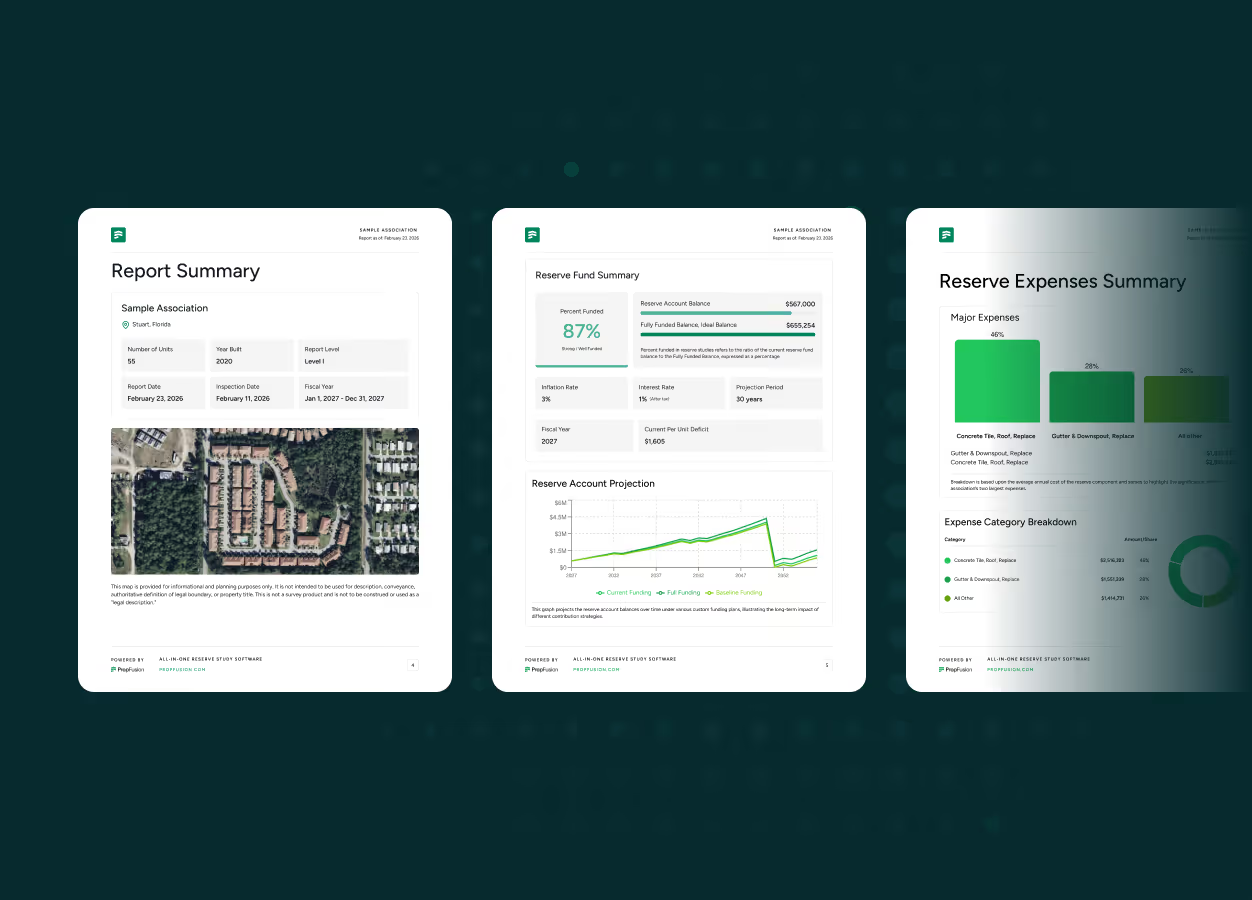
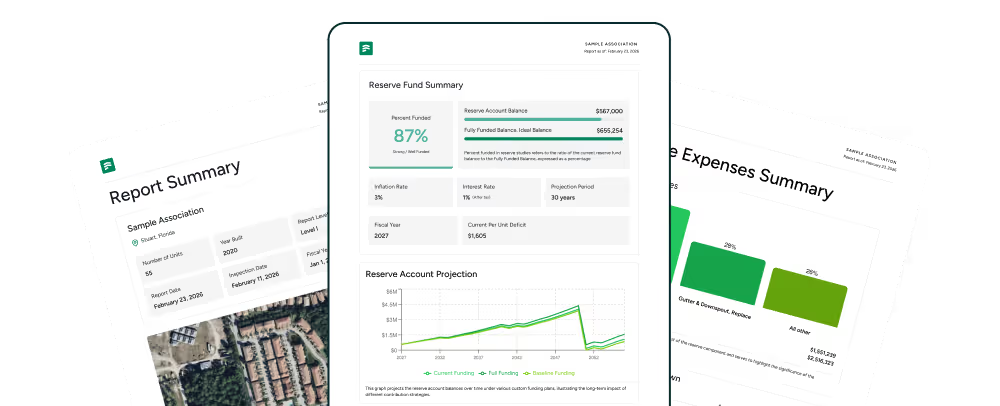
- A funding plan that projects contributions, interest, and expenses over at least 20 to 30 years.
In Mississippi, there is no legal requirement to use a particular credential, but most boards prefer firms that specialize in community association reserve studies and understand national standards.
Set a target funding level
Because state law does not specify a reserve funding percentage, boards should choose a target that balances risk and affordability. Many associations aim to keep reserves in at least the 70 to 100 percent funded range over time, meaning they have most or all of the money they will need based on the reserve study’s projections.
Underfunded associations often face abrupt increases in assessments or special assessments when major projects come due.
Update every 3 to 5 years
Costs and conditions change. Even in the absence of a statutory timeline, updating the reserve study every 3 to 5 years is considered best practice. In fast-changing cost environments or after significant projects, shorter intervals can make sense.
Between full updates, the board should at least revisit the funding plan annually during the budget process and adjust contributions as needed.
Align your budget and disclosures with the plan
Mississippi does not impose detailed reserve disclosure requirements the way some other states do, but that does not mean you should treat the reserve study as an internal document. For credibility and transparency, your annual budget and owner communications should:
- Show the planned reserve contribution for the coming year.
- Summarize the key upcoming projects over the next 3 to 5 years.
- Explain how current contributions align with the long term funding plan.
Owners may be more willing to accept realistic, steady contributions if they understand what the money will be used for and how it reduces the risk of disruptive special assessments.
Document board decisions
In a state with no statutory reserve mandate, your board minutes and resolutions become even more important. When you adopt a reserve funding plan, adjust contributions, or decide to defer a project, document the reasons and reference your reserve study.
That record helps demonstrate that the board is acting thoughtfully and consistently, even if you are making trade-offs in a tight budget year.
Special considerations for small and self-managed associations
Many Mississippi associations are small and self-managed, sometimes with volunteer boards that have limited time and no professional management support. Even in these communities, a streamlined reserve study can be invaluable:
- It gives new board members an objective roadmap for what is coming due, instead of relying on institutional memory.
- It helps self-managed boards avoid undercharging assessments and then being forced into emergency special assessments.
- It provides third-party documentation that can reassure buyers, lenders and insurance carriers that the association is planning responsibly.
If a full-scope engineering study feels out of reach, some boards start with a simpler component list and cost estimates, then upgrade to a formal professional study as the budget allows.
How PropFusion supports Mississippi HOAs and condos
PropFusion is designed to make this entire process easier, especially in states like Mississippi where boards must set their own standards. Using PropFusion, boards and managers can:
- Centralize their reserve study, budget, and project data so that everyone is working from a single source of truth.
- Run “what if” scenarios on contribution levels and timelines to see how different decisions affect future cash flow and the risk of special assessments.
- Track upcoming projects and actual costs against the reserve plan, updating assumptions as real-world data comes in.
Because PropFusion supports communities in all 50 states, the platform can also accommodate future statutory changes. If Mississippi ever adopts formal reserve study or reserve funding requirements, you will already have a structured data set and workflows in place to demonstrate compliance.
Key takeaways for Mississippi boards and managers
For Mississippi HOAs and condominium associations, the core message is simple: state law does not currently require reserve funds or reserve studies, but prudent boards act as if it did. You must rely on your governing documents, your duty of care, and industry standards to build a funding plan that protects your owners and your property values.
A clear, professional reserve study, updated regularly and backed by a realistic funding plan, will put your association in a stronger position with owners, buyers, lenders, and insurers. Using tools like PropFusion to manage that plan turns reserve planning from a one-off project into an ongoing, data-driven process.
Finally, remember that this guide is informational only and does not replace legal advice. For questions about how Mississippi law applies to your specific association, always consult a Mississippi-licensed community association attorney.
Related reserve study resources for Mississippi
Compare reserve study laws in nearby states, or find help running one for your association:
FAQ
Does Mississippi law require HOAs or condos to keep a separate reserve bank account?
No Mississippi statute expressly requires a separate reserve account. However, many governing documents do, and best practice is to keep operating and reserve funds in separate accounts to improve transparency and prevent accidental commingling.
Can owners in a Mississippi association vote to waive reserve funding?
Because there is no statutory mandate, owners and boards in Mississippi have significant flexibility. In many communities, the declaration allows owners to approve a budget with minimal or no reserve contributions. Even if that is legally permitted, boards should carefully explain the risk of future special assessments before recommending underfunding.
Are Mississippi associations required to disclose reserve information in resale documents?
Mississippi does not have a uniform statewide resale disclosure statute for HOAs and condos comparable to some other states. However, your governing documents or management agreement may require specific disclosures, and many associations voluntarily provide budget and reserve information to avoid disputes with buyers and sellers. Local custom and lender expectations often drive these practices.
How much should a Mississippi association contribute to reserves each year?
There is no one-size-fits-all percentage in statute. A common starting point is whatever the reserve study recommends to keep the association near its chosen funding target, often in the 70 to 100 percent funded range over time. For some smaller communities, that may translate to 10 to 20 percent of the annual budget, but the only reliable answer comes from a component-based reserve study tailored to your property.
What happens if our Mississippi association has no reserves at all?
An association with no reserves is exposed to serious financial and political risk. When a roof, road, or major mechanical system fails, the board will likely need to levy a large special assessment or finance the work, both of which can create hardship for owners and friction within the community. Chronic underfunding can also weaken buyer interest and complicate financing.
Do we need a professional reserve study provider, or can the board do it ourselves?
Mississippi law does not require you to use a professional, but most boards find that a qualified reserve study firm provides better asset inventories, more realistic cost estimates, and more defensible funding recommendations. Self-prepared spreadsheets are better than nothing, but they can miss important components or underestimate costs, especially for complex condominium projects.
The information contained on this page is provided for informational purposes only, and should not be construed as legal advice on any subject matter. You should not act or refrain from acting on the basis of any content included on this page without seeking legal or other professional advice. The contents of this page contain general information and may not reflect current legal developments or address your situation. We disclaim all liability for actions you take or fail to take based on any content on this report.
Get proposals from vetted reserve study professionals - with 30-year funding plans, powered by modern technology, and compared side by side for free.
Take the guesswork out of your reserve study
From site inspection to 30-year funding plan, PropFusion handles the entire reserve study - accurate, transparent, and built on modern technology that gives you full control over your reserves.