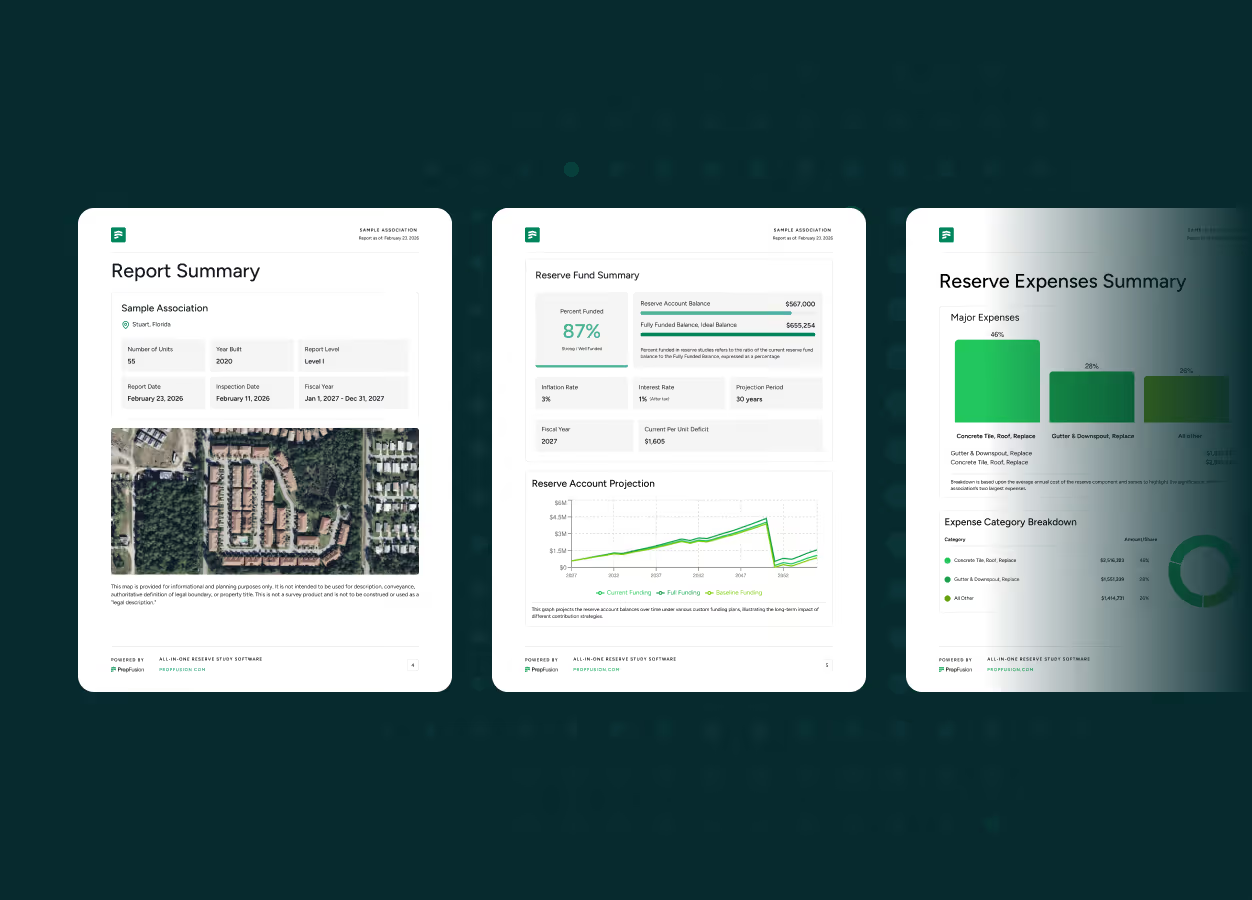
Colorado Reserve Study Requirements (2026)

Colorado’s Common Interest Ownership Act (CCIOA) focuses on reserve governance: it requires associations to maintain reserves responsibly, adopt written policies about reserve studies and reserve fund investment, and keep any existing studies on file. But it does not set a statutory minimum reserve balance or explicitly force every HOA to commission a reserve study on a fixed schedule.
See the full reserve study requirements by state guide
This guide cuts through the noise and explains exactly what Colorado law requires today. It covers reserve funds, reserve study policies, common misconceptions about proposed legislation, and practical best practices for HOAs, condo associations, and townhome communities. You will see what is legally required, what is strongly recommended, and how to build a reserve program that holds up under owner, lender, and regulator scrutiny.
Legislation Links
Colorado Common Interest Ownership Act (CCIOA)
Colorado Division of Real Estate - HOA Frequently Asked Questions
Are reserve studies legally required in Colorado? No. Colorado does not currently mandate that HOAs or condo associations conduct a reserve study on a fixed schedule. Instead, CCIOA requires associations to adopt a written policy describing when reserve studies will be prepared, whether there is a funding plan for recommended work, and whether any study is based on physical and financial analysis.
Does Colorado law require HOAs to maintain a reserve fund? CCIOA gives associations the power to adopt budgets for revenues, expenditures, and reserves, and state guidance treats reserves as a core part of good governance. While there is no statutory minimum balance or percentage, boards are expected to maintain reserves sufficient to meet foreseeable capital expenses and to avoid predictable financial crises.
How often should a Colorado HOA update its reserve study? The statute does not specify a frequency. Colorado’s Division of Real Estate and industry guidance generally recommend updating reserve studies every three to five years, with annual reviews of the funding plan in between. Communities with aging infrastructure or major projects may update more frequently.
Is there a state-mandated percentage (like 10 percent) that Colorado HOAs must put into reserves? No. There is no Colorado statute that sets a fixed percentage of the budget for reserves. The oft-cited “10 percent” figure is a lender and industry rule of thumb, not a legal requirement. Boards should set contribution levels based on a professional reserve study and their fiduciary duty to protect the association’s long-term financial health.
Need a reserve study in Colorado? Compare multiple reserve study proposals for free.
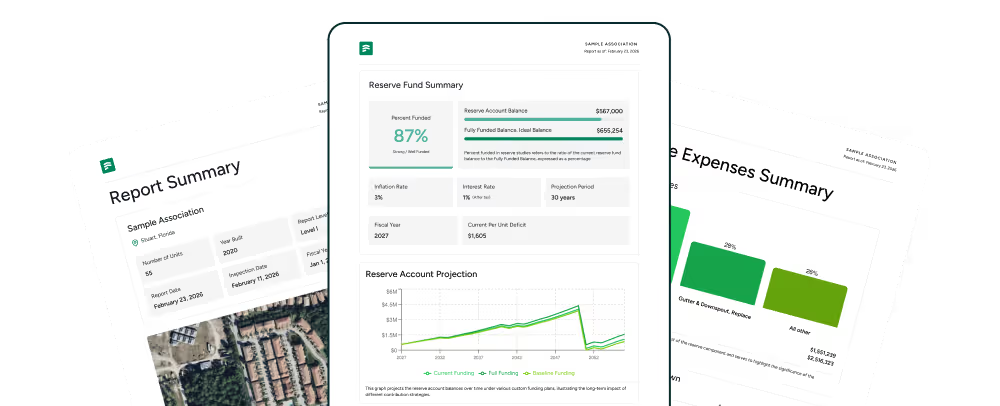
Get proposals from vetted reserve study professionals - with 30-year funding plans, powered by modern technology, and compared side by side for free.
How Colorado regulates HOA reserve funds
Colorado’s framework for HOA and condo reserves is built around the Colorado Common Interest Ownership Act (CCIOA), codified in article 33.3 of title 38 of the Colorado Revised Statutes.
Under CCIOA, associations have explicit authority to “adopt and amend budgets for revenues, expenditures, and reserves” and to levy assessments to cover common expenses. This makes reserves a core part of the budgeting process rather than an optional extra.
Instead of dictating a specific contribution formula, Colorado requires “responsible governance policies.” Associations must adopt written policies covering at least nine topics, including investment of reserve funds and policies around reserve studies: when a study will be prepared, whether a funding plan exists for recommended work, and whether the study is based on a physical and financial analysis.
That is the legal backbone for reserve planning in Colorado.
Reserve funds: what is required and what is not
There is no single statute that says “every HOA must hold X dollars in reserve” or “every association must fund reserves at Y percent of the operating budget.”
Colorado instead expects boards to exercise prudent judgment in how they establish and fund reserves, guided by fiduciary duty and their written policies.
The Division of Real Estate describes reserves as a separate account intended for non-annual, capital expenses such as roofs, asphalt, fencing, and mechanical equipment, distinguishing them clearly from operating budgets that cover recurring costs.
If an association consistently ignores reserves, it may be failing its responsibility to protect the community’s physical assets and financial stability.
Practically, most Colorado associations maintain a dedicated reserve fund, include a reserve line item in their annual budget, and make regular contributions based on a long-term capital plan.
The absence of a statutory minimum percentage does not mean boards can underfund reserves without risk; it simply shifts more judgment onto the board.
Reserve studies: policy requirement versus actual mandate
One of the most confusing aspects of Colorado law is the difference between requiring a reserve study and requiring a reserve study policy. CCIOA section 38-33.3-209.5 requires associations to adopt a governance policy that addresses:
- When the association has a reserve study prepared.
- Whether there is a funding plan for any work recommended by that study and the projected funding sources.
- Whether the reserve study is based on both a physical and financial analysis. (Justia Law)
Crucially, this language is triggered by “when the association has a reserve study prepared.” It does not, by itself, compel the association to order a study by a set date or on a recurring basis.
The Colorado Division of Real Estate’s HOA Forum on reserve funds states it bluntly: Colorado does not require a reserve study, but it does require a reserve policy, and there is no state-set minimum for how much must be reserved.
Colorado also requires associations to keep any existing reserve study as part of the official records and to make it available to owners upon request, reinforcing that reserve planning is part of transparent governance.
Several bills have tried to go further. For example, a prior proposal would have required associations to commission a reserve study at least every three years and to identify how they would pay for future work, but this language now lives only in the statute’s requirement for a reserve study policy.
Another 2022 bill (HB22-1387) that would have imposed tighter reserve requirements never became law. Some online articles still mistakenly describe these bills as if they were in force, which is simply incorrect.
What your Colorado reserve study policy should cover
Even though Colorado does not mandate a reserve study, the required policy around reserve studies is not a formality. The policy should, at a minimum:
- State whether the association will conduct reserve studies and, if so, who is responsible for initiating them.
- Define the intended frequency (for example, a full study every three to five years, with annual financial reviews).
- Specify whether the study will be done internally or by a professional and what qualifications are expected.
- Clarify how the board will develop and adopt a funding plan based on the study’s recommendations.
- Outline how the board will communicate study findings and funding decisions to the membership.
Altitude Community Law, a Colorado HOA law firm, emphasizes that, under CCIOA, associations are not required to have a reserve study or fund reserves at a particular level, but they must have a policy that addresses when a study will be done, whether there is a funding plan, and what type of analysis the study includes. (Altitude Community Law)
A vague or unused policy is a red flag; if you ever face owner complaints or legal scrutiny, the policy and your adherence to it will be part of the record.
How often to perform reserve studies in Colorado
Without a statutory mandate, frequency becomes a question of best practice. National and industry guidance typically recommend updating reserve studies every three to five years, with annual reviews of the reserve balance and funding plan in between. (Goodwin & Company)
In Colorado, factors like freeze-thaw cycles, hail, high UV exposure, and wildfire risk can accelerate wear on roofs, pavement, and building envelopes. That makes a five-year gap feel very long for many communities. A common pattern for Colorado associations is:
- Full site-visit reserve study every three to five years.
- Interim “no-site-visit” financial updates in the intervening years, especially after major projects.
- Policy language requiring an immediate review of funding if unexpected large failures occur.
Associations with significant structural components (parking structures, mid-rise buildings, retaining walls) or aging infrastructure should lean toward the shorter end of the range.
Funding levels: separating law, lender expectations, and best practice
That “10 percent” figure you often see is usually a lender or industry heuristic, used by Fannie Mae and others to judge whether an association is putting a meaningful amount into reserves. It is a screening tool, not a Colorado statute.
A brand-new community with low near-term capital needs may be fine below 10 percent for a time. An older community with roofs, siding, and parking lots all within ten years of replacement will likely need contributions far above 10 percent to avoid special assessments.
The rational way to set contributions is straightforward:
- Commission (or internally prepare) a realistic reserve study that identifies all major components, their remaining life, and their replacement cost.
- Use that study to model multiple funding plans and select one that keeps the reserve balance positive over the long term.
- Align your budget’s reserve line item with that funding plan and document the reasoning in meeting minutes.
Applicability to older and different types of communities
Many Colorado HOAs were created before CCIOA took effect in 1992, but CCIOA’s governance policy requirements, including reserve funds and reserve study policies, apply to pre-CCIOA communities for events after certain dates. In practice, this means:
- Most modern condos, townhomes, and single-family HOAs are subject to CCIOA’s reserve-related governance rules.
- Even older communities that predate CCIOA pick up these obligations for current operations, not just for new associations.
- Your declaration and bylaws may go further than CCIOA, explicitly requiring a reserve fund or a periodic reserve study.
The DRE’s 2023 HOA Forum makes clear that boards and managers can be held accountable if they ignore reserves altogether; failing to plan can be viewed as a breach of fiduciary duty. That is true regardless of whether the community is technically “new” or “old” under CCIOA.
A practical compliance roadmap for Colorado HOAs and condos
To bring this all together, a Colorado association that wants to be fully aligned with both the letter and spirit of the law can follow this roadmap:
Step 1: Confirm your legal status. Work with association counsel or a knowledgeable manager to confirm that you are governed by CCIOA and to identify any additional requirements in your declaration or bylaws.
Step 2: Adopt or update your reserve study policy. Ensure your responsible governance policies explicitly cover when reserve studies will be conducted, how they will be funded, and what type of analysis will be used. Make sure the policy is realistic; if it says “every three years,” actually plan and budget for that.
Step 3: Adopt an investment policy for reserves. CCIOA specifically calls out investment of reserve funds as a required policy topic. Define permissible accounts, risk tolerance, and how you will protect principal.
Step 4: Commission a reserve study (even if not mandated). While the statute does not force you to do it, a professional reserve study is the most defensible basis for setting contributions and explaining decisions to owners. The law allows internally conducted studies, but government and law firm guidance both caution that DIY studies are rarely advisable unless someone on the board truly has the right expertise.
Step 5: Align your budget with the funding plan. Build a multi-year path toward adequate funding, rather than swinging dues dramatically in a single year. Document the plan and your rationale in the minutes.
Step 6: Keep records and communicate. Retain the most recent reserve study and make it available as an association record; summarize the study and funding plan at annual meetings and in owner communications.Clear explanations reduce pushback when contributions increase.
Related reserve study resources for Colorado
Compare reserve study laws in nearby states, or find help running one for your association:
Frequently Asked Questions
Has Colorado recently changed its laws to require reserve studies statewide?
No. As of 2025, Colorado has not enacted a law that universally requires all HOAs and condo associations to commission reserve studies on a fixed schedule. Some bills have attempted to do this in the past, but they did not become law. Associations are, however, required to adopt a policy that addresses reserve studies and reserve funding and to manage reserves prudently.
Do Colorado condos and townhome communities have stricter reserve obligations than single-family HOAs?
The same CCIOA governance policy requirements apply broadly, but condos and townhome associations usually control more shared building components, which raises the practical need for robust reserves and professional studies. Single-family HOAs may have lower structural exposure but still face large capital items like roads, clubhouse roofs, and amenities, so they also benefit from a formal reserve program even if their legal obligations are similar.
What happens if our Colorado association has no reserve policy?
If you are subject to CCIOA and have not adopted the required responsible governance policies-including policies on investment of reserve funds and reserve studies-you are out of compliance with the statute. In a dispute, that failure can be used as evidence that the board did not exercise responsible governance, increasing the risk of claims against the board and management.
Can we handle our reserve study internally to save money?
Colorado law allows internally conducted reserve studies to satisfy the policy requirement, but both the Division of Real Estate and experienced HOA law firms caution against relying solely on DIY analyses unless the board has genuine engineering and financial expertise. A weak internal study will not protect you if your funding assumptions prove unrealistic.
How should a Colorado HOA communicate reserve decisions to owners?
The board should include the reserve funding plan in its annual budget presentation, summarize key findings from any reserve study, and explain why contribution levels are increasing or staying flat. Providing clear narratives and projections reduces owner resistance and shows that the board is acting deliberately rather than reacting only when emergencies occur.
The information contained on this page is provided for informational purposes only, and should not be construed as legal advice on any subject matter. You should not act or refrain from acting on the basis of any content included on this page without seeking legal or other professional advice. The contents of this page contain general information and may not reflect current legal developments or address your situation. We disclaim all liability for actions you take or fail to take based on any content on this report.
Get proposals from vetted reserve study professionals - with 30-year funding plans, powered by modern technology, and compared side by side for free.
Take the guesswork out of your reserve study
From site inspection to 30-year funding plan, PropFusion handles the entire reserve study - accurate, transparent, and built on modern technology that gives you full control over your reserves.