Arizona HOA Reserve Study & Reserve Fund Requirements (2026)

Arizona community associations operate in a grey area when it comes to reserve funding. There is no Arizona statute that forces an HOA or condominium association to create a reserve fund or to commission a formal reserve study, but the law does require specific disclosures about reserves in resale documents and gives boards explicit authority to adopt budgets with reserves. That combination often confuses boards, owners, and even real estate professionals.
See the full reserve study requirements by state guide
This guide explains how Arizona regulates HOA and condo reserve funds, what A.R.S. 33-1242, 33-1260 and 33-1806 actually say, and how boards can use reserve studies as a best-practice tool even though they are not mandated. It is written for board members, association managers, and reserve study professionals who want clear, practical direction rather than vague generalities.
Legislation Links
Arizona Condominium Act - A.R.S. 33-1242
Arizona Condominium Resale Disclosures
Arizona Planned Community Resale Disclosures - A.R.S. 33-1806
Are reserve funds required by law for HOAs or condos in Arizona?
No. Arizona law does not require an HOA or condominium association to create or fund a reserve account. However, it does require certain reserve information to be disclosed in resale documents for both condominiums and planned communities.
Does Arizona law require an HOA or condo to perform a reserve study?
No. There is no statutory requirement in Arizona to conduct a reserve study for either condominiums or planned communities. Reserve studies are a best practice and are often recommended by attorneys, reserve professionals, and lenders, but they are not mandated by statute.
Which Arizona statutes should boards review regarding reserves?
Boards should focus on the Arizona Condominium Act and Planned Community Act, especially A.R.S. 33-1242 (board powers and budgets), 33-1260 (condominium resale disclosures), and 33-1806 (planned community resale disclosures). These provisions frame the legal expectations around budgets, reserves, and what must be disclosed to buyers.
How often should an Arizona HOA or condo update its reserve study?
Because there is no statutory requirement, frequency is driven by best practice. Many Arizona HOA law firms and reserve professionals recommend updating a reserve study at least every 3-5 years, with lighter annual reviews in between to reflect changes in costs, completed projects, and component conditions.
Need a reserve study in Arizona?
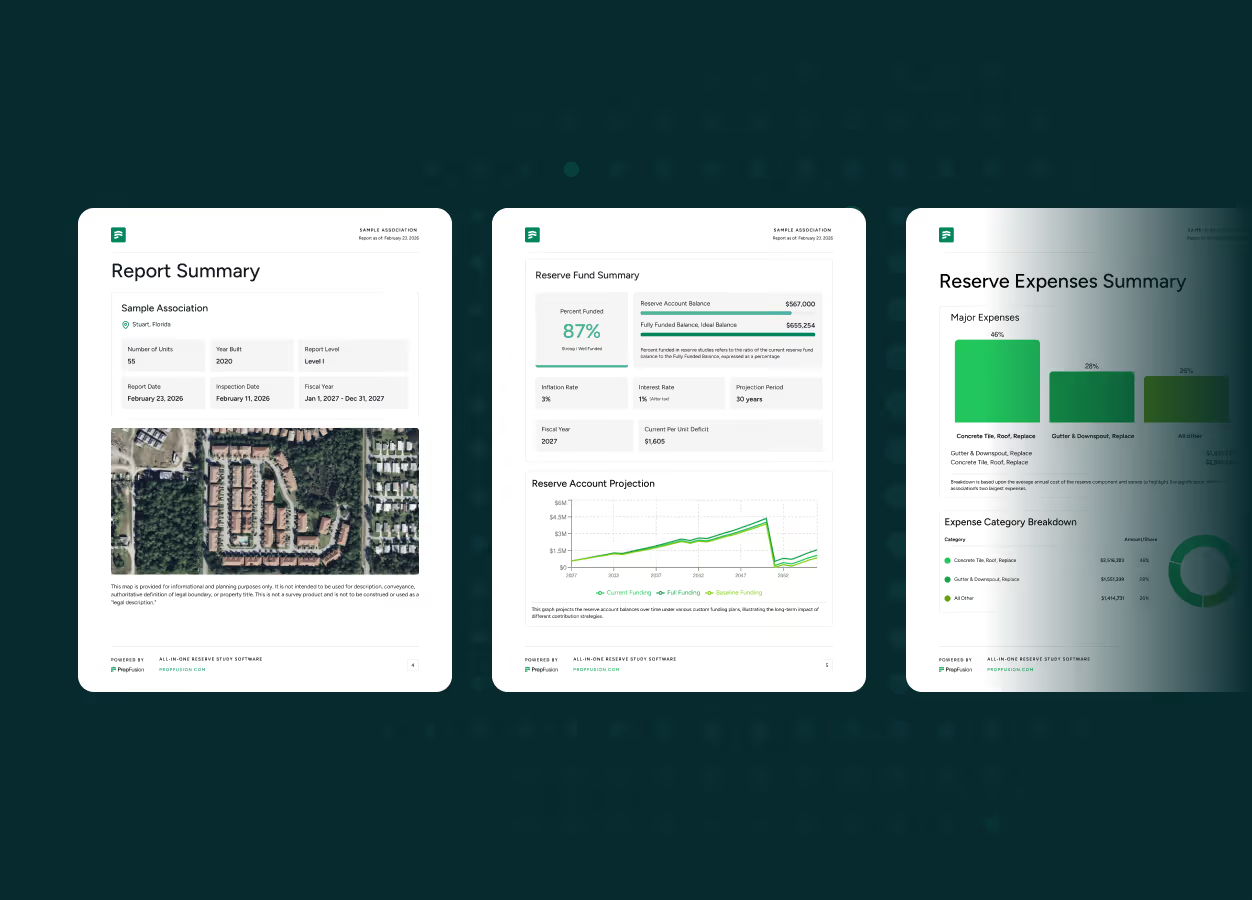
Get proposals from vetted reserve study professionals - with 30-year funding plans, powered by modern technology, and compared side by side for free.
Arizona’s legal framework for HOA and condo reserves
Arizona community associations are primarily governed by two sets of statutes in Title 33 of the Arizona Revised Statutes:
- The Arizona Condominium Act (A.R.S. 33-1201 through 33-1270) applies to condominium associations.
- The Arizona Planned Community Act (A.R.S. 33-1801 and following) applies to most single-family and townhome HOAs.
Under A.R.S. 33-1242, a condominium association has the power to adopt and amend budgets for revenues, expenditures, and reserves, and to collect assessments for common expenses. Planned communities have analogous powers under their statutes. (azleg.gov)
In other words, Arizona law clearly expects boards to think in terms of budgets and long-term costs, but it does not dictate exactly how much must be set aside or when.
What Arizona law does and does not require

There are three core points every Arizona board needs to understand:
No mandatory reserve accounts or minimum reserve levels
Arizona law does not require a developer or association to create or fund a reserve account. Multiple authoritative summaries confirm that there is no statutory requirement in Arizona to maintain reserves or to fund them to any particular level. (Mulcahy Law Firm)
This means two associations on the same street can have totally different reserve funding policies. One may be well funded, with a formal reserve study and a robust savings strategy; the other may be operating almost hand-to-mouth, relying on special assessments and fee spikes when major projects come due.
No statutory requirement to conduct a reserve study
Arizona statutes do not compel an HOA or condo association to commission a reserve study. National overviews of state reserve laws list Arizona among the states with no statutory requirement to conduct a reserve study or to fund reserves.
That does not mean reserve studies are optional from a risk-management perspective. It simply means the legislature has left it to boards, owners, and lenders to decide what level of planning is acceptable.
Strong disclosure requirements when a unit is sold
Arizona does require clear disclosure of reserve information in resale documents. This is where many boards underestimate their obligations.
For condominiums, A.R.S. 33-1260 requires that, in most cases, the association (or the unit owner in small communities) provide a resale disclosure including, among other items, financial information and the amount, or a statement that there is no amount, included in the budget as a reserve for repairs and replacement.
For planned communities with fifty or more lots, A.R.S. 33-1806 requires the association to provide, within ten days of notice of a pending sale, a resale disclosure that includes the total amount of money held by the association as reserves and a copy of the most recent reserve study, if any.
For smaller planned communities and condos (fewer than fifty units), the unit owner typically provides the disclosure, but the underlying obligation to tell the truth about reserve funds remains.
The practical takeaway: there may be no law forcing an association to have reserves or a reserve study, but if you have them, Arizona law effectively forces you to show your hand when an owner sells.
How governing documents and fiduciary duties fill the gaps
Because statutes are relatively light, a lot of the “real” rules for Arizona reserve funding live in three other places: governing documents, fiduciary duties, and lender expectations.
Governing documents (CC&Rs, bylaws, and policies)
It is common for Arizona CC&Rs or bylaws to require some form of reserve funding, and sometimes to reference reserve studies explicitly. If your declaration says the association “shall maintain reasonable reserves for capital replacements” or similar, that becomes a binding obligation for the board, even though state law is silent. Ignoring those provisions can create legal and political problems when owners feel blindsided by special assessments.
Fiduciary duties and nonprofit corporate law
Most Arizona HOAs and condos are organized as nonprofit corporations. Directors are subject to the general corporate duty of care: they must act in good faith, in the best interests of the association, and with the care that an ordinarily prudent person in a similar position would exercise.
Running a multi-million-dollar community with no plan for roof replacements, pavement, and major mechanicals is hard to defend under that standard, especially when safer alternatives like reserve studies are widely available. Courts and owners will judge the board’s decisions in context, including whether it understood long-term costs and made a rational funding plan.
Lender expectations and market pressure
Even though Arizona does not mandate reserves, many lenders do. For condominiums in particular, national loan programs (Fannie Mae, Freddie Mac, FHA, etc.) pay close attention to an association’s financial health, reserve funding, and any existing reserve study. If your community has little or no reserves, owners may discover that financing options are limited or more expensive.
On the resale side, a weak reserve position can show up in the required disclosures and be used by buyers as leverage in negotiations, lowering sale prices or pushing them toward better-funded communities.
Best-practice reserve funding strategy for Arizona
Given this landscape, a “do nothing because the law doesn’t force us” approach is short-sighted. A more responsible and defensible reserve strategy in Arizona typically includes:
- Establishing a dedicated reserve account - Even though statutes do not force it, most Arizona HOA law firms recommend maintaining reserve funds in a separate account from operating funds and avoiding commingling. (hoaboards.net) This makes it clear that long-term capital projects are being funded intentionally rather than “left over” from operations.
- Commissioning a baseline reserve study - A full reserve study provides:
- A component inventory: all common-area assets that will eventually need repair or replacement.
- Remaining useful life estimates for each component.
- Current replacement cost estimates, based on Arizona’s market and inflation.
- A funding plan that spreads contributions over time to avoid shocks.
In Arizona, there is no mandated format or credential for reserve study providers, but working with a qualified reserve professional who understands local construction and climate is strongly advisable.
- Updating the reserve study on a regular cycle - Industry practice for associations without statutory requirements is to:
- Update the study at least every 3-5 years with a site visit and new cost data.
- Review it annually at budget time and adjust contributions as needed. (Mulcahy Law Firm)
This cadence balances cost with realism: prices change, components age faster or slower than expected, and projects get added or deferred.
- Aligning budgets, disclosures, and communication - Because A.R.S. 33-1260 and 33-1806 tie disclosure obligations to the association’s reserves and any existing reserve study, your operating budget, reserve contributions, and disclosure forms all need to tell the same story. (azleg.gov)
In practice, that means:
- Making sure the reserve contribution line item in the budget matches what the reserve study recommends (or consciously documenting any deviation).
- Ensuring resale disclosures accurately state the total amount held in reserves and attach the most recent reserve study if one exists.
- Explaining the reserve strategy transparently to owners at annual meetings and in budget cover letters.
What this means for small Arizona communities
Small HOAs and condos (fewer than fifty units) are not exempt from risk just because some disclosure obligations shift from the association to the seller. They still face:
- The same long-term capital costs as larger communities.
- The same lender scrutiny when buyers try to obtain financing.
- The same reputational risk if surprise special assessments become the norm.
In smaller associations, reserve studies are often even more critical because the cost of a roof, road, or major mechanical replacement falls on a much smaller owner base.
How PropFusion helps Arizona communities manage reserves
PropFusion is designed to sit on top of this Arizona legal framework and make it practical:
- Reserve planning for boards: Build funding plans that mirror your reserve study, test scenarios (deferring a project, adjusting contributions), and see the impact on cash flow and reserve levels over time.
- Portfolio visibility for managers: For management companies with multiple Arizona communities, see at a glance which associations are underfunded and where disclosure-related risks are highest.
- Collaboration with reserve professionals: Share assumptions, update components, and keep your reserve study data and budgets synchronized instead of scattered across spreadsheets.
- Documentation for disclosures: Quickly pull current reserve balances and forward-looking projections to support accurate, timely resale disclosures for both condominiums and planned communities.
Arizona law may not force you to have reserves or a reserve study, but it does force you to reveal what you are (or are not) doing when units are sold. A structured reserve program, backed by good data and clear tools, is the most straightforward way to reduce the risk of owner backlash, legal disputes, and lender problems.
PropFusion gives Arizona boards, managers, and reserve professionals the infrastructure to do that without reinventing the wheel every budget season.
Related reserve study resources for Arizona
Compare reserve study laws in nearby states, or find help running one for your association:
Frequently Asked Questions
Are Arizona HOAs and condos legally required to maintain an “adequate” reserve fund?
No. Unlike some states, Arizona statutes do not define “adequate reserves” or require any specific minimum funding level. The board decides what is adequate, subject to its fiduciary duties and any requirements in the governing documents.
Does Arizona require HOAs or condos to have a reserve study on file?
No. There is no statute that requires a reserve study to be performed or kept on file. However, if an association has a reserve study, planned communities with fifty or more lots must provide a copy of the most recent study as part of the resale disclosure package.
What exactly must be disclosed about reserves in Arizona resale documents?
For condominiums, A.R.S. 33-1260 requires that the resale disclosure include financial information and the amount, or a statement that there is no amount, included in the budget as a reserve for repairs and replacement. For larger planned communities (fifty or more lots), A.R.S. 33-1806 requires disclosure of the total amount of money held as reserves and a copy of the most recent reserve study, if any.
Can an Arizona HOA or condo keep operating and reserve funds in the same bank account?
Legally, Arizona does not explicitly prohibit commingling, but most HOA law firms consider it a poor practice. Keeping reserves in a separate account makes it easier to show owners, auditors, and buyers that long-term capital projects are being funded intentionally and that reserve money is not being quietly consumed by operating expenses.
What happens if an Arizona association is seriously underfunded?
There is no automatic state penalty for having low reserves, but underfunding usually leads to special assessments, emergency fee increases, deferred maintenance, and reduced property values. It can also make it harder for buyers to obtain financing and can expose the board to criticism or legal challenges if owners argue that the board failed its duty of care.
Are small Arizona communities (under fifty units) exempt from reserve planning?
No. They are exempt from some association-level disclosure mechanics, but they still face the same long-term repair and replacement costs. If anything, smaller associations are more vulnerable because large projects are funded by fewer owners. A reserve study and clear funding plan are just as important for a 20-unit community as for a 200-unit one.
How often should Arizona boards revisit their reserve strategy?
At minimum, boards should review reserve funding annually during budget season and commission a full update of the reserve study at least every 3-5 years. If there are major projects, unanticipated cost spikes, or significant changes in the community’s amenities, an earlier update is wise.
The information contained on this page is provided for informational purposes only, and should not be construed as legal advice on any subject matter. You should not act or refrain from acting on the basis of any content included on this page without seeking legal or other professional advice. The contents of this page contain general information and may not reflect current legal developments or address your situation. We disclaim all liability for actions you take or fail to take based on any content on this report.
Get proposals from vetted reserve study professionals - with 30-year funding plans, powered by modern technology, and compared side by side for free.
Take the guesswork out of your reserve study
From site inspection to 30-year funding plan, PropFusion handles the entire reserve study - accurate, transparent, and built on modern technology that gives you full control over your reserves.